

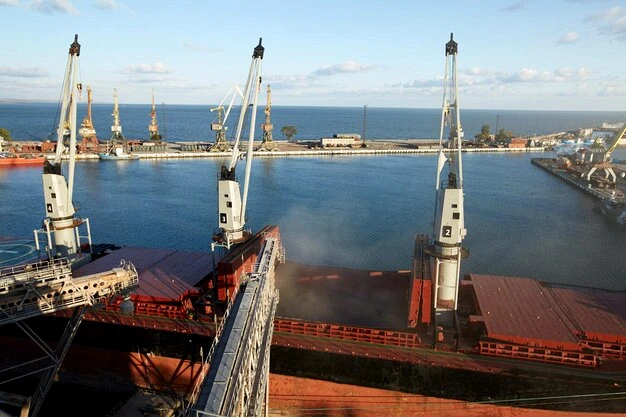
A dry port and modern logistics center on the Odesa–Kyiv highway turns proximity to port Odesa and Kyiv into faster, more resilient supply chains. NovaHub’s EU standard design, phased master plan, and reliable infrastructure create a scalable inland gateway where shippers can clear, store, and distribute cargo efficiently across Ukraine.
Locating a modern dry port on the Odesa–Kyiv highway creates a powerful multimodal gateway that links seaports, road corridors, and inland logistics hubs in one integrated system. It shortens lead times, cuts drayage costs, and gives shippers reliable alternatives when seaport terminals are congested or disrupted. For investors, it opens scalable, resilient capacity close to Ukraine’s main consumer and industrial zones.
Today many logistics operators struggle with overloaded seaports, fragmented warehousing, and unpredictable transit times inside Ukraine. From consulting projects in transport and warehousing, one pattern is clear. Assets win when they sit at the intersection of several strong corridors instead of depending on a single gate, especially in volatile markets. That is exactly why the Odesa–Kyiv axis and a well designed dry port near port Odesa are attracting attention from international and local players.
This article explains how a strategic port location along the Odesa–Kyiv highway works in practice, why a dry port concept matters for supply chains in Ukraine, and how the NovaHub logistics center uses this corridor to offer reliable, contemporary, and fast infrastructure at European quality standards. You will also see pros and cons, real life scenarios, common mistakes, and practical tips for investors and shippers.
🚛 What makes the Odesa–Kyiv corridor a strategic logistics backbone?
The road between Odesa and Kyiv is more than a domestic route. It connects Black Sea ports with the capital region and further transit links toward Central and Eastern Europe. This combination of seaport access and inland demand creates a natural spine for warehousing and distribution activities.
Geographical positioning within Ukraine
Odesa sits on the Black Sea and hosts the country’s key maritime gateways. Kyiv concentrates population, purchasing power, and administrative functions. A logistics asset positioned between them can reach import flows from the sea and consumer markets inland with similar efficiency. In short, it balances gateway and hinterland functions in one place.
For many shippers, this balance translates into flexible routing. Cargo can arrive at terminals near port Odesa, move by truck to a dry port on the Odesa–Kyiv highway, and from there be reloaded for regional distribution across central Ukraine or for export via alternative corridors.
Connectivity with seaports and inland markets
The key takeaway is that a strategic port location is not only about distance to the quay. It is about how quickly cargo can switch between modes with minimal idle time. A dry port close to the main highway can clear containers, store them under customs control if needed, and dispatch them without congesting seaport yards.
In practice this improves both import and export flows. Imports clear and move closer to final customers. Exports consolidate near the highway before moving to maritime terminals, which helps carriers plan capacity and reduces empty trips.
Resilience and alternative routing potential
Recent years have shown how fragile single channel logistics can be in Ukraine. Blocked port access, damaged infrastructure, or regulatory changes can slow flows overnight. An inland logistics center Ukraine can rely on needs alternatives. That means redundant routes, ability to cross dock cargo, and space to buffer stock.
A dry port on the Odesa–Kyiv transit axis provides exactly that. When one maritime gate or road segment faces disruption, traffic can move through alternate ports or border crossings while still using the same inland storage and distribution base.
📦 How does a modern dry port concept work near port Odesa?
A dry port functions as an inland extension of a seaport. It performs many of the same operations that usually occur at the terminal, but in a location with more space, lower land costs, and better highway access. For shippers, it feels like moving the seaport gate closer to customers.
Core functions of a dry port
Typical services include container storage, customs clearance, consolidation and deconsolidation, cross docking, and sometimes light value added operations. Because the site is inland, it can use more rational layouts and expand faster than a crowded quay area.
Bottom line, a dry port allows seaports to specialize in vessel handling while inland hubs specialize in cargo handling. That division of roles improves productivity at both ends of the chain.
Specific advantages for the Odesa–Kyiv route
On the Odesa–Kyiv corridor, the dry port concept shortens the “last maritime mile.” Containers do not need to stay in costly terminal yards for long. They move quickly to the inland hub where time sensitive operations and longer storage are more economical.
This is especially useful for imported goods destined for Kyiv and central Ukraine. Instead of stopping operations in Odesa, shippers shift the control point to a place with faster truck access, improved security, and more predictable lead times.
Role of NovaHub as an example dry port
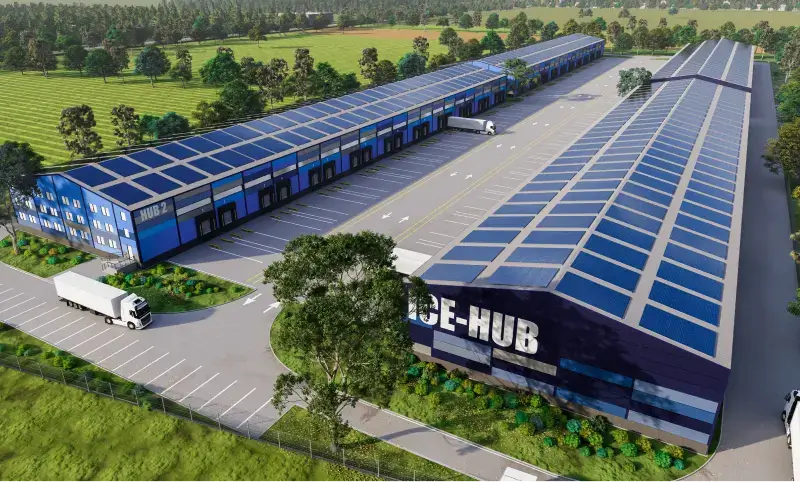
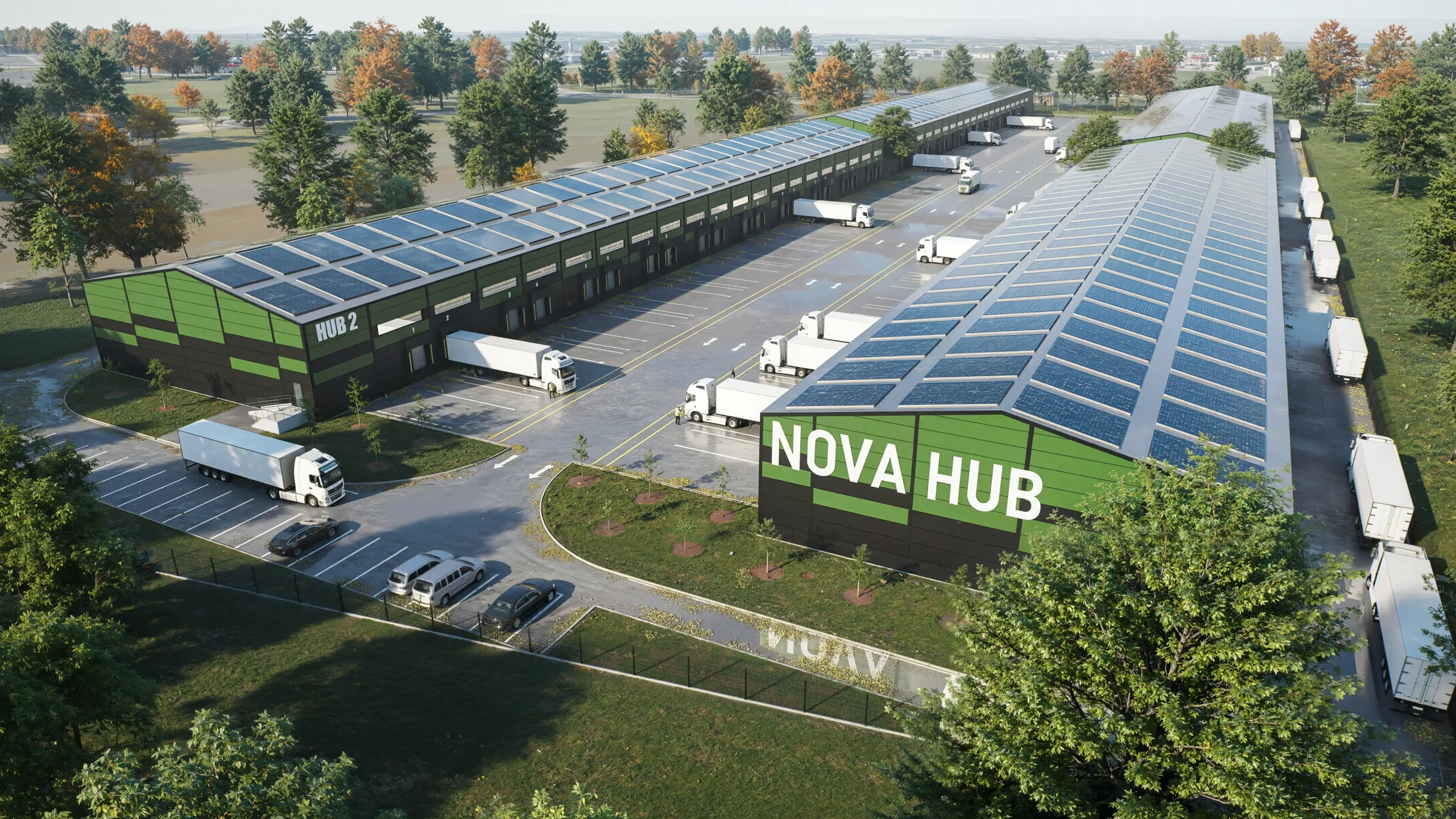
NovaHub positions its project as a large scale logistics center on the Odesa–Kyiv highway, with master planning designed specifically for dry port functions. The investment concept focuses on reliable infrastructure, contemporary warehouse specifications, and compliance with European construction standards for load bearing structures and energy efficiency.
Through the visual overview provided on the project visualization, potential investors can see how proximity to the corridor and port directions translates into practical handling areas and building clusters.
🧭 Why is the exact location of NovaHub strategically chosen?
Not every site between Odesa and Kyiv offers the same potential. Micro location matters. Access to interchanges, nearby settlements, and technical utilities influences operating costs and service levels over the entire life of the asset.
Access to the Odesa–Kyiv highway
NovaHub’s concept places warehouse and handling areas close to major road junctions of the Odesa–Kyiv route. Short feeder access to the main highway means trucks spend less time on secondary roads, consume less fuel, and experience fewer delays in local traffic.
To summarize, what matters most in location analysis is total door to door time, not only kilometers. Efficient on and off ramps, clear traffic patterns, and safe entry points to the site reduce hidden costs for carriers and tenants.
Proximity to port and hinterland clients
The site design works for flows in both directions. Containers and bulk shipments coming from the Black Sea terminals can be redirected quickly to storage or handling within the dry port. At the same time, regional producers and importers can deliver or pick up goods without driving into congested port areas.
This dual orientation near port Odesa and Kyiv region expands the catchment area. It allows the future logistics park to serve both maritime and purely inland customers, from manufacturing companies to large retailers.
Site master plan and layout
The NovaHub master plan, presented in the plan section, illustrates road circulation inside the complex, positioning of warehouse modules, and buffer zones for truck parking. The layout takes into account typical maneuvering radiuses for long combination vehicles to ensure safe and fast loading.
Facilities are grouped to allow phased construction. This helps investors start with a core cluster that already functions as a dry port while keeping flexibility for later expansion as demand grows.
📊 Key characteristics of the NovaHub logistics center Ukraine
A strategic location only reaches its full value when combined with robust technical characteristics. NovaHub emphasizes a mix of capacity, quality, and controllability that aligns with European norms.
Technical and operational specifications
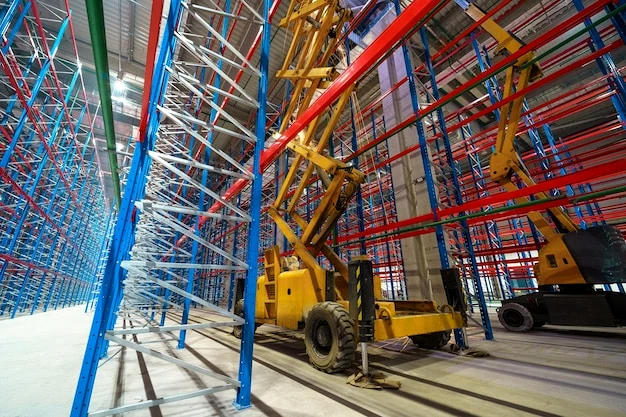
According to the published concept in the characteristics overview, the logistics center is planned with modern floor load capacities, clear internal heights suitable for high-bay racking, and dock equipment designed for intensive turnover. The utility grid supports temperature controlled storage options where needed.
The buildings are designed for fast handling, with sufficient dock doors per square foot of storage and circulation roads that separate heavy truck traffic from light vehicles and staff movement.
Reliability and European construction standards
NovaHub highlights reliability and compliance with European standards as core promises. That includes attention to fire safety regulations, structural resilience, and energy efficient envelopes to keep operating costs predictable over time.
In brief, investors and tenants gain confidence that the asset will remain competitive and compliant for many years without expensive retrofits, which is a known risk in older Ukrainian warehouse stock.
Comparison: traditional warehouse vs dry port logistics center
| Parameter | Traditional stand-alone warehouse | Dry port logistics center like NovaHub |
|---|---|---|
| Main function | Storage for single region | Multimodal gateway for several regions and ports |
| Connection to seaports | Indirect, via third party terminals | Planned as inland extension of port operations |
| Infrastructure standard | Often mixed, legacy systems | Contemporary, aligned with EU norms |
| Scalability | Limited by surroundings | Phased expansion within one master plan |
| Resilience | Depends on local roads only | Integrated in national corridor with alternative routing |
⚖️ Pros and cons of a strategic port location on the Odesa–Kyiv highway
Every investment decision requires a balanced view. Even a strong concept such as a dry port on this corridor brings both advantages and limitations that stakeholders should understand clearly.
Advantages of the NovaHub type location
- Multimodal access. Direct road access to the Odesa–Kyiv axis with fast links toward Black Sea ports and the capital region enhances routing flexibility for shippers.
- Cost efficiency over time. Land and operating costs inland are typically lower than in seaport terminals, especially for longer storage or buffer stocks.
- Scalable capacity. Phased development based on one coherent master plan allows capacities to grow alongside demand without losing functional quality.
- European quality standards. Contemporary warehouse design and construction according to EU practices improve safety, energy performance, and tenant satisfaction.
- Resilience of supply chains. The dry port setup can absorb shocks from port disruptions or route closures by redirecting flows while keeping the same inland hub.
Limitations and risks to consider
- Dependence on road transport. Until rail links or additional modes are added, most flows rely on trucking, which exposes users to fuel price and driver availability issues.
- Regulatory complexity. Inland customs and security procedures for a dry port need clear coordination with port and border authorities, which may require additional setup time.
- Market demand cycles. Overbuilding capacity ahead of demand can temporarily reduce returns if leasing or throughput ramps more slowly than planned.
- Infrastructure maintenance. Public road quality on some sections between Odesa and Kyiv can vary, which raises maintenance needs for transport fleets.
- Geopolitical uncertainty. The wider context in Ukraine still carries risks that investors must factor into structuring and risk mitigation.
📚 Practical scenarios: how companies can use a dry port near port Odesa
Concepts become valuable when translated into concrete use cases. Below are two scenarios that illustrate how different actors can benefit from a strategic port location on the Odesa–Kyiv corridor.
Scenario 1: Retailer consolidating imports for central Ukraine
A large non food retailer imports containers through maritime terminals in the Odesa region. Today, trucks collect containers directly from the port and drive to several small warehouses around Kyiv. The process creates congestion, unbalanced utilization, and frequent demurrage charges.
By shifting the control point to a dry port style complex like NovaHub, the retailer can clear containers inland, deconsolidate them into store ready shipments, and then distribute to outlets. This reduces double handling, improves stock visibility, and cuts dwell times in port terminals.
Scenario 2: Agro exporter building seasonal buffer
A grain exporter uses export terminals by the sea but faces strong seasonality. During harvest, local silos and port elevators become overloaded. Transport prices spike and loading slots at the terminal are tight.
Using a logistics center Ukraine based on the Odesa–Kyiv axis, the company can move part of the volume to inland storage in advance. When port slots open, it dispatches trucks in a controlled rhythm. This smooths demand for transport, helps the exporter negotiate better freight conditions, and reduces the risk of lost sales.
Scenario 3: 3PL offering value added services
A third party logistics provider wants to launch labeling, light assembly, or returns handling for e commerce clients. Space inside port terminals is too expensive and limited for such operations.
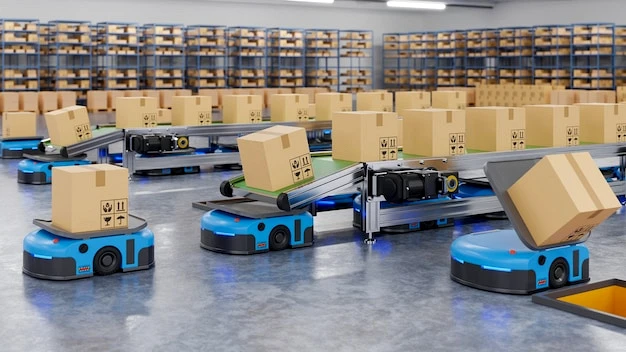
The provider can rent modules in a contemporary logistics park like NovaHub and create a service cluster. Close corridor access keeps transit times short, while modern specifications support automation and digital tracking.
❗ Common mistakes when evaluating or using a strategic port location
Many projects on strong corridors underperform because initial decisions ignore operational realities. Avoiding a few typical errors can significantly improve outcomes.
Underestimating last mile access and internal traffic
Some investors focus on highway distance and ignore the quality of local access roads or the internal circulation plan. The result is bottlenecks at the gate, unsafe maneuvers, and lost capacity during peak hours.
To prevent this, always evaluate how trucks enter, queue, and leave the site under realistic traffic volumes. The road map information for NovaHub is a good example of how to communicate these aspects openly.
Ignoring building specifications behind the marketing
Attractive location claims cannot compensate for substandard warehouses. Low clear heights, poor flooring, or insufficient dock equipment constrain future tenants and limit automation options.
Serious investors examine technical passports, construction standards, and compliance proofs rather than only renders. They verify that the developer delivers the promised European level of quality.
Overreliance on one customer or sector
Some dry port projects rely on a single large tenant or on one commodity segment. If that client relocates or if the segment faces structural change, the whole asset struggles.
Diversifying the tenant mix across retail, industrial, and logistics operators reduces dependency and stabilizes cash flows over long cycles.
Neglecting digital visibility and control
Without reliable digital tools, operators can lose track of containers, trucks, or construction progress. This leads to disputes, delays, and budget overruns.
Best practice is to require transparent reporting, construction monitoring, and operational dashboards from the developer or operator. NovaHub, for example, emphasizes online monitoring of building progress as part of its value proposition.

🛠️ Practical tips for investors and logistics managers
To convert the theoretical advantages of the Odesa–Kyiv corridor into real business results, decision makers should apply structured evaluation criteria and collaboration models.
1. Assess the corridor, not just the plot
Look beyond the boundaries of the site. Map typical flows between Odesa, Kyiv, and your key partners. Consider congestion patterns, police check points, and seasonal road conditions.
The key takeaway is that even a strong micro location cannot fully offset systematic delays on connecting routes, so you need a holistic corridor view.
2. Compare technical standards and expansion options
Create a simple comparison matrix for candidate sites with columns for warehouse height, floor loading, dock ratio, and expansion potential.
| Criterion | NovaHub style dry port | Legacy warehouse in city fringe |
|---|---|---|
| Clear height | High bay, suitable for multi level racking | Often limited, restricts vertical storage |
| Expansion potential | Phased sites within one plan | Constrained by neighboring buildings |
| Energy efficiency | Modern envelopes, lower operating costs | Older materials, higher utility bills |
| Compliance | Designed to EU standards | Mixed, sometimes below current norms |
This type of structured comparison clarifies why a contemporary facility can command higher occupancy and yields despite slightly higher initial investment.
3. Align contracts with operational realities
Lease or service agreements should reflect real handling patterns. If your business is seasonal, negotiate flexible space options or volume based pricing where possible.
Specify performance indicators like gate throughput times, dock availability, and uptime of critical infrastructure. This protects both tenant and developer by clarifying expectations in advance.
4. Plan for digital integration from day one
Connect warehouse management, transport management, and customs systems early in the project. A dry port only reaches its full value when information flows as smoothly as trucks and containers.
In many projects the most painful delays come from document errors, not physical limits. Digital integration sharply reduces this risk.
5. Use staged investment to manage risk
Instead of committing to the full long term capacity immediately, consider phased investment tied to demand triggers. This matches the phased construction model offered by projects like NovaHub.
In short, staged investment preserves optionality and allows you to scale once proven volumes materialize.
📈 Why NovaHub’s strategic location is attractive in the current market
Despite uncertainties, demand for quality logistics space in Ukraine has shown resilience, particularly around key corridors linked to international trade. Investors and occupiers look for assets that can bridge present challenges and future integration with European networks.
Alignment with European and regional logistics trends
Industry analyses from global consultancies highlight a shift toward regionalized supply chains and more inventory kept near final markets. Dry ports fit this pattern by placing stock in flexible hubs closer to demand yet still connected to major ports.
“Inland ports and logistics hubs are becoming critical nodes in resilient supply chains as companies rebalance global and regional flows.”
— Logistics Insight Report, 2024
NovaHub’s corridor position and European style standards respond directly to this trend, making it easier for international clients to integrate the site into broader networks.
NovaHub’s unique strengths: reliability, modernity, speed, quality
From the concept documentation, NovaHub emphasizes four qualities. Reliability in infrastructure and developer performance. Contemporary design that supports automation and sustainable operations. Speed of construction and commissioning. Consistent quality in both buildings and services.
Together these traits position the project as more than a land play. It becomes an operational platform where shippers and logistics providers can grow with controlled risk in a critical Ukrainian corridor.
✅ Conclusion: turning a strategic port location into long term value
A dry port and logistics center on the Odesa–Kyiv highway turns geographic advantage into practical logistics performance. By connecting port flows near Odesa with inland markets around Kyiv and beyond, it offers faster routing, more resilient supply chains, and scalable capacity for a wide range of sectors.
When combined with contemporary European grade warehouses and transparent digital control, a project like NovaHub can become a high quality logistics center Ukraine based shippers and investors rely on for years. The key is to evaluate corridor dynamics, technical standards, and developer reliability with the same rigor.
Bottom line, if you are considering investment in logistics real estate or looking for a new operational base, exploring NovaHub’s strategic location on the Odesa–Kyiv route is a logical next step. Visit the project’s online materials, review the master plan, and discuss how tailored warehouse or dry port solutions can fit your network.
As the holiday season approaches, many companies face peak deliveries, winter stock builds, and tight storage. This is the ideal moment to rethink how your Christmas logistics can benefit from a strategic, well connected hub. Explore NovaHub’s modern warehouse opportunities and imagine your next festive season with smoother flows, happier customers, and a supply chain that feels as reliable as your favorite holiday tradition.
Sources
— Logistics Insight Report (2024)
— European Logistics Real Estate Review (2023)
— Black Sea Transport Corridor Study (2022)
— Ukraine Warehouse Market Outlook, Industry Association (2023)
— Regional Infrastructure and Connectivity Brief, Independent Consultants (2024)
FAQ
What makes the Odesa–Kyiv highway so important for a dry port project like NovaHub?
The Odesa–Kyiv route links Ukraine’s main Black Sea ports with the capital region and central markets. A dry port on this axis can handle seaport flows and inland distribution in one place, which reduces drayage time, increases routing flexibility, and strengthens resilience during disruptions.
How does a dry port near port Odesa differ from a traditional warehouse?
A dry port acts as an inland extension of the seaport and offers customs clearance, container storage, and cross docking in a multimodal setup. A traditional warehouse usually serves only local storage functions and has weaker links to maritime terminals and national corridors.
Why are European construction standards important for NovaHub’s warehouses?
European standards support safety, structural reliability, and energy efficiency that remain relevant for many years. This reduces long term operating costs, enables high bay racking and automation, and gives international tenants confidence that the asset will meet their corporate compliance rules.
What practical benefits can a retailer gain from using a dry port on the Odesa–Kyiv corridor?
A retailer importing through Odesa can shift container clearance and deconsolidation to the dry port, then ship store ready deliveries to central Ukraine. This approach cuts demurrage, simplifies stock control, reduces double handling, and brings product closer to consumers.
Which common mistakes should investors avoid when choosing a strategic port location?
Typical errors include focusing only on distance instead of last mile access, ignoring real building specifications, depending on a single tenant, and neglecting digital visibility. The article recommends corridor analysis, technical due diligence, tenant diversification, and early system integration to avoid these issues.
How does NovaHub’s master plan support scalability for future growth?
The master plan groups facilities so that the complex can be built in phases without losing traffic efficiency. This allows investors to start with a functional dry port core and add capacity as demand grows, while preserving one coherent logistics ecosystem.
Why is digital integration highlighted as a key success factor for a dry port?
Many delays in logistics come from document errors and lack of visibility rather than physical congestion. Integrating warehouse, transport, and customs systems from the start ensures that information flows smoothly, which shortens lead times and supports performance guarantees for tenants and carriers.
How does NovaHub support resilience during port or route disruptions?
By acting as an inland buffer with ready storage and handling capacity on a major corridor, NovaHub enables shippers to redirect volumes between different ports or border crossings while keeping the same logistics base. This ability to reroute around disruptions is central to modern resilient supply chains.