

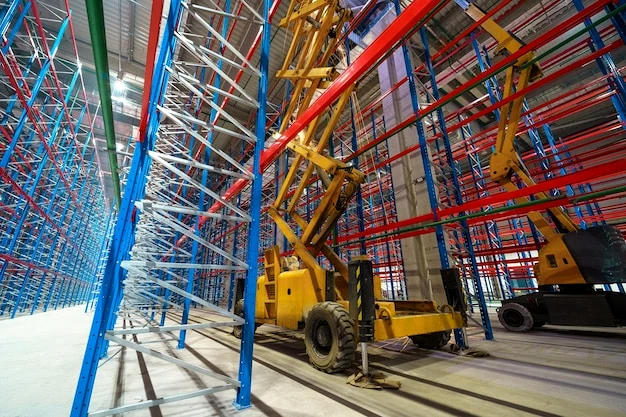
Businesses handling heavy or bulky loads in Ukraine gain critical safety, speed, and space efficiency from crane-beam warehouses, especially when these systems are integrated early into modern logistics complex design.
Across Ukraine, many companies are rethinking how they design storage and production facilities. Labor shortages, rising land costs, and safety requirements push owners to get more throughput from every square meter instead of simply building bigger. One of the most effective tools for this is a warehouse with a crane beam that can move heavy loads safely and quickly above the working area.
This article explains which types of business critically depend on a warehouse with a crane beam in Ukraine, how to choose the right configuration, what pros and cons to expect, and how such solutions integrate into a modern logistics center in Ukraine. You will also see real-life style scenarios, typical mistakes to avoid, and practical tips drawn from industry best practices and technical data.
🏗️ What is a warehouse with a crane beam and how does it work?
Basic concept of crane beams in warehouses
A crane beam is a structural system installed under the roof or on gantries that allows a lifting device to move along a defined span and transport loads within the warehouse space. Warehouse cranes are essential equipment for lifting and handling goods and are used where forklifts or manual handling are not efficient or safe. They reduce the number of floor movements and let you use the full height of the building.
Single girder and double girder overhead cranes are the most common systems. According to industry data, warehouse overhead bridge cranes are offered with capacities from 5 to 30 tons, while other warehouse cranes can range from 1 to 100 tons. This wide range allows owners to adapt the system to anything from light palletized goods to heavy machinery and steel coils.
Key technical characteristics that matter
From an engineering point of view, several parameters define how a crane beam will perform in a specific building. Suspended crane beams can have a load capacity of around 2 tons, but single girder crane beams as a family offer lifting capacities from 0.5 to 16 tons. The crane beam span can range roughly from 3 to 36 meters, which is enough to cover small bays and wide industrial halls.
Lifting height can reach up to 56 meters in some configurations. This is far above what many typical storage facilities need, yet it shows how effectively crane beams can use the full clear height of high-bay premises. Operating temperatures from minus 25 to plus 40 degrees Celsius make such cranes suitable for most regions of Ukraine, from industrial zones in central oblasts to coastal centers near Odesa.
Types of crane systems used in logistics and storage
Different warehouse strategies require different crane technologies. Double beam gantry cranes are used in warehouses for loading and unloading containers and for outdoor storage yards. Gantry cranes are designed to move large and heavy loads efficiently when you do not want or cannot install a bridge crane inside the building.
Inside the warehouse, single girder underslung crane beams are optimal for small spaces and can be installed within existing openings. They usually run on the bottom flange of roof beams. Larger facilities often use double girder overhead cranes that provide higher lifting capacity and better hook approach. Warehouse cranes can be operated with ground controls or remote control systems, which allows safe and flexible operation even in congested areas.
🏭 Which businesses in Ukraine critically need crane-beam warehouses?
Metallurgy, heavy fabrication, and engineering plants
For metal service centers, machine-building plants, and fabrication workshops, a warehouse with a crane beam is not just convenient. It is critical infrastructure. Long profiles, sheets, coils, and heavy components are very difficult and unsafe to handle only with forklifts. Crane beams facilitate the lifting and transport of such heavy loads across different zones, from incoming goods to cutting lines and assembly stations.
Many Ukrainian manufacturers combine storage and production under the same roof. In those cases, a well-planned crane system replaces multiple floor vehicles, reduces bottlenecks, and cuts handling time. Without it, throughput and worker safety would suffer, especially when each unit can weigh several tons.
Construction materials, concrete, and modular housing producers
Producers of precast concrete, wall panels, and modular buildings routinely move high-weight, bulky items. Gantry cranes and overhead beams allow them to store products vertically or in dense racks, then lift them directly onto trucks. This significantly shortens loading time on construction sites with tight schedules.
For such sectors, a modern logistics center in Ukraine that integrates both indoor crane beams and outdoor gantry cranes has a strong competitive advantage. It can handle heavy structural elements regardless of weather and maintain reliable supply to building projects across the country.
Automotive, agricultural machinery, and spare parts distribution
Warehouse cranes are also vital for businesses that deal with heavy automotive or agricultural components. Engines, transmissions, and large spare parts may arrive in containers or on pallets that exceed safe manual handling limits. A single girder crane beam with a capacity between 2 and 10 tons often covers the majority of such operations.
When these goods are stored in a dedicated premises for warehousing in Ukraine, crane beams support fast cross-docking, ensure safe assembly of kits, and increase packing efficiency. They also reduce damage risk for expensive equipment, which directly improves margins for dealers and distributors.
Container, port-adjacent, and rail-served hubs
Ukraine’s position between European and Black Sea trade routes means that intermodal hubs near ports and rail terminals are gaining importance. Double beam gantry cranes in such locations help load and unload containers, flat racks, and heavy machinery from rail wagons and trucks.
A logistics campus that combines indoor crane beams with outdoor gantries and container yards can act as a central node for regional distribution. Businesses that rely on sea and rail access, such as agri-exporters or equipment importers, often find such infrastructure to be a deciding factor when selecting a site.
📊 How do crane-beam warehouses compare by scale and performance?
Small versus large warehouse scenarios
Single girder underslung cranes are well suited for compact warehouses where floor space is limited and the span is modest. They can be installed in existing openings, which makes them ideal when upgrading an older building without major structural changes. In many Ukrainian SMEs, this is the first step toward mechanized handling.
Larger industrial halls typically use overhead bridge cranes or double girder systems that cover wider spans and higher loads. These solutions demand more engineering work but offer enormous handling flexibility. When you design a new premises for warehousing in Ukraine from scratch, it often makes sense to plan such systems together with the main steel structure.
Technical comparison table by application
To visualize the differences, consider the following simplified comparison of crane-beam configurations for typical use cases.
| Application type | Recommended crane type | Typical capacity | Span range | Lifting height |
|---|---|---|---|---|
| Small parts warehouse | Single girder underslung | 0.5–2 tons | 3–12 m | Up to 10 m |
| Fabrication / assembly hall | Single girder overhead | 2–16 tons | 10–24 m | Up to 20 m |
| Heavy industrial plant | Double girder overhead | 10–30 tons | 18–36 m | Up to 30 m |
| Container / outdoor yard | Double beam gantry crane | 20–40+ tons | Variable | Up to 56 m |
This table is not a design standard. It shows how different crane systems align with varying business needs and building dimensions. Actual parameters depend on specific loads, building geometry, and technical regulations.
Environmental and operating conditions
Ukraine’s climate creates a wide temperature spectrum in which lifting systems must operate reliably. Fortunately, many industrial crane beams are designed for use from minus 25 to plus 40 degrees Celsius. That makes them suitable for both unheated facilities in colder regions and warmer coastal or southern areas.
Warehouse cranes can be operated with wired ground controls or wireless remotes. Remote control is often chosen in modern facilities because it lets operators maintain safe distance from loads and avoid congested floor zones. According to industry guidance, such control methods improve ergonomics and reduce accident risk when combined with training and clear operating procedures.
✅ Pros and cons of a warehouse with a crane beam
Advantages of crane-beam warehouses
From an operational perspective, the benefits are significant when the crane system is correctly sized and integrated into the building.
- Higher space utilization: Crane beams use the full height of the building and free up floor space that forklifts or stackers would otherwise occupy.
- Improved safety: Heavy and awkward loads are lifted mechanically rather than manually, which reduces risk of injuries and product damage.
- Faster handling: Loads can move directly between receiving, storage, and production zones without multiple transfers.
- Flexibility for different loads: From small components to 16-ton or heavier items, the same rail system can serve multiple workstations.
- Reduced need for large fleets: A well-designed crane may replace several heavy forklifts and lower fuel or battery costs.
Limitations and challenges
There are also constraints that must be acknowledged before deciding that a crane-beam solution is the right approach.
- Initial investment: Structural steel, rails, and lifting equipment add capital cost compared to a simple shell warehouse.
- Engineering requirements: The building frame must carry dynamic loads, which may limit retrofits in weak structures.
- Operating complexity: Operators need training, and maintenance must be scheduled to keep the system safe and available.
- Less flexible layout changes: Once the crane runway is installed, large changes to the bay structure can be more complicated.
- Regulatory compliance: Lifting equipment must meet safety standards and undergo periodic inspections.
When benefits clearly outweigh drawbacks
In practice, these limitations are outweighed when heavy or large-volume goods dominate your flow. If your business regularly handles more than 1 ton units, the productivity and safety gains usually compensate for capital costs. This is especially true in a modern logistics center in Ukraine with high throughput, where every minute of handling time impacts lead times and service quality.
From a financial viewpoint, integrating crane beams into a new-build project may also be cheaper than trying to retrofit piecemeal later. Structural design can be optimized once instead of expanded repeatedly with temporary solutions.
📍 How crane-beam warehouses fit into modern Ukrainian logistics hubs
Integration with multimodal infrastructure
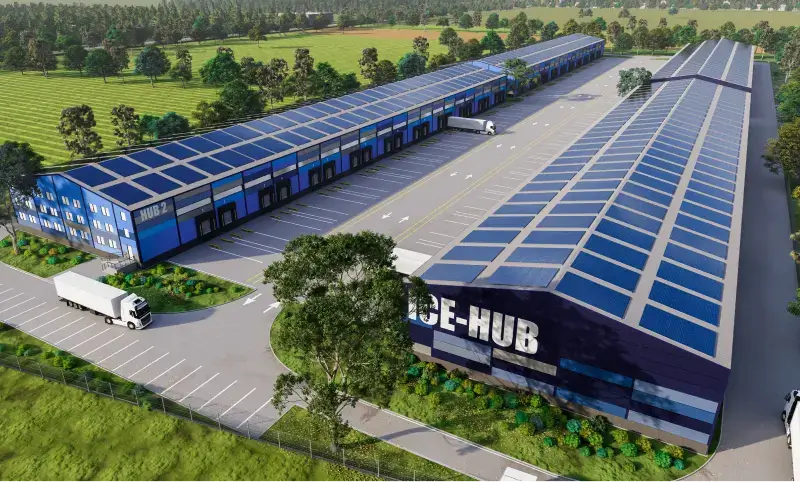
A contemporary logistics campus in Ukraine is rarely just a simple box. It combines warehousing, offices, cross-dock areas, and sometimes light manufacturing. When such a complex is located near an Odesa–Kyiv highway, sea port, dry port, and railway lines, the efficiency of internal handling becomes crucial, because external transport is already optimized.
Crane-beam systems inside the warehouse connect the outside world with interior operations. Containers unloaded by gantry cranes can be stripped, and heavy goods immediately lifted onto internal transport or storage positions. This shortens the path between ship or rail and final delivery vehicles.
Example: investment in a modern logistics complex
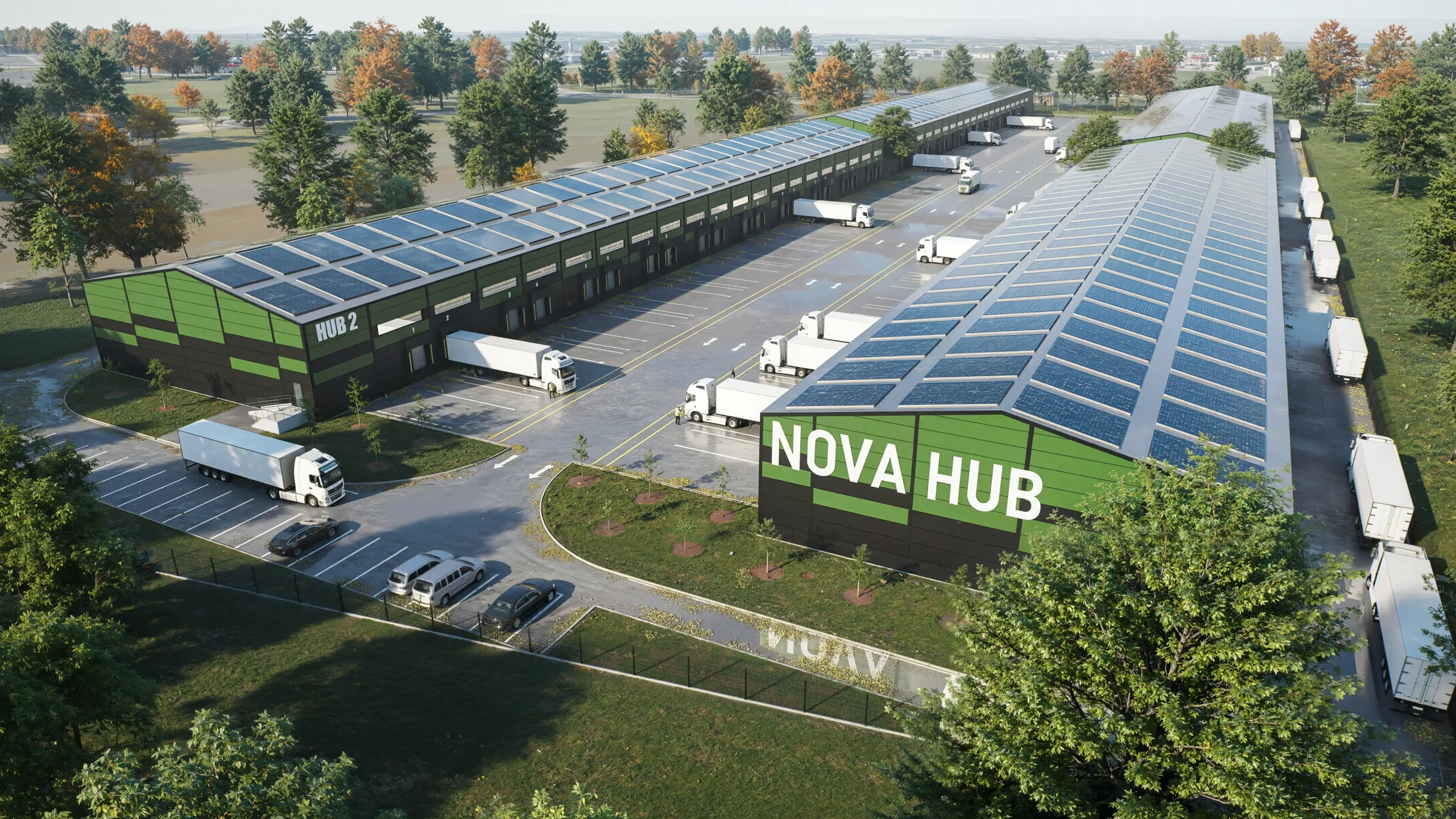
Consider an investment project where the total land plot is about 41,970 square meters and the built logistics complex covers about 19,174 square meters with 2,460 square meters of offices. The site is placed strategically close to main road and rail corridors, and is equipped with autonomous water supply, around 1 MW of electrical power, automatic fire alarms, 24/7 video surveillance, a shelter, and a solar power station for green energy.
At such a location, developed with project management from specialized firms and a general contractor focused on industrial construction, it makes strong sense to integrate overhead crane beams right into the design. With an estimated payback period of around seven years for the entire logistics investment, every gain in handling speed and labor efficiency supports the business case.
For readers interested in this type of project, NovaHub provides access to an investment in a modern logistics complex that follows high European building standards, with reliability, speed, and construction quality as core priorities.
Coordinating schedule and crane installation
To achieve a coherent result, crane design must be synchronized with the overall project timeline. If conceptual and detailed design run from early April to late November, permits from August to early January, and construction begins in mid-January with commissioning by August the following year, crane systems must be engineered and procured inside that window.
Proper sequencing ensures that crane runways and supports are embedded in the main structure instead of added later. This reduces steel quantities, saves time, and avoids conflicts with fire systems, lighting, and ventilation that are also routed under the roof.
🧩 Real-world style examples: how different companies use crane beams
Case 1: Steel service center near a major highway
Imagine a steel service center operating near the Odesa–Kyiv route. The business stores coils, plates, and structural profiles, cuts them to length, and distributes them across Ukraine. Daily, dozens of trucks arrive and depart. Without a crane beam, unloading coils of several tons each would require heavy forklifts, long waiting times, and large maneuvering spaces.
By installing two single girder overhead cranes with 10-ton capacity and a 20-meter span, the center can unload trucks directly inside the building, move coils to storage racks and cutting lines, and reload processed goods. Handling time per truck drops significantly, floor congestion is reduced, and safety improves, since workers are no longer close to swinging or unstable loads.
Case 2: Agricultural machinery warehouse with assembly zone
Consider a company that imports agricultural machinery and also performs pre-delivery inspection, assembly, and customization. The warehouse must store complete machines, parts, and large attachments. Some components weigh more than 2 tons. Previously, multiple forklifts and mobile cranes were required, which complicated coordination and increased operating costs.
After building a new premises for warehousing in Ukraine with a 24-meter span and 12-meter clear height, the company installs a single girder crane beam with 8-ton capacity on the main bay and a lighter 2-ton underslung crane over the assembly area. This layout allows components to be moved from the receiving dock to assembly and then to the outbound zone without touching the ground more than necessary. The result is smoother planning, fewer delays, and a safer environment.
Case 3: Intermodal hub with indoor and outdoor cranes
A regional logistics provider develops a hub near a dry port and rail yard. Outdoors, double beam gantry cranes load containers from wagons to the yard and trucks. Indoors, overhead cranes move heavy equipment, project cargo, and palletized goods. The combination lets the operator offer specialized services for heavy and oversized shipments that others cannot handle.
This setup becomes a key marketing advantage. Customers who ship heavy generators, industrial lines, or construction machinery prefer a partner who can handle lifting in a controlled, reliable way rather than relying on temporary mobile cranes each time.
⚠️ Common mistakes when planning crane-beam warehouses
Underestimating future load requirements
One frequent mistake is selecting a crane capacity only for current needs, without considering growth. For example, a business may install a 2-ton system, then later switch to 4-ton products. Replacing or reinforcing the entire crane and runway can become expensive and disruptive.
To avoid this, define realistic growth scenarios. If you might handle up to 8 tons later, it can be more cost-effective to design for that from the beginning, even if you start with lower loads.
Ignoring building structure and deflection
Another error is planning crane beams in isolation from the building frame. Columns, beams, and foundations must be sized for static and dynamic forces from the crane. If not, you risk excessive deflection, cracks, or even structural damage.
Always involve structural engineers with crane experience, and ensure that the crane supplier and building designer coordinate data such as span, wheel loads, and lifting class. This is especially important when rebuilding or extending older facilities.
Insufficient attention to workflow and ergonomics
Some projects position cranes only over storage racks and forget key workstations like packing, inspection, or assembly. Operators then must move loads multiple times or use extra equipment, which defeats the purpose of the crane.
Map material flows from inbound to outbound before fixing crane positions. Consider where operators will stand, how often each path is used, and where remote control or pendant stations should be located for safety and convenience.
Lack of training and maintenance culture
Crane systems are often treated as simple tools, but in reality they are safety-critical machines. A mistake is to provide minimal training and irregular maintenance. This can lead to unsafe practices, near-misses, and unplanned downtime.
Set up a preventive maintenance schedule, daily pre-use checks, and documented training for operators and supervisors. According to guidance from professional associations, such measures significantly reduce accident rates.

🔧 Practical tips for choosing and operating crane-beam warehouses
Actionable recommendations for project planning
To put all of this into practice, owners and managers should follow some clear steps during planning and implementation. In essence, you want to align technical design, operations, and financial goals from the start.
- Define your critical flows: Identify which loads, routes, and areas generate most handling time and risk, then prioritize crane coverage there.
- Plan with future in mind: Choose crane capacities and spans that can support your three to five year growth, not only current volumes.
- Integrate with building design: Coordinate crane runways, columns, and foundations early so the structure remains efficient and compliant.
- Ensure safety and training: Introduce clear operating procedures, emergency protocols, and refresher training for crane operators.
- Use remote control where helpful: Consider remote operation to keep people away from suspended loads and congested floor zones.
Checklist for evaluating a potential crane-beam site
When you review options for a warehouse with a crane beam in Ukraine, a structured checklist makes decision making easier.
- Location and access: Assess road, rail, and port connectivity and how that matches your inbound and outbound flows.
- Building dimensions: Verify clear height, span, and column grid to support your preferred crane configuration.
- Power and infrastructure: Ensure sufficient electricity, fire safety, and data systems to support cranes and other automation.
- Regulatory environment: Confirm local permitting requirements for industrial lifting equipment and structural changes.
- Expansion options: Check if land and building layout allow future bays or additional crane lines.
Expert insight on best practices
As many industry experts emphasize, investment in cranes brings the highest return when it is part of a holistic warehouse design rather than an isolated purchase.
Effective warehouses treat crane beams as part of an integrated flow system, not just a lifting gadget. The real value comes from shorter lead times, better space use, and fewer handling errors.
— European Materials Handling Federation (2023)
Owners who adopt this mindset tend to achieve smoother operations, higher safety, and better financial results over the asset’s lifecycle.
📝 How NovaHub adds value for crane-beam logistics projects
Modern construction to European standards
NovaHub focuses on the sale and construction of contemporary warehouses and logistics complexes that meet high European standards. For projects that require crane beams, this means structures are designed from the outset with adequate stiffness, load-bearing capacity, and fire safety. The result is a robust yet efficient frame where crane rails, power supply, and safety systems align from day one.
Modern materials and design tools help optimize steel quantities, which can offset part of the investment in cranes and supporting infrastructure. This balance is especially important in large sites where multiple bays and crane lines operate simultaneously.
Reliability, speed, and quality in delivery
Time to market often determines the success of a logistics project. NovaHub emphasizes reliability, fast execution, and high build quality, which are vital when a complex timeline coordinates design, permitting, and construction over roughly one and a half years. That approach reduces the risk of delays that could postpone revenue from the new facility.
Because crane systems must be installed and tested before commissioning, a disciplined schedule and experienced coordination between project managers, crane suppliers, and builders are crucial. NovaHub’s integrated approach helps synchronize these efforts under one coherent plan.
Tailored solutions for different business models
Not every business needs the same type of crane or even the same intensity of mechanization. Some require a heavy industrial setup, others only a light single girder beam over a packing zone. NovaHub supports tailoring building specifications and layouts to these differences while keeping room for future upgrades.
For clients who expect to scale up, crane-ready structures can be designed so that additional runways or higher capacity equipment can be added later with minimal disruption. This flexibility supports both current and future business scenarios.
🎄 Conclusion: is a crane-beam warehouse the right step for your business?
To sum it up, a crane-beam warehouse becomes critical when your business handles heavy or bulky goods, requires high throughput, or must make the most of limited floor space. For many Ukrainian manufacturers, logistics providers, and distributors, such systems are now an essential part of safe and efficient operations. When integrated into a modern logistics center in Ukraine, crane beams connect external transport modes with streamlined internal flows.
The key is to plan crane capacity, spans, and workflows together with building design, safety, and long-term development plans. With careful engineering and a focus on reliability, speed, and quality, you transform lifting equipment from a cost item into a strategic advantage. If you are considering upgrading or building new storage premises in Ukraine, reviewing crane-beam options early in the process is one of the smartest decisions you can make.
As the New Year approaches, many companies re-evaluate their infrastructure and plan fresh investments. This is an ideal moment to explore how a modern crane-equipped warehouse can refresh your logistics, bring a sense of new beginnings to your supply chain, and support sustainable growth. Visit NovaHub’s website to discover up-to-date New Year opportunities, inspiring warehouse concepts, and solutions that match your plans for a stronger, more efficient year ahead.
Sources
— European Materials Handling Federation (2023)
— Statista Research on Warehouse Automation (2024)
— Logistics Infrastructure Report, Eastern Europe (2023)
— Forbes Industrial Innovation Council
— Industry Report by McKinsey on Supply Chain Resilience (2022)
FAQ in English
What types of businesses in Ukraine most critically need crane-beam warehouses?
Companies in metallurgy, heavy fabrication, construction materials, modular housing, agricultural machinery, and intermodal logistics hubs rely heavily on crane beams. They handle multi-ton loads and bulky items where forklifts and manual methods are insufficient for safe and efficient work.
What lifting capacities and spans are typical for warehouse crane beams?
Single girder crane beams often range from 0.5 to 16 tons, while suspended systems can handle around 2 tons. Spans typically vary from about 3 to 36 meters, which suits small warehouses and large industrial halls. Heavy warehouses may use overhead bridge cranes up to 30 tons or more.
How do crane beams improve space utilization in a logistics center in Ukraine?
Crane beams move loads above the working area and use the full building height, which frees floor space that forklifts would need. This allows denser storage layouts, better access to racks and workstations, and shorter internal routes between receiving, storage, and dispatch zones.
What are the main disadvantages of installing a crane-beam system?
The main challenges include higher initial investment, stricter structural and engineering requirements, the need for operator training, and less flexibility for major layout changes. However, for operations that frequently handle loads over 1 ton, productivity and safety benefits often outweigh these drawbacks.
What operating temperatures can typical warehouse crane beams handle?
Many industrial crane beams are designed to work reliably from about minus 25 to plus 40 degrees Celsius. This temperature range makes them suitable for most Ukrainian regions, including unheated industrial buildings and logistics hubs in colder climates.
How should I plan crane capacity to avoid common mistakes?
Avoid sizing the crane only for today’s loads. Instead, consider realistic growth over three to five years and design for the highest expected unit weight. It is usually more economical to build in extra capacity now than to reinforce crane runways or replace equipment later.
What practical steps should I take before choosing a warehouse with a crane beam in Ukraine?
Start by mapping your key material flows and identifying loads that cause bottlenecks or safety risks. Then analyze building dimensions, location, power availability, regulatory requirements, and future expansion options to ensure the crane system and structure will remain suitable as your business grows.
How does NovaHub support projects that require crane-beam warehouses?
NovaHub designs and builds modern warehouses and logistics complexes to high European standards, with structures ready for crane loads. They focus on reliability, fast project delivery, and quality, coordinating building design, crane integration, and infrastructure so the final facility supports efficient, safe lifting operations.
Can crane systems be retrofitted into existing warehouse buildings?
Yes, but the existing structure must be checked for adequate strength and deflection under dynamic crane loads. Single girder underslung cranes can sometimes be installed in existing openings, yet complex or heavy-duty systems may require reinforcement or even partial rebuilding to remain safe and compliant.
Why are remote controls recommended for modern warehouse cranes?
Remote controls allow operators to stand at a safe distance from suspended loads and away from congested floor zones. This improves ergonomics and reduces the chance of accidents, especially in busy logistics centers where multiple vehicles and people share the same space.