

A modern logistics center requires strategic multimodal location, optimized high-bay design, strong utilities, digital control, safety, and sustainability. NovaHub’s Ukrainian complex integrates these features with clear timelines and a 7-year payback.
Supply chains are under constant pressure from volatile demand, rising transport costs, and stricter customer expectations for speed and transparency. Facilities that worked a decade ago often cannot support same-day fulfillment, omnichannel sales, or resilient international routes. Companies that still rely on basic storage buildings lose time and money in every operation and struggle to scale when the market suddenly changes.
This article explains what defines a truly modern logistics center, which capabilities are no longer optional, and how to evaluate projects in Ukraine and beyond against these criteria. We will look at location strategy, technology, safety, sustainability, scalability, and typical mistakes investors make. You will also see how a next-generation complex like NovaHub’s investment project near the Odesa–Kyiv corridor puts these principles into practice to deliver reliable, fast, high-quality service.
In simple terms, we will outline nine mandatory characteristics that turn a building into a high-performing logistics hub and help you decide what to demand from your future facility or partner.
😊 What makes the location of a modern logistics center truly strategic?
The first and often most decisive factor is where the facility is placed. A logistics hub can only be effective if it minimizes transport time and integrates naturally into existing trade routes and customer flows. This is especially important for a logistics center in Ukraine that serves both domestic and international traffic.
1. Proximity to major roads and highways
A high-performance hub needs quick access to national and regional highways so trucks avoid congested city centers and long detours. For example, NovaHub’s complex is positioned close to the Odesa–Kyiv highway. This gives direct access to two of the country’s most important economic poles and reduces line-haul costs for both northbound and southbound flows.
In practice, easy access to a trunk road means more predictable transit times, better slot management for carriers, and fewer penalties for missed delivery windows. It also enables flexible route planning for last-mile and regional distribution.
2. Multimodal connectivity
Modern centers rarely rely on road transport alone. Multimodal hubs that connect road, sea, and rail provide more options when fuel prices spike or certain borders become congested. According to industry data, these integrated platforms are crucial for efficient international operations and export flows.
The NovaHub project is sited near a sea port, a dry port, and a railway connection. This combination supports containerized imports and exports and simplifies transfers between ship, rail, and truck. Operators can optimize each leg of transport based on cost and lead time instead of being locked into a single mode.
3. Sufficient land and future expansion capability
Strategic location is not only about the map; it is also about the land bank. A total plot of 41,970 square meters provides space for current buildings, internal roads, parking, and further development. This matters when businesses outgrow initial capacity quicker than expected.
In the long run, a large, well-shaped site allows new warehouse modules, additional docks, or value-added service zones to be added with minimal disruption. That creates a natural path to scalability instead of forcing an expensive relocation.
😊 How should a logistics center be designed and built for efficiency?
Once the location is right, the next question is how the complex is engineered. A сучасний логістичний центр is not just a large box. It is a purpose-built environment that enables fast, accurate, and safe movement of goods.
4. Optimized internal layout and working heights
Efficient space design separates storage, picking, value-added services, and loading docks into clearly defined zones. This reduces travel time for people and equipment and helps maintain process flow. According to industry practice, specialized areas for cross-docking, packing, and returns handling are now standard in distribution environments.
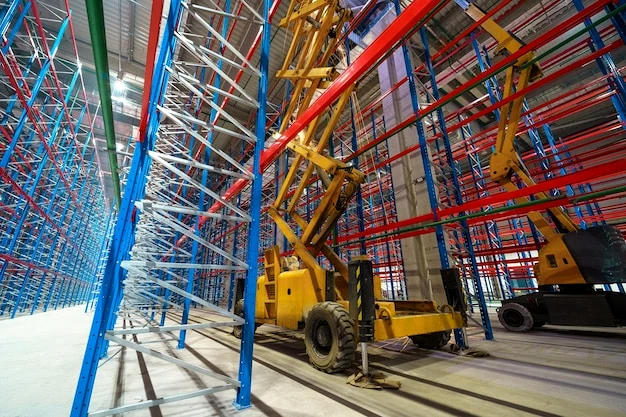
Working heights between 8 and 12 meters, as implemented in NovaHub warehouses, support modern racking systems and maximize cubic utilization. Higher clear heights, combined with the right racking design and safety systems, increase pallet positions without expanding the building footprint.
5. Balanced mix of warehouse and office space
A successful hub integrates operational areas and management functions under one concept. In the NovaHub complex, the total built area is 19,174 square meters, with 2,460 square meters of office space. This ratio allows warehouse teams, planners, customer service, and management to collaborate closely.
Dedicated office space also enables IT, HR, and training functions to support the operation. This is vital when you run advanced Warehouse Management Systems (WMS) and Transportation Management Systems (TMS) that require constant monitoring and optimization.
6. High-quality construction and reliable infrastructure
Reliability begins with the physical structure. NovaHub focuses on modern construction that meets high European standards, which improves durability, insulation, and safety. The facility has autonomous water supply and 1 MW of installed electrical capacity, which provides a stable base for daily operations and future automation projects.
This kind of engineering focus ensures consistent temperature control, resilience against extreme weather, and lower long-term maintenance costs. It also supports the company’s positioning on reliability, speed, and quality.
😊 Why are technology and automation essential in a modern hub?
Technology is now as important as concrete and steel. Without digital control and automation, even a well-located building struggles to meet modern performance expectations.
7. WMS, TMS, and real-time visibility
Modern logistics centers rely on sophisticated WMS platforms to manage inbound, storage, picking, and outbound flows. These systems provide real-time inventory visibility, slotting optimization, and task management for operators. Industry research confirms that advanced inventory management reduces stockouts and excess stock by improving accuracy and control.
TMS platforms manage transport planning, carrier selection, and freight cost optimization. Together, WMS and TMS form the digital backbone of a high-performing hub and make data-driven decisions possible every day.
8. Automation and robotics where they add value
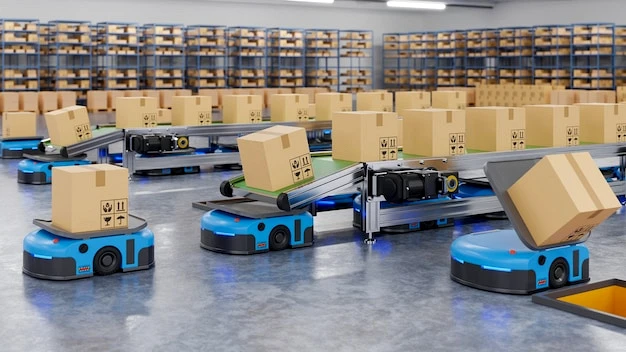
Automation technologies, from conveyors to robotic handling, are increasingly implemented to increase speed and reduce human error. According to sector analyses, robots and automated conveyors help accelerate picking and packing operations, especially in high-volume environments.
However, automation must be applied selectively. Facilities should be designed with the power, space, and safety provisions for future automation, even if the first phase remains semi-manual. NovaHub’s 1 MW power provision and modern layout enable this gradual upgrade path.
9. Integrated security and monitoring systems
Technology also enhances control and security. The NovaHub complex uses 24/7 video surveillance across the premises. Combined with access control and an automatic fire alarm system, this reduces theft risks, supports insurance requirements, and protects staff and inventory.
Real-time monitoring data can be linked to incident management workflows, which makes investigations faster and improves compliance with customer and regulatory standards.
😊 How do safety and resilience shape a future-ready logistics center?
In recent years, safety and business continuity have become central selection criteria for tenants and investors. A logistics hub must protect people, assets, and operations even under stress.
10. Advanced fire protection and structural safety
Automatic fire alarm systems, properly zoned detection, and suitable fire suppression technologies are non-negotiable. They protect high-value inventory and reduce the risk of full-site shutdowns after an incident. This is particularly important in tall racked environments with 8 to 12 meter heights.
Structural robustness and high-quality materials also limit damage from extreme weather or accidents. In short, serious safety engineering is not a cost center; it is a strategic risk management tool.
11. On-site shelter and emergency preparedness
The presence of a shelter on the NovaHub site illustrates a broader point. Modern facilities must be designed with emergency scenarios in mind. This includes safe zones for staff, clear evacuation routes, emergency lighting, and drills.
These measures protect people and support regulatory compliance. They also reassure clients who place their supply chains and goods in your care.
12. Energy resilience and autonomous utilities
Continuous operation depends on reliable utilities. An autonomous water supply helps keep essential processes running when municipal systems are disrupted. Sufficient electrical power, backed by a modern solar power station, improves energy autonomy and cost control.
According to logistics experts, facilities that can maintain at least partial operations during external disruptions provide a significant competitive advantage. They deliver on customer promises when others are forced to pause.
😊 How important is sustainability in a modern logistics center?
Environmental and social considerations are now part of mainstream logistics strategy. Customers, investors, and regulators expect continuous improvement in carbon footprint and resource use.
13. Renewable energy and reduced emissions
A solar power station, such as the one installed at the NovaHub complex, lowers dependence on the grid and reduces greenhouse gas emissions. This directly supports corporate ESG objectives and can reduce operating expenses over the life of the asset.
When paired with efficient LED lighting, modern insulation, and smart energy management, these systems turn the warehouse into an energy-optimized asset instead of a cost-heavy building.
14. Efficient land and building utilization
Higher working heights and optimized rack layouts increase storage density. This avoids unnecessary land use and helps keep the overall footprint compact. Efficient vehicle circulation areas and well-designed docks also reduce idling times and fuel consumption.
As a result, a modern hub can handle more volume with fewer resources. This balance supports both environmental goals and financial performance.
15. Stakeholder and community impact
Responsible logistics centers consider impact on nearby communities, including traffic patterns, noise, and employment. Facilities located near major routes like the Odesa–Kyiv highway help keep heavy vehicles away from residential streets.
At the same time, they create high-quality jobs in operations, engineering, and management, supported by modern office spaces and training areas.
😊 What are the main advantages and limitations of a modern logistics center?
In practice, even the best-designed hub brings both strengths and constraints. Understanding them helps investors and users set realistic expectations and design effective contracts.
Key advantages
- Higher productivity: Optimized layouts, WMS, and automation cut handling times and errors, which increases throughput without proportionally growing labor.
- Improved reliability: Robust utilities, safety systems, and surveillance reduce downtime and protect goods, which supports consistent service levels.
- Better scalability: Large plots, high working heights, and modular building concepts let you expand capacity as volumes grow.
- Lower operating costs: Renewable energy, efficient building systems, and modern equipment lower energy and maintenance expenses over time.
- Stronger customer value: Fast, transparent, and reliable logistics enhance your brand and help win demanding clients.
Typical limitations
- High initial investment: Advanced construction, technology, and safety features require significant upfront capital that not all operators can afford.
- Complex implementation: Integrating WMS, TMS, and automation demands specialized expertise and careful change management.
- Longer planning horizon: From design to commissioning, a full-scale complex can take years. The NovaHub project, for example, moves from design in April 2025 to commissioning in August 2026.
- Dependence on skilled labor: Operating advanced systems requires trained staff. Talent gaps can limit the realized benefits of the facility.
😊 How does NovaHub’s project illustrate these 9 mandatory characteristics?
To make these concepts more tangible, it helps to look at a specific case. NovaHub is developing a next-generation logistics complex that integrates the characteristics discussed above into a single site.
Project overview in numbers
| Parameter | NovaHub Complex |
|---|---|
| Total land area | 41,970 m² |
| Total built area | 19,174 m² |
| Office space | 2,460 m² |
| Example unit (HUB 1) warehouse | 4,016 m² |
| Example unit (HUB 1) office | 574 m² |
| Working height range | 8–12 m |
| Electrical power capacity | 1 MW |
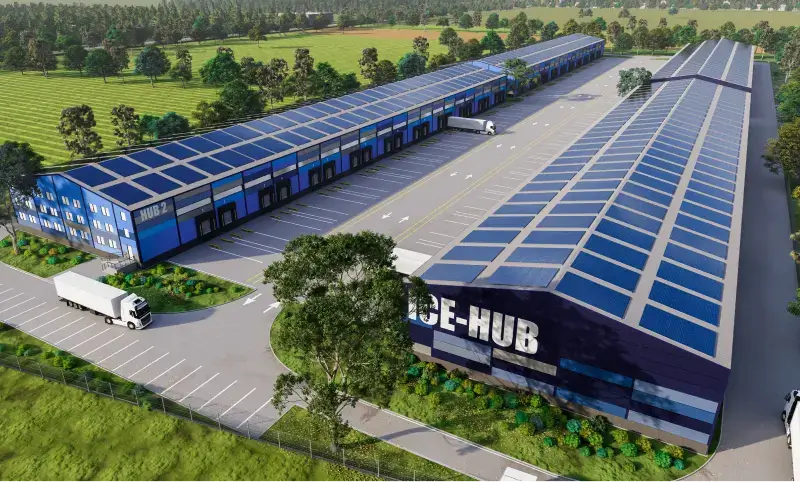
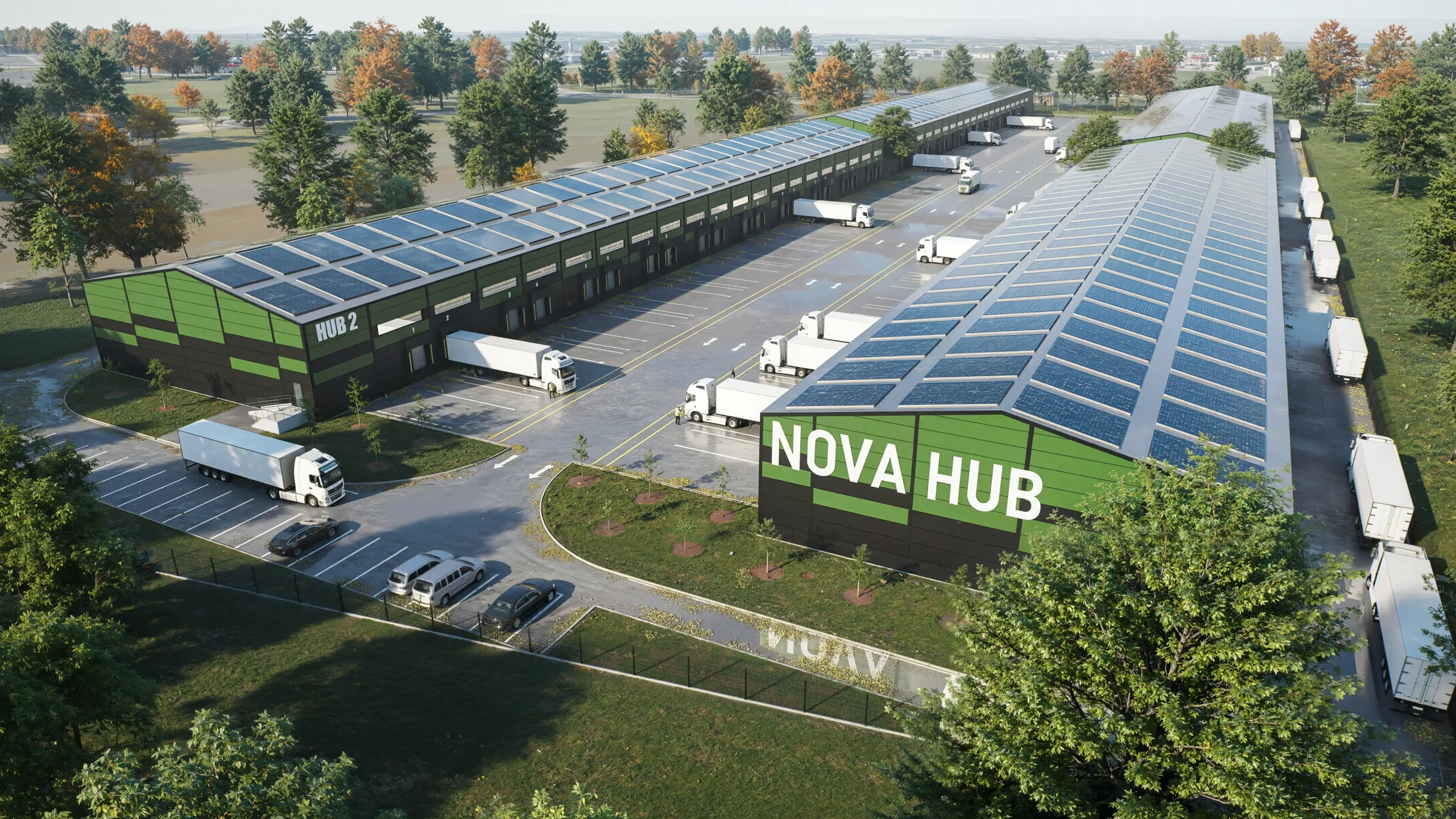
The complex is strategically located near the Odesa–Kyiv highway and multiple port and rail connections. It combines large-scale warehousing with modern office environments, autonomous water supply, 24/7 surveillance, and a solar power station to ensure energy autonomy and resilience.
Timeline and investment logic
NovaHub structures the project in clear phases. Design work runs from April to November 2025, permitting from August 2025 to early January 2026, followed by construction starting in mid-January 2026 and commissioning in August 2026. The targeted investment payback period is 7 years.
This illustrates a disciplined approach to planning and an understanding that high-quality construction and advanced systems require time. Investors gain long-term value in exchange for this careful preparation.
Real-world example: upgrading from legacy warehouse to NovaHub hub
Imagine a regional distributor currently working from a low-height, city-center building with no automation and limited dock capacity. They face frequent congestion, long loading times, and minimal visibility into stock. Moving into a NovaHub unit with 8–12 meter heights and WMS integration would immediately increase pallet capacity and reduce manual errors.
With access to the Odesa–Kyiv corridor and nearby ports, they could serve both domestic retail chains and export customers far more efficiently. Over time, they might add conveyors or other automation, supported by the 1 MW power capacity and robust building design.
😊 What are common mistakes when planning or choosing a logistics center?
Many companies know they need a more advanced facility but still make predictable errors during planning, selection, or implementation. Avoiding these mistakes saves time, money, and frustration.
Frequent errors and how to prevent them
- Underestimating future volume growth: Some investors choose a building that fits current needs only. When demand grows, they run out of space and have to relocate. To prevent this, prioritize scalable layouts and sites with room for expansion.
- Ignoring multimodal potential: Focusing only on cheap land, far from ports or rail, leads to high transport costs. Consider long-term trade patterns and use locations with road, sea, and rail options where possible.
- Cutting corners on safety and utilities: Skipping advanced fire systems or under-sizing power and water supply lowers initial cost but increases operating risk. Specify robust utilities and safety from day one.
- Delaying digitalization: Implementing WMS or TMS “later” often means never. Integrate core digital systems into the initial project so processes and data structures start correctly.
- Neglecting change management: Staff may resist new layouts or technologies. Plan training, clear communication, and phased go-lives to build acceptance and competence.

😊 What practical tips help make the most of a modern logistics center?
Translating high-level requirements into concrete actions can be difficult. In a nutshell, the following recommendations will help you design, select, or operate a facility that delivers the promised value.
Actionable recommendations
- Start with a process map: Document your end-to-end flows from inbound to outbound. Use this to design zones, docks, and office locations rather than simply copying another warehouse layout.
- Align building specs with equipment strategy: Before finalizing heights and column spacing, define the type of racking, forklifts, or automation you plan to use so the building supports them.
- Plan IT and infrastructure together: Involve WMS, TMS, and network experts during design. Ensure adequate power, data cabling, and Wi-Fi coverage everywhere you will use scanners or automation.
- Run realistic simulations: Test picking routes, dock schedules, and storage strategies using real or simulated data to find bottlenecks before construction finishes.
- Set measurable KPIs: Define target productivity, error rates, and energy consumption for the new site and monitor them from the first day of operation.
- Choose partners with proven project management: Use experienced developers and contractors who understand logistics, similar to how NovaHub cooperates with professional project management and construction firms.
😊 How does NovaHub support investors and tenants in Ukraine?
For many companies, building or leasing a new hub is one of the largest strategic decisions they will make in a decade. Having a partner that combines technical excellence, reliable execution, and modern standards can dramatically reduce risk.
Reliability, modern standards, and speed
NovaHub focuses on reliability in delivery and operations. By using modern construction practices that align with high European standards, the company creates facilities that are durable, energy-efficient, and ready for advanced logistics technology.
At the same time, clear timelines from design through commissioning demonstrate a commitment to speed and quality. This balance allows investors to plan cash flows confidently and tenants to schedule migrations with minimal disruption.
Aligned with national and regional logistics needs
As a leading example of a logistics center in Ukraine, the NovaHub project aligns closely with the country’s growing role in regional and international trade. Its strategic location near major corridors and ports, combined with advanced infrastructure, supports both local distribution and cross-border operations.
Interested investors can review the details of this investment in logistics complex near Odesa and Kyiv and evaluate how it fits into their wider supply chain strategy.
😊 How does a modern logistics center compare to a traditional warehouse?
To clarify the practical differences, it is useful to place traditional facilities and modern logistics hubs side by side. The gap is more than cosmetic; it affects daily operations, service levels, and long-term competitiveness.
Side-by-side comparison
| Aspect | Traditional Warehouse | Modern Logistics Center |
|---|---|---|
| Primary role | Static storage | Dynamic hub for storage, distribution, and value-added services |
| Technology level | Basic inventory records, often manual | Advanced WMS/TMS, real-time visibility and analytics |
| Building design | Lower heights, generic layout | 8–12 m heights, optimized zones and docks |
| Transport links | Often single-mode road access | Integrated road, sea, and rail connectivity |
| Energy and utilities | Standard grid power, no renewables | 1 MW-level power, solar generation, autonomous water |
| Safety and security | Basic alarms, limited CCTV | 24/7 surveillance, automatic fire systems, emergency shelter |
As seen in this comparison, a modern hub functions as a central nervous system for the supply chain rather than just a storage room. It uses technology, design, and infrastructure to create a resilient and efficient platform for growth.
According to an industry report by McKinsey (2023), companies that invest in integrated, technology-enabled logistics hubs can improve fulfillment speed by up to 30 percent while reducing logistics costs per unit.
McKinsey Global Logistics Insight, 2023
Conclusion
Nine characteristics define a modern logistics center that can handle today’s and tomorrow’s supply chain requirements. Strategic location, optimized design, digital control, strong safety, sustainability, and scalability work together to create a high-performance hub. Projects like NovaHub’s complex near the Odesa–Kyiv corridor show how these principles can be combined in practice with reliable, modern construction and clear timelines.
For investors and tenants, the task is to evaluate facilities against these criteria instead of focusing on size alone. When you choose a partner that delivers reliability, high European standards, and fast, high-quality execution, your logistics operation becomes a competitive advantage rather than a cost burden.
As you plan for the New Year and set fresh supply chain goals, consider upgrading your infrastructure to a truly next-generation hub. Explore NovaHub’s modern logistics solutions to bring more stability, speed, and confidence into your operations and start the year with a resilient, future-ready facility that supports your growth ambitions.
Sources
— McKinsey Global Logistics Insight (2023)
— World Bank Logistics Performance Report (2023)
— Statista Research on Warehouse Automation (2024)
— Forbes Technology Council, Supply Chain Innovation Articles
— Industry Report by European Logistics Association (2023)
FAQ
What makes NovaHub’s location near the Odesa–Kyiv highway strategic?
The site provides direct access to a major national corridor and nearby ports and rail, which shortens transit times for both domestic and international flows. This combination reduces transport costs and increases delivery reliability.
How large is the NovaHub logistics complex and its land plot?
The total land area is 41,970 square meters, while the built complex area is 19,174 square meters. This includes 2,460 square meters of office space integrated with warehouse operations for better coordination.
Why are 8–12 meter working heights important in a logistics center?
Working heights between 8 and 12 meters enable modern racking systems and better use of cubic space. This increases pallet capacity without expanding the footprint and supports higher throughput.
What utilities and energy features support resilience at NovaHub?
The complex has an autonomous water supply, 1 MW of electrical capacity, and a solar power station. Together they provide energy autonomy, support potential automation, and keep operations running during disruptions.
How long does it take NovaHub to deliver the new logistics complex?
The project moves from design in April 2025 to commissioning in August 2026. This includes parallel permitting and a construction start in January 2026, reflecting a structured, realistic schedule.
What safety systems are installed in the NovaHub logistics center?
The facility includes an automatic fire alarm system, continuous 24/7 video surveillance, and a shelter for emergencies. These measures protect staff, inventory, and continuity of operations.
What are the main advantages of choosing a modern logistics hub over a traditional warehouse?
A modern hub offers higher productivity, better reliability, scalability, and lower long-term operating costs. It also delivers stronger customer value through faster, more transparent logistics services.
What common mistakes should I avoid when planning a new logistics facility?
Avoid underestimating future volume, under-investing in utilities and safety, and postponing WMS or TMS implementation. Plan for multimodal access, involve IT early, and invest in staff training and change management.
How does the 7-year payback period influence investment decisions?
A defined 7-year payback horizon helps investors model cash flows and compare the project with alternative uses of capital. It reflects the balance between higher upfront quality and long-term operational savings.
Why is a mix of warehouse and office space beneficial in a logistics center?
Combining 2,460 square meters of office space with warehouse areas allows planners, managers, and customer service teams to work close to operations. This improves communication, decision-making, and responsiveness to client needs.