


Odesa’s port-centric cold storage, including NovaHub’s class-A complex, strengthens Ukraine’s cold chain by combining reliable temperature control, modern infrastructure, and strategic access to sea, rail, and highway routes.
Global food and pharmaceutical supply chains are under pressure to deliver fresher products, reduce waste, and cut emissions while operating in an increasingly volatile environment. For companies working with temperature-sensitive goods in Ukraine, the Black Sea region is especially strategic, because it connects seaborne trade, inland rail, and road corridors in one compact geography. In this context, cold chain logistics around Odesa is turning into a competitive advantage, not just a support function.
This article explains how modern freezer and refrigerated warehouses near Odesa support reliable temperature control from port to shelf, why infrastructure quality matters as much as location, and what to look for when evaluating facilities or investment projects. We will analyze design features of state-of-the-art hubs like NovaHub’s class-A campus, the strengths and limitations of port-centric cold storage, typical mistakes operators make, and practical steps to improve performance, sustainability, and ROI.
❄️ Why cold chain logistics in Odesa is strategically important
How Odesa connects sea, rail, and highway flows
Odesa sits at a junction where maritime traffic, railways, and the Odesa–Kyiv highway meet. This allows importers and exporters of chilled and frozen cargo to consolidate flows in one region instead of spreading operations across distant sites. Port-centric cold storage warehouses in Odesa shorten the distance between vessel discharge, container stripping, and transfer into long-term refrigerated storage.
NovaHub’s logistics campus near Odesa builds on this advantage by locating close to the seaport, a dry port, and key rail connections. This configuration reduces internal trucking cycles, which supports faster transshipment and more predictable lead times for temperature-sensitive product lines.
Odesa as an emerging logistics center of Ukraine
In practice, Odesa already functions as a de facto logistics center of Ukraine for many food and agri companies. The concentration of port services and warehousing capacity allows shippers to aggregate frozen meat, seafood, dairy, and fruit volumes before dispatch to central and western regions of the country.
As modern class-A facilities come online, including multi-temperature complexes with working heights from 8 to 12 meters, the region’s role grows from simple transit point to full-scale distribution and value-add hub. This shift attracts both operators and investors looking for scalable cold chain infrastructure.
Why temperature control near the port matters
The cold chain is a temperature-controlled supply chain that keeps cargo within a defined low-temperature range. According to industry guidelines, continuous temperature control is one of the main tools for preventing bacterial growth and preserving safety, quality, and freshness.
When cold storage is located directly in or near Odesa’s port area, pallets spend less time in uncontrolled environments between ship, truck, and warehouse dock. That reduces the risk of warm-up events that historically caused product claims, insurance issues, or silent quality losses that only appear later on the retail shelf.
Key sectors using cold storage warehouses in Odesa
Several sectors rely heavily on refrigerated warehousing close to the Black Sea gateways. Food importers store frozen meat, poultry, fish, and vegetables that are then distributed across national retail networks. Exporters of processed foods and some fresh produce consolidate shipments before containerization and loading for overseas markets.
Pharmaceutical companies use high-reliability cold rooms to protect vaccines and temperature-sensitive medicines. Even non-food sectors, such as certain chemical and cosmetic products, benefit from controlled temperature and humidity that modern facilities can deliver.
❄️ What defines a modern cold storage warehouse in Odesa?
Thermal envelope and multi-temperature capability
Modern cold storage warehouses rely on advanced thermal envelopes that keep internal temperatures stable even when outside conditions fluctuate rapidly. NovaHub designs its buildings with high-performance insulation and building materials that limit thermal bridges and reduce energy losses.
Multi-temperature functionality is equally important. NovaHub’s complexes support various temperature zones within one campus, which allows operators to handle frozen, chilled, and ambient-sensitive products simultaneously without duplicating infrastructure at multiple locations.
Vertical efficiency and building heights
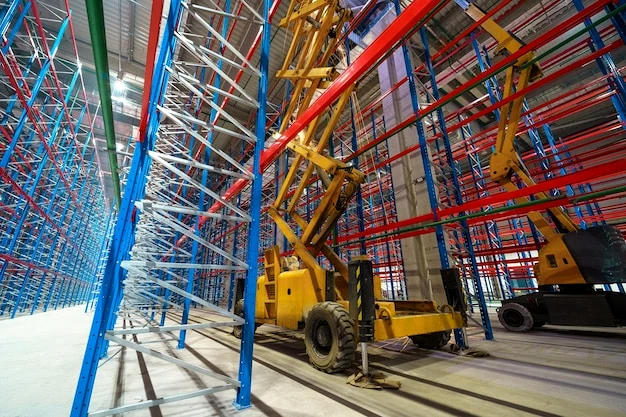
Working heights from 8 to 12 meters significantly impact capacity and cost per pallet. Taller buildings allow higher racking systems or automated storage technologies, which increases throughput without additional land. This is particularly valuable near Odesa’s port, where strategically located land is finite and expensive.
Put simply, more cubic meters of temperature-controlled space within the same footprint mean better asset utilization and greater flexibility to accommodate seasonal peaks in seafood, meat, or fruit volumes.
Reliable utilities and safety systems
Cold storage relies on uninterrupted power supply. NovaHub’s logistics complex near Odesa incorporates autonomous electricity capacity of about 1 megawatt, which reduces exposure to grid instability and helps maintain continuous refrigeration.
Facilities are also equipped with automatic fire alarm systems, 24/7 video surveillance, and shelters. This combination of safety and security features supports compliance and enhances confidence for international shippers who expect European-level standards in their logistics networks.
Layout, loading zones, and yard geometry
Beyond the building shell, the layout of docks, staging areas, and yards determines real throughput. NovaHub optimizes loading zones and yard geometry to minimize truck waiting times and internal bottlenecks. This matters for refrigerated logistics because trucks and containers must be turned quickly to avoid temperature deviations and demurrage costs.
Expansion-ready utility capacity and modular design also allow tenants to scale operations as demand grows, without rebuilding the entire site or compromising existing operations.
❄️ How NovaHub’s Odesa logistics campus is structured
Project scale and land utilization
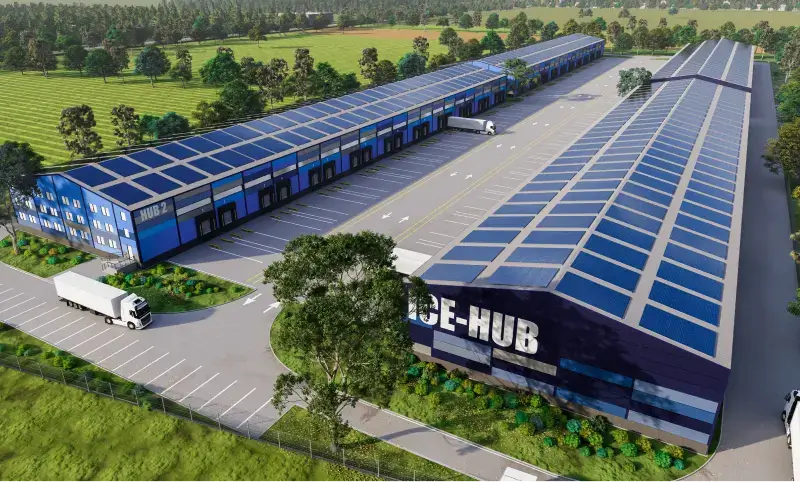
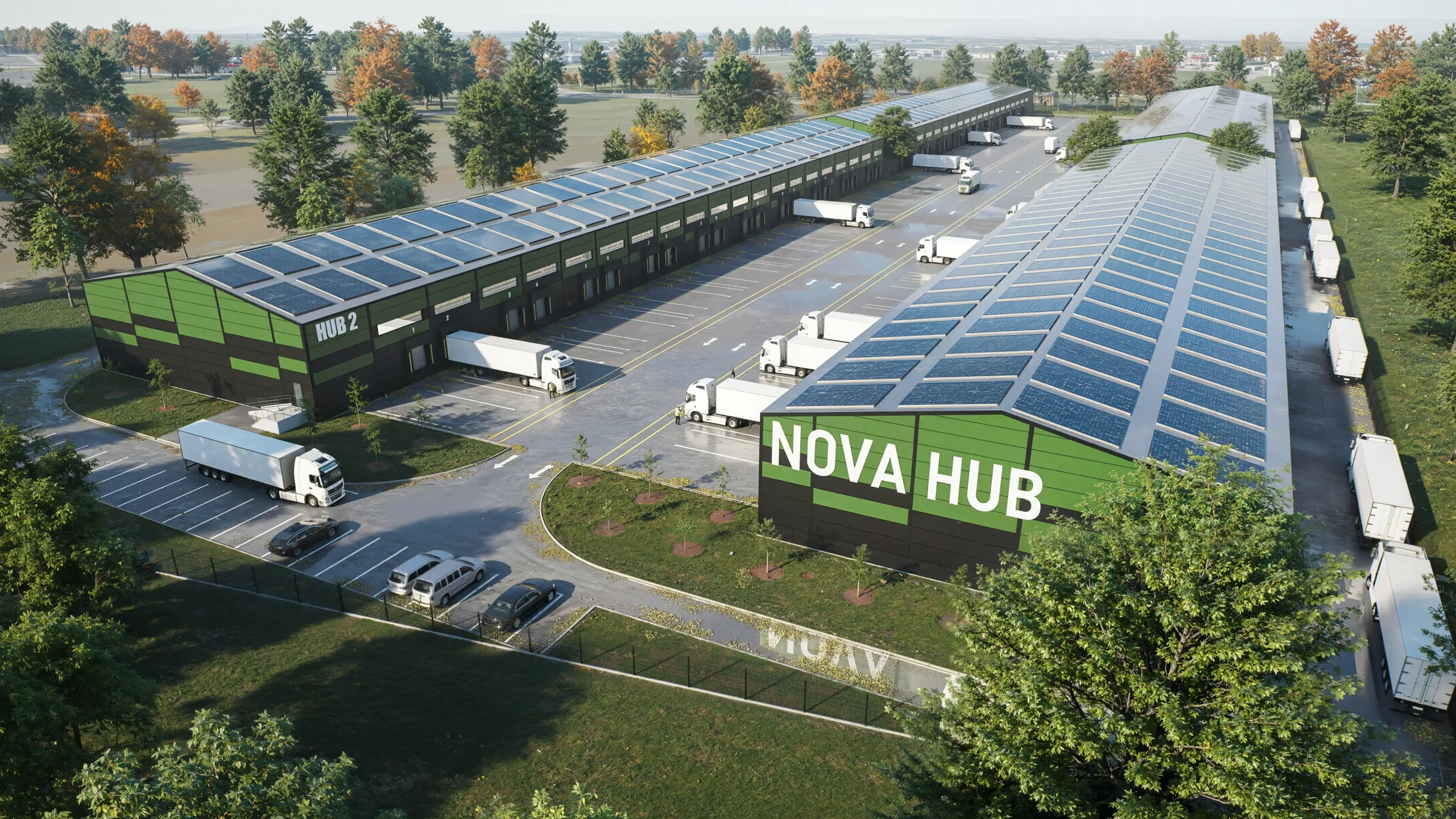
The NovaHub campus near Odesa is planned as a large, integrated logistics complex. The total land plot covers 41,970 square meters. Within this area, the total built-up space of the complex is projected at 19,174 square meters, including warehouses and supporting infrastructure.
The site also includes approximately 2,460 square meters of office space. These offices enable on-site management, customs brokers, quality controllers, and tenant teams to work directly next to storage and handling operations, which speeds up decision-making and problem resolution.
Development stages and timeline
The campus is developed in four stages to align capacity additions with market demand and investor risk appetite. Project design activities are scheduled between April 7, 2025 and November 28, 2025. Permitting is planned from August 18, 2025 to January 9, 2026.
Construction is targeted to start on January 15, 2026, with commissioning expected in August 2026. This staged approach supports more predictable project management and gives potential tenants and partners time to align their own network plans with the new capacity.
Infrastructure, energy, and green components
From an infrastructure standpoint, the campus is designed with autonomous water supply and a reliable electricity system backed by 1 megawatt of available power. This supports heavy refrigeration loads, automation, and office requirements without compromising stability.
A solar power station on site contributes green energy to the complex. In practice, this reduces reliance on grid power and supports sustainability goals for tenants who must report supply chain emissions or align with international ESG expectations.
Project management and quality execution
Professional project management is provided by TOV “SK GROUP”, while general contracting responsibilities are carried by TOV “BAU-CENTER”. Their roles include ensuring that construction quality matches the design intent and European standards followed by NovaHub.
In short, the combination of experienced project management, a structured development schedule, and strong contractors increases confidence that the facility will be delivered on time and operate reliably as a modern refrigerated logistics hub.
| Key Parameter | NovaHub Odesa Campus |
|---|---|
| Total land area | 41,970 m² |
| Total complex area | 19,174 m² |
| Office space | 2,460 m² |
| Working height | 8–12 m |
| Electricity capacity | 1 MW autonomous supply |
| Payback period (investment) | Approximately 7 years |
❄️ Pros and cons of port-centric cold storage in Odesa
Advantages of locating cold storage near Odesa port
Locating refrigerated facilities close to the port brings several operational and strategic advantages for companies that depend on cold chain logistics.
- Reduced transport time: Shorter distance between ship, terminal, and warehouse limits temperature fluctuations and lowers fuel and handling costs.
- Faster customs and inspections: Authorities and inspection services are usually concentrated near the port, which can accelerate clearance for perishable products.
- Higher cargo flexibility: Shippers can decide later whether to export, re-export, or distribute domestically, because inventory is already positioned at a key gateway.
- Better consolidation options: Multiple importers and exporters can pool volumes, which improves container utilization and negotiating power with carriers.
- Strong infrastructure: Modern logistics centers often provide robust utilities, fire safety, and monitoring systems that enhance product safety.
Limitations and risks to consider
At the same time, operating cold storage warehouses in Odesa near the port also introduces some limitations that investors and tenants need to consider.
- Higher land and construction costs: Strategic locations typically command premium prices, which can increase project budgets and rental rates.
- Congestion risk: Port areas may experience traffic peaks during vessel arrivals, which can create bottlenecks without good yard planning and scheduling.
- Regulatory complexity: Proximity to international gateways often brings stricter regulatory oversight and documentation requirements.
- Infrastructure dependence: Operators rely on road, port, and rail performance. Disruptions can quickly impact cold chain stability.
- Capital intensity: High-quality refrigeration, insulation, and monitoring systems require significant upfront investment compared with ambient warehouses.
Balancing benefits and constraints in project planning
For many businesses, the benefits of port-centric cold storage outweigh the challenges, especially when facilities are designed with expansion-ready utility capacity and strong operational planning. Careful layout design, dock scheduling, and temperature monitoring can mitigate congestion and infrastructure risks.
NovaHub’s campus, for example, combines strategic location with modern building standards and automation-ready layouts. This helps investors and tenants achieve a balanced risk-return profile over the campus’s approximate seven-year payback horizon.
Comparison with inland refrigerated warehousing
Inland facilities further from Odesa can offer lower land costs but may increase transport distances and risk of temperature breaks. The choice depends on product characteristics, distribution patterns, and required service levels.
| Aspect | Port-Centric Cold Storage | Inland Cold Storage |
|---|---|---|
| Distance to port | Very short | Moderate to long |
| Land cost | Higher | Lower |
| Temperature risk | Lower between ship and warehouse | Higher due to longer haul from port |
| Flexibility for export/import | High | Medium |
| Typical use case | Import/export hubs and consolidation | Regional distribution and last-mile |
❄️ Technology, monitoring, and automation in the cold chain
Temperature and humidity monitoring systems
Cold storage warehouses need precise temperature and humidity control to protect product quality. Automated monitoring systems track conditions continuously and alert operators if temperatures deviate from defined ranges.
These systems support traceability as data logs can be linked to batches, pallets, and shipments. This information is critical in case of quality claims or audits by retailers and regulators.
Automation and storage optimization
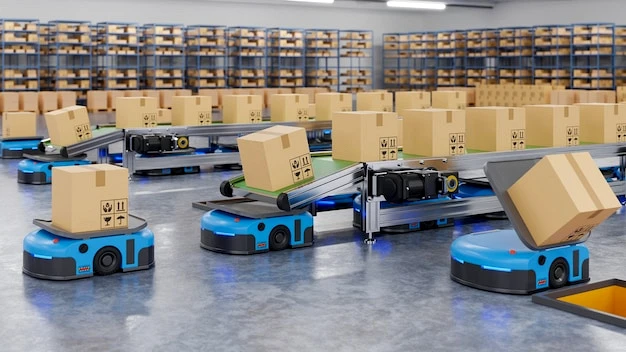
Advanced automated storage and retrieval systems (AS/RS) increase space utilization and reduce human error. According to industry reports, automation can also improve food safety because fewer people physically handle the product.
As noted by a leading cold chain study (Cold Chain Industry Review, 2023), automated storage and digital monitoring are becoming central tools for improving traceability and reducing product loss in refrigerated logistics.
Cold Chain Industry Review (2023)
NovaHub’s high working heights and class-A building standards create good conditions for integrating such automated solutions as tenants or operators scale their operations.
Energy efficiency and green energy
Energy-efficient facilities are essential for sustainable cold chain operations, because refrigeration is energy-intensive by nature. High-quality thermal envelopes, efficient refrigeration systems, and smart controls all help reduce consumption.
The presence of a solar power station on NovaHub’s campus supports greener operations by providing part of the needed electricity from renewable sources. This aligns with global efforts to lower the carbon footprint of logistics networks without compromising performance.
Security, fire safety, and business continuity
Refrigerated warehouses must protect both goods and people. Features like automatic fire alarm systems, 24/7 video surveillance, and shelters contribute to robust risk management. They also support compliance with insurer requirements and international buyer expectations.
When combined with autonomous water and power supplies, these safety systems enhance business continuity. Tenants can maintain operations even when external infrastructure faces temporary disruptions.
❄️ Practical examples of cold chain use cases around Odesa
Example 1: Frozen seafood importer optimizing dwell time
Consider a seafood importer receiving containers of frozen fish through Odesa. Previously, containers were trucked to an inland warehouse several hours away, which increased the risk of temperature deviations whenever reefer units malfunctioned during road transport.
By relocating storage to a port-adjacent facility with strong cold chain logistics, the company can unload containers quickly, move pallets into a multi-temperature warehouse, and reduce internal transit time. This change improves product shelf life, reduces quality complaints from retailers, and lowers fuel and trucking costs.
Example 2: National retail chain sourcing from multiple origins
A national supermarket chain buys chilled dairy and frozen foods from different suppliers, both domestic and international. Using cold storage warehouses in Odesa, the chain can consolidate these flows near the port, check quality, and then send mixed loads to regional distribution centers across Ukraine.
The strategic location near the Odesa–Kyiv highway and rail lines simplifies outbound planning. It also allows the chain to respond quickly to demand spikes in central and northern regions without overloading smaller local warehouses.
Example 3: Pharmaceutical distributor ensuring strict compliance
Pharmaceutical products often require tight temperature ranges and reliable documentation. A distributor using a modern facility near Odesa can rely on continuous temperature and humidity monitoring, autonomous power, and fire safety systems that meet demanding standards.
These conditions allow the distributor to demonstrate compliance to authorities and international partners, improve audit outcomes, and avoid costly product recalls linked to temperature abuse.
Investment scenario: Leveraging NovaHub’s campus
For institutional or private investors interested in the logistics sector, the NovaHub campus near Odesa represents a structured opportunity. The project offers a projected payback period of about seven years, supported by strong location fundamentals and rising demand for modern refrigerated infrastructure.
Interested readers can explore this investment in a logistics complex to understand how NovaHub combines reliability, speed of delivery, and high European construction standards in practice.
❄️ Common mistakes in planning and operating cold storage in Odesa
Mistake 1: Underestimating power and utility needs
Some operators underestimate the electricity and water requirements of large-scale refrigeration systems. This can lead to unstable operations and unplanned outages, which are especially damaging for cold chain cargo.
The solution is to design with sufficient autonomous capacity, as NovaHub does with its 1 MW power infrastructure, and to plan for future expansions from the start.
Mistake 2: Focusing only on location, not building quality
Another frequent error is prioritizing proximity to the port over building standards. Older or poorly insulated facilities may seem cheaper at first but can create high operating costs and inconsistent temperature control.
Choosing facilities with modern thermal envelopes, optimized docking areas, and European-level construction standards is essential for long-term performance and cost stability.
Mistake 3: Neglecting process design and yard management
Even the best building cannot compensate for poor process design. If truck scheduling, dock assignment, and internal workflows are weak, congestion and long waiting times will undermine efficiency.
Operators should design processes and yard geometry carefully, then adjust them based on data from daily operations, especially during seasonal peaks.
Mistake 4: Insufficient monitoring and traceability
Relying on manual checks for temperature and humidity often leads to incomplete records and delayed responses to equipment problems. This undermines traceability, which is a key requirement in modern food and pharma supply chains.
Automated monitoring and data logging provide a more reliable foundation for compliance and quality management, and they support faster root-cause analysis when issues occur.

❄️ Practical tips for shippers and investors using Odesa cold storage
Tips for food and pharma shippers
- Map your temperature risks: Identify segments between port, warehouse, and final destination where temperature is hardest to control, then choose facilities that minimize those segments.
- Check building specifications: Confirm working heights, insulation quality, and multi-temperature capabilities to ensure the warehouse fits your product mix and growth plans.
- Audit monitoring systems: Ask how temperature and humidity are monitored, how alerts are handled, and how data is stored for audits and investigations.
- Review yard and dock operations: Observe real loading and unloading processes to check waiting times and how quickly pallets move from trucks into cold rooms.
Tips for investors evaluating logistics projects
- Align with market demand: Focus on locations like Odesa where seaport traffic, rail connections, and highways converge, because these areas have stronger long-term demand for refrigerated capacity.
- Assess construction standards: High-quality class-A warehouses with European standards tend to attract better tenants and maintain value over time.
- Review payback and phasing: Look for structured projects with clear development stages, realistic commissioning dates, and an achievable payback period.
- Evaluate sustainability features: Solar power, efficient thermal envelopes, and automation readiness can improve both operating margins and attractiveness to international users.
Collaborating effectively with a logistics developer
Working with an experienced developer like NovaHub can significantly reduce complexity. Developers who focus on reliability, speed, and quality construction help align technical design with practical operational needs.
Early collaboration allows tenants to customize temperature zones, office layouts, and automation provisions so that the final facility supports their unique workflows from day one.
Incorporating Odesa into your wider supply chain
When integrating Odesa-based facilities into your network, consider how they connect to inland distribution centers and retail platforms. The goal is to use the region as a strategic node that balances international flows with domestic distribution needs.
Companies that treat Odesa as a core logistics center of Ukraine, rather than just a port city, are better positioned to leverage its full potential in cold chain logistics.
❄️ How NovaHub supports reliable, modern cold chain logistics
Reliability as a core design principle
NovaHub structures its projects around reliable utilities, robust building envelopes, and advanced safety systems. Autonomous water supply, 1 MW of power, and automatic fire detection help ensure that operations remain stable even under challenging external conditions.
This focus on reliability reduces the risk of stock losses and service interruptions for tenants, which is critical when dealing with high-value refrigerated cargo.
Modern construction with European standards
The company builds class-A warehouses with modern materials and designs that meet European quality benchmarks. Multi-temperature capability, high working ceilings, and efficient loading areas are standard elements rather than optional extras.
Such construction quality not only improves operations but also reassures international partners and auditors who increasingly expect harmonized standards across their global logistics networks.
Speed and quality in project delivery
NovaHub’s structured timeline for its Odesa campus illustrates a commitment to both speed and quality. Clear design periods, a defined permitting window, and a targeted commissioning date give stakeholders confidence in the schedule.
Coordinated project management and experienced contractors help keep construction on track, so tenants can plan their own network changes with minimal risk of delay.
Positioning Odesa for the future
By investing in modern, multi-stage logistics campuses near Odesa’s port and transport corridors, NovaHub contributes to the city’s role as a central node in Ukraine’s temperature-controlled supply chains. Facilities are built with expansion in mind, which allows capacity to grow alongside market demand.
This forward-looking approach means that companies choosing NovaHub’s sites today are not just solving immediate storage needs. They are securing a scalable platform for future growth in cold chain logistics.
❄️ Conclusion
Cold chain logistics around Odesa is evolving from a basic support function into a strategic pillar for food, pharma, and other temperature-sensitive industries. Port-centric cold storage warehouses in Odesa offer strong advantages, especially when they combine modern thermal design, reliable utilities, and efficient loading operations.
NovaHub’s class-A logistics campus near the Odesa–Kyiv corridor shows how high construction standards, autonomous infrastructure, and staged development can create a resilient hub that supports both shippers and investors. Companies that integrate these facilities into their networks gain better quality control, lower waste, and more flexible import and export options.
If your business is planning for the next phase of growth, this is an ideal time to reassess your refrigerated network and consider how Odesa can act as a core logistics center of Ukraine. As the New Year and holiday season approach, many brands update their supply chains to handle festive peaks and fresh demand. Explore NovaHub’s solutions to position your products, from frozen foods to pharmaceuticals, in modern warehouses ready for the next year of growth and seasonal opportunities.
Sources
— Cold Chain Industry Review (2023)
— Global Logistics Infrastructure Report (2024)
— European Cold Storage Association Insights (2023)
— McKinsey Supply Chain Sustainability Perspective (2024)
— Food Safety and Refrigerated Transport Briefing (2022)
FAQ in English (USA)
What makes Odesa so important for cold chain logistics in Ukraine?
Odesa combines a seaport, dry port, rail connections, and the Odesa–Kyiv highway in one region, which concentrates flows of temperature-sensitive cargo. This location allows companies to shorten internal transport distances and use the city as a strategic consolidation and distribution hub.
How do modern cold storage warehouses in Odesa protect product quality?
They use advanced thermal envelopes, multi-temperature zones, and automated temperature and humidity monitoring to maintain stable conditions. According to industry practice, these features help prevent bacterial growth and preserve food safety, texture, and flavor for sensitive products.
What are the main advantages of port-centric cold storage compared with inland sites?
Port-adjacent warehouses reduce the distance between ship and storage, which lowers temperature risks and internal trucking costs. They also provide better flexibility for import, export, or domestic distribution decisions because inventory is already located at a key international gateway.
What key specifications does NovaHub’s Odesa logistics campus offer?
The campus is planned on 41,970 m² of land, with 19,174 m² of total complex area and 2,460 m² of office space. It offers working heights of 8 to 12 meters, about 1 MW of autonomous power, and is designed as a multi-stage class-A facility.
How long is the planned development timeline for the NovaHub complex near Odesa?
Design is scheduled from April 7, 2025 to November 28, 2025, with permitting from August 18, 2025 to January 9, 2026. Construction is planned to start on January 15, 2026, with commissioning expected in August 2026.
What are common mistakes when choosing cold storage facilities in Odesa?
Typical errors include underestimating power needs, focusing only on location while ignoring building quality, and neglecting yard and process design. These mistakes can cause unstable temperature control, congestion, and higher operating costs over time.
How does NovaHub address sustainability in its cold storage projects?
NovaHub combines efficient thermal envelopes with autonomous electricity and a solar power station to reduce reliance on external grid power. These features support lower energy consumption and help tenants align with global sustainability and ESG expectations.
What payback period can investors expect from the NovaHub Odesa campus?
The logistics complex is planned with an estimated investment payback period of approximately seven years. This figure reflects the combination of strategic location, modern class-A specifications, and strong demand for refrigerated warehousing around Odesa.
How should shippers integrate Odesa-based cold storage into their wider network?
Shippers should treat Odesa as a central node that links international flows through the seaport with inland distribution centers. By consolidating chilled and frozen cargo there, they can improve responsiveness to demand in different regions of Ukraine while protecting product quality.