


Logistics centers near Odesa offer stronger demand, infrastructure status, and clearer payback than traditional offices. NovaHub’s modern complex combines strategic location, resilience, and ESG features for a seven‑year target payback.
Investors who once focused almost exclusively on office real estate are now rethinking their strategies. Structural shifts in global trade, the rise of e‑commerce, and hybrid work models are changing how capital flows into property. In Ukraine, and especially around Odesa, logistics assets are not just a defensive play. They are becoming one of the most promising growth stories in commercial real estate.
This article explains why reallocating capital from traditional office buildings into a modern logistics hub can offer better risk‑adjusted returns, stronger demand fundamentals, and deeper strategic value. We will explore seven key reasons, examine Ukraine’s unique logistics context, compare offices and warehouses side by side, and analyze a first‑class project example that shows how a logistics center in Ukraine can work in practice. You will also find pros and cons, real‑world style scenarios, typical mistakes to avoid, and practical tips for evaluating an investment with NovaHub.
📦 Why logistics centers are outperforming offices in Ukraine
Structural demand: Odesa as the core logistics gateway
Ukraine’s logistics map has been redrawn by war and trade disruptions. Odesa has effectively become the country’s main logistics gateway because many other ports are either inaccessible or severely constrained. Almost 80 percent of all cargo in Ukraine currently passes through the ports of the Odesa region, which handle about 65 percent of the nation’s trade volume.
Odesa’s infrastructure had been strengthening even before the war. The region has seven ports, a new runway capable of handling cargo flights, and extensive rail and road connections. According to several logistics market reviews, Odesa is now seen as the natural candidate to become the dominant logistics center in the Black Sea basin. For investors, this translates into robust long‑term demand for high quality warehouse and distribution space.
Office demand under pressure from hybrid work
In contrast, office assets are facing structural headwinds. Many global and local companies have adopted hybrid or remote work models. This has reduced the need for large conventional office floors and increased subleasing activity. Even when companies retain space, they often seek shorter leases, more flexibility, and cost reductions.
Investors in office buildings carry higher leasing and vacancy risk in such an environment. Repositioning older offices to meet new workplace standards can require heavy capital expenditure. That capital often generates lower incremental returns compared to investing in a well located logistics facility that directly supports Ukraine’s export and import flows.
Logistics as critical infrastructure, not optional space
Unlike offices, which can be downsized or relocated more easily, logistics centers are mission critical for businesses that move physical goods. Agricultural exporters, retail chains, and manufacturers in Ukraine depend on reliable warehousing, temperature‑controlled storage, and multimodal access to ports, highways, and rail.
In effect, a modern logistics complex behaves more like infrastructure than discretionary real estate. This can lead to more resilient occupancy, stronger tenant stickiness, and a higher probability of stable cash flows across market cycles.
🏗️ What defines a modern first‑class logistics center today?
Technical standards beyond “four walls and a roof”
A contemporary logistics asset in Ukraine must meet European‑level standards on safety, energy efficiency, and operational convenience. NovaHub focuses on reliability, fast execution, and high construction quality that aligns with these expectations. This is a different value proposition than legacy warehouses that lack modern systems.
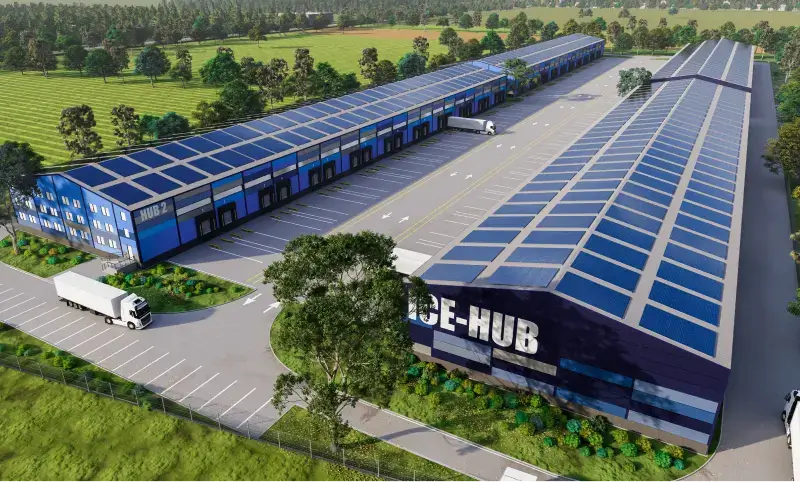
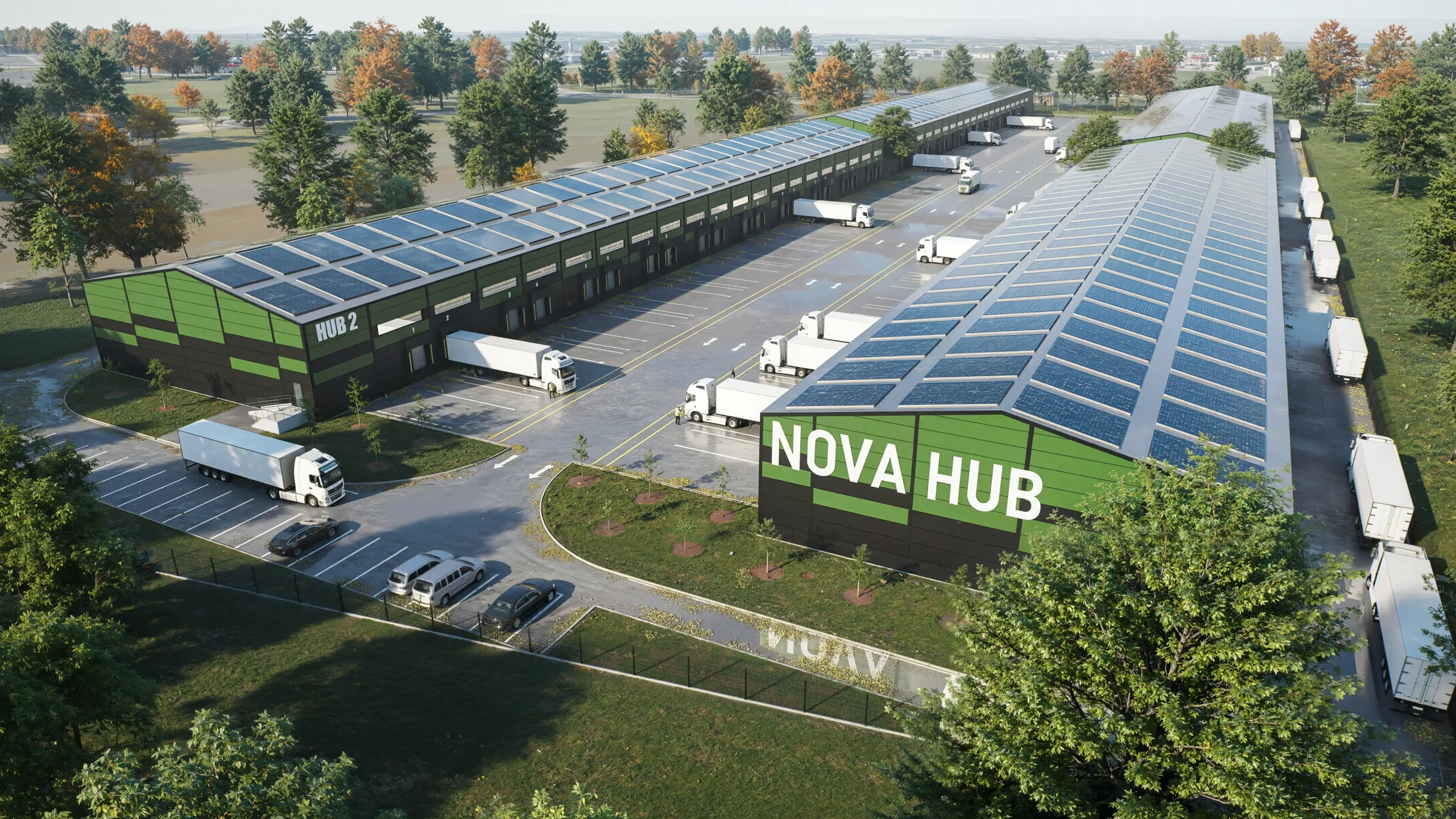
The planned logistics complex offered through NovaHub illustrates these standards. It is designed on a land plot of 41,970 square meters, with a total building area of 19,174 square meters. The facility includes approximately 2,460 square meters of office space for on‑site management and tenant operations, integrated within the wider logistics ecosystem.
Strategic location and multimodal connectivity
Location is the backbone of any logistics investment. The NovaHub complex sits near the Odesa–Kyiv highway and has convenient links to a sea port, dry port, and railway infrastructure. This connectivity shortens transit times and minimizes the “first and last mile” bottlenecks that often erode supply chain efficiency.
Such positioning matters even more in a country where agricultural exports like grain and sunflower products rely on timely shipment windows. Reliable access to ports and rail can directly support national food security and reduce external risks that arise from route disruptions.
Resilience features: utilities, safety, and energy
For investors, it is no longer sufficient that a logistics center simply functions during normal conditions. The NovaHub project includes autonomous water supply, around 1 MW of electrical capacity, an automatic fire alarm system, and 24/7 video surveillance. There is also a designated shelter, which aligns with current risk management expectations in Ukraine.
An on‑site solar power station further strengthens resilience and reduces operational costs through green energy. In short, these features help create a first‑class logistics center that remains attractive to demanding international tenants who expect continuity of operations and ESG aligned assets.
📈 Seven reasons to choose a logistics center instead of office investment
Reason 1: Stronger and more diversified demand drivers
Demand for logistics space in Ukraine is powered by multiple sectors. Agricultural exporters, fertilizer distributors, importers of consumer goods, and e‑commerce players all need well structured storage and distribution nodes. Container transport in Ukraine is expected to grow significantly, which adds another layer of demand for cross‑docking and container handling areas.
Office space, by comparison, is more closely tied to corporate headcounts and white‑collar employment trends. When companies shrink, merge, or digitize, office demand can fall quickly. Logistics demand instead tracks physical trade volumes and supply chain needs, which are being reinforced by customs reforms and infrastructure initiatives like China’s Silk Road corridors.
Reason 2: More predictable cash flows and lower vacancy risk
Because logistics centers form part of tenants’ critical operations, lease terms often reflect long‑term commitments. Tenants are less inclined to relocate frequently once their processes, racking systems, and temperature‑controlled chambers are calibrated to a specific facility.
In many office markets, tenants negotiate break clauses and shorter terms. This increases cash flow volatility for landlords. A well located logistics center in Ukraine, especially in the Odesa region, can often secure more stable occupancy profiles, which supports financing and makes income projections more reliable.
Reason 3: Higher strategic value in Ukraine’s current context
In Ukraine’s present circumstances, logistics assets contribute directly to national resilience and food security. Warehouses support the storage and movement of grain, sunflower products, and fertilizers. Their setup therefore has macroeconomic and geopolitical importance beyond typical commercial real estate.
The planned fertilizer logistics center in the Odesa region, spanning about 6,000 square meters and located roughly 20 kilometers from Odesa near a major highway, is a good example of such strategic infrastructure. Facilities like these help keep export corridors open and reduce the sensitivity of Ukraine’s economy to regional disruptions.
Reason 4: Attractive payback profile and value creation potential
From an investor’s perspective, payback time and internal rate of return are crucial. The NovaHub logistics complex is structured around an investment payback period of about seven years, assuming typical occupancy and rental conditions for such assets. This timeframe is competitive for institutional grade logistics in emerging markets.
Investors also have options for value creation. They can support the build‑to‑suit tailoring of warehouse space for specific tenants, upgrade temperature‑controlled zones, or layer in additional services. All of these can lift effective rents without the heavy tenant improvement costs often associated with high‑end office interiors.
Reason 5: Stronger alignment with global trade and policy trends
International initiatives and policies favor logistics infrastructure. China’s Silk Road strategy has stimulated investment in Ukrainian ports and railways, which naturally increases demand for supporting warehouse capacity. Customs reforms have shortened cargo clearance times at ports, making efficient logistics centers even more valuable as throughput rises.
Office assets do not benefit from this same policy tailwind. Their performance is tied more closely to local corporate dynamics and less to global trade corridors. For investors seeking exposure to Ukraine’s integration into regional and global supply chains, logistics centers offer a more direct route.
Reason 6: Better fit for ESG and green transformation goals
Investors worldwide now weigh environmental and social criteria alongside returns. A contemporary logistics center can integrate solar energy, efficient lighting, and optimized layouts that reduce energy consumption per ton of goods handled. The NovaHub complex showcases this through its solar power station and modern building design.
Upgrading older office stock to similar ESG standards can be costly, especially in buildings that were never designed for modern efficiency systems. Logistics assets can embed these features from the outset, which improves long‑term competitiveness and can unlock preferential financing terms from sustainability focused lenders.
Reason 7: Professional delivery and project management capabilities
A final and often underestimated reason is execution. The NovaHub logistics complex is overseen by TOV “SK GROUP” as project manager and TOV “BAU‑CENTER” as general contractor. The project includes a clear timeline, from design in 2025 to commissioning planned for August 2026.
Office projects without this level of structured planning and experienced partners may face delays, budget overruns, or design compromises. Investors gain comfort when logistics projects are handled by teams used to fast yet high quality construction that meets European standards of safety and reliability.
⚖️ Logistics center vs office: key investment differences
Side‑by‑side comparison
To make the contrast tangible, the table below summarizes how a modern logistics center compares with a typical office building on several core criteria.
| Criterion | Modern logistics center in Ukraine | Traditional office building |
|---|---|---|
| Main demand drivers | Trade flows, exports, e‑commerce, industrial activity | Corporate headcount, services sector employment |
| Location priority | Near highways, ports, rail, industrial zones | Central business district or business parks |
| Tenant stickiness | High, due to operational setup and infrastructure | Medium, depends on lease terms and workplace strategy |
| Capex intensity over time | Moderate, focused on systems and racking | High, frequent interior refurbishments and fit‑outs |
| Resilience in Ukraine context | Critical infrastructure for food and trade security | Important but not mission critical for most tenants |
Example: NovaHub complex characteristics
The NovaHub logistics complex demonstrates what a first‑class asset can look like in practice. It combines warehouse space with 2,460 square meters of office areas for administration and operations. The site’s 41,970 square meters of land allow for ample truck maneuvering and parking, which is essential for efficient flow of goods.
With autonomous utilities, a 1 MW electrical capacity, and dedicated shelter, the complex is tailored for continuous operation. For an investor, these features can reduce operational downtime risks and increase the appeal to high quality tenants working in agriculture, retail, or industrial sectors.
Timeline and execution risk profile
Below is a simplified view of the planned timeline for the NovaHub logistics project near the Odesa–Kyiv corridor.
| Phase | Period | Key activities |
|---|---|---|
| Design | April 7, 2025 – November 28, 2025 | Architectural and engineering design, technical specifications |
| Permitting | August 18, 2025 – January 9, 2026 | Approvals, regulatory compliance, documentation |
| Construction start | From January 15, 2026 | Groundworks, structural and systems installation |
| Commissioning | August 2026 | Testing, final inspections, handover for operation |
Such a clear phasing reduces uncertainty for investors. It also shows how a well planned logistics investment can begin generating returns relatively quickly once commissioning is complete.
✅ Pros and cons of investing in a logistics center instead of offices
Main advantages
In practice, investors often ask for a concise view of the upsides. Here are the key advantages.
- Resilient demand: Logistics space benefits from rising trade volumes, container transport growth, and Odesa’s central role in Ukraine’s exports.
- Infrastructure status: A modern logistics hub is mission critical for tenants, which can translate into longer leases and lower vacancy.
- Strategic location leverage: Proximity to the Odesa–Kyiv highway, ports, and rail offers a competitive edge that offices cannot easily replicate.
- ESG and energy benefits: Features like solar power, autonomous utilities, and modern systems support ESG goals and reduce operating costs.
- Clear payback horizon: The NovaHub complex, for example, targets an investment payback period of about seven years, which is attractive for many investors.
Key limitations and risks
At the same time, a balanced view requires acknowledging the risks and constraints.
- Sector concentration: Investors are more exposed to trade and logistics cycles, which can be volatile during geopolitical shocks.
- Specialized asset design: Highly tailored facilities can be harder to repurpose than generic offices if tenant needs change significantly.
- Operational complexity: Logistics centers require close coordination on safety, temperature regimes, and truck flows, which demands competent management.
- Regulatory and infrastructure risk: Port access, customs rules, or highway conditions can evolve, affecting throughput and demand.
- Capital requirement: High quality logistics projects with modern systems and shelters require meaningful upfront capital, even if returns are attractive.
🚚 Practical examples: how logistics center investments work in real life
Scenario 1: Export‑oriented logistics hub near Odesa
Imagine an investor who funds a modern logistics center near Odesa with direct access to the Odesa–Kyiv highway and nearby ports. Tenants include grain exporters, a fertilizer distributor, and a retail chain that imports consumer goods via containers. The facility offers both medium‑temperature and low‑temperature storage chambers.
Because nearly 80 percent of Ukraine’s cargo now passes through Odesa’s ports, the tenants rely on this facility as a key consolidation and storage node. Rental income is diversified across several sectors, while the investor benefits from the region’s growing container and bulk freight volumes.
Scenario 2: Fertilizer logistics center as critical infrastructure
Consider the new fertilizer logistics hub in the Odesa region with about 6,000 square meters of space, situated around 20 kilometers from the city along a major highway. This asset supports the storage and distribution of fertilizers that are essential for Ukraine’s agricultural sector.
Because of its location and critical role, the center enjoys strong, long‑term tenancy. Its performance is linked to agricultural output and export volumes rather than office employment trends. For the investor, this provides exposure to the real economy and national food security priorities.
Scenario 3: Build‑to‑suit warehouse solution
Through Odesa Logistic Park, companies can commission build‑to‑suit warehouse facilities that align precisely with their operational needs. This can include tailored racking layouts, temperature regimes, and specialized loading docks. NovaHub and its partners deliver these with a focus on speed and quality.
In such a setup, the investor benefits from a pre‑committed tenant with a long lease, often signed before construction. This reduces leasing risk and helps secure financing on favorable terms. It also creates a bespoke, high‑yielding logistics asset rather than a speculative office building.
🚫 Common mistakes investors make with logistics centers
Underestimating location and access nuances
One frequent error is to treat any land near a highway as equally suitable. Investors sometimes overlook important details such as maneuvering space for trucks, turning radii, or distance from port gates and rail terminals. These factors directly affect tenant operating costs and can determine whether the facility is competitive.
To avoid this, investors should conduct detailed traffic flow analyses and engage experienced operators familiar with the Odesa region’s port and road specifics.
Ignoring utility resilience and safety systems
Another mistake is to focus mainly on rental yield while neglecting the resilience of utilities and safety infrastructure. In Ukraine’s current environment, autonomous water supply, stable power capacity, fire systems, and shelters are not optional extras. They are often decisive for tenant selection.
Skipping these investments can reduce occupancy, limit the pool of international tenants, and undermine long‑term asset value.
Over‑customizing for a single tenant
Investors are sometimes tempted to design a facility too narrowly around one tenant’s specific processes. While build‑to‑suit elements are valuable, excessive customization can make the asset difficult to re‑lease if that tenant leaves or restructures.
The better approach is to combine tailored features with a flexible base design that can accommodate different logistics or light industrial uses over time.
Misjudging construction partners and project governance
Choosing contractors and project managers without proven logistics experience can create delays, cost overruns, and design flaws that are hard to fix later. Logistics centers have more complex requirements than standard industrial sheds, especially where temperature control and safety are involved.
Investors should prioritize partners with a demonstrated track record and clear project governance. In the NovaHub example, TOV “SK GROUP” and TOV “BAU‑CENTER” provide that structured oversight from design through commissioning.
Comparing logistics yields only with office yields
A final error is to compare logistics returns purely with office yields in the same city, without adjusting for different risk profiles and strategic roles. Logistics centers in Ukraine often carry higher macroeconomic significance and potentially faster growth tracks.
Investors should evaluate them on a stand‑alone basis, taking into account payback periods, demand drivers, and policy tailwinds rather than relying on simple yield spreads vs offices.

🛠️ Practical tips for evaluating investments in a modern logistics center
Focus on the real catchment area, not just the address
When assessing a potential logistics center in Ukraine, look beyond the postal code. Map actual travel times to the key ports in the Odesa region, the Odesa–Kyiv highway junctions, and the nearest rail facilities. Validate how long trucks take to reach customs points after leaving the site.
These practical travel metrics will reveal how competitive the location really is for potential tenants such as exporters, importers, and e‑commerce players.
Check technical specifications against future tenant needs
Do not evaluate building specifications in a vacuum. Instead, match the complex’s power capacity, water autonomy, ceiling heights, floor load, and temperature‑controlled chambers against the requirements of likely tenant profiles. For instance, fertilizer storage or agricultural produce exporters may need particular temperature ranges and safety systems.
In short, the more closely the specs align with real demand segments, the stronger your tenancy prospects and pricing power will be.
Assess resilience and ESG credentials early
Resilience and sustainability are not just reputational issues. They influence operating costs, tenant attraction, and financing terms. Check whether the logistics complex has features like a solar power station, efficient lighting, and storm‑resistant design, as in the NovaHub project.
These elements can support long‑term value, especially when international investors and tenants screen assets for ESG compliance.
Review project governance and delivery schedule
Analyze the project’s governance structure and key milestones. A clear timeline from design to commissioning, as seen in the NovaHub schedule, signals professional management and reduces execution risk. Ask how changes will be handled and how quality will be assured.
This can prevent unpleasant surprises during construction and helps ensure that your logistics center opens on time to meet tenant commitments.
Model conservative but realistic cash flows
When building your financial model, use realistic assumptions for occupancy ramp‑up, rental levels, and operating costs. Incorporate the target seven year payback as a base case if it aligns with your project’s profile. Stress test scenarios with slower leasing or temporary trade disruptions.
This disciplined approach helps you determine whether the investment still meets your return thresholds under less favorable conditions.
Leverage experienced partners for build‑to‑suit and leasing
Finally, do not underestimate the value of local expertise. Partnering with a company like NovaHub, which focuses on selling and building modern warehouses and logistics complexes to European standards, can streamline tenant acquisition and design decisions.
Such partners understand how to mix speed and quality so that your asset is both rapidly delivered and structurally sound for long term operation.
📚 What industry trends say about Ukraine’s logistics future
Growth expectations and international capital flows
Ukraine’s logistics market is expected to grow rapidly as the country rebuilds, reorients trade, and integrates further with global markets. According to various market analyses, some of the largest international investments since the war have flowed into Ukrainian logistics companies and infrastructure.
These moves reflect a belief that resilient logistics will be central to the country’s recovery and future competitiveness. For private investors, aligning with this trend through a modern logistics center can offer both financial and strategic upside.
Role of Odesa in national and regional stability
Odesa’s ports have recorded around a 70 percent increase in exported products since the start of the year, according to several trade summaries. This underscores how much the region matters for Ukraine’s export capacity and fiscal health. Efficient logistics centers around Odesa support this flow.
As highlighted in a recent Ukrainian logistics market review, Odesa’s combination of ports, rail hubs, and a modern cargo runway makes it the cornerstone of Ukraine’s Black Sea logistics network.
Ukrainian Logistics Market Review (2024)
By supporting these networks, investors in logistics centers indirectly contribute to broader economic and food security goals.
Customs reforms and process efficiency
Customs reforms have already shortened cargo clearance times at Ukrainian ports. This speeds up throughput and amplifies the importance of well organized warehouses that can receive, store, and dispatch goods with minimal delays.
Facilities like the planned NovaHub complex, with easy access to sea and dry ports and to the Odesa–Kyiv highway, are well positioned to benefit from these efficiency gains.
🧭 How NovaHub supports investors in logistics centers
Reliable partner with European‑standard quality
NovaHub specializes in the sale and construction of modern warehouses and logistics complexes that meet high European construction standards. The company emphasizes reliability, speed, and quality, which are core requirements for investors seeking durable assets in a complex environment like Ukraine.
With professional project management and experienced contractors, NovaHub aims to reduce execution risk and ensure that both structural and operational standards are met or exceeded.
Example project: investment in a modern logistics complex
For investors who prefer a concrete case, NovaHub presents an investment opportunity into a strategically located logistics complex with integrated office space, autonomous utilities, solar energy, and advanced safety systems. The planned payback period of around seven years is competitive for this asset class.
You can review the core parameters and concept of this logistics complex through the official NovaHub project overview on the investment in logistics complex page.
Next steps for potential investors
If you are considering reallocating capital from offices into a first‑class logistics center in Ukraine, the next practical step is to clarify your target return, time horizon, and risk tolerance. Then engage with NovaHub to examine how specific projects align with your criteria.
With the right partner and a professionally designed asset around Odesa’s logistics hub, you can build exposure to one of Ukraine’s most dynamic and strategically important real estate segments.
🔚 Conclusion
Investing in a modern logistics center in Ukraine offers a compelling alternative to traditional office assets. Structural demand growth, Odesa’s central role in national trade, and the infrastructure‑like nature of logistics facilities all support a stronger long term outlook. At the same time, resilience features, ESG advantages, and clear payback horizons make well designed complexes attractive from a risk‑return perspective.
Office real estate will continue to play a role, but logistics hubs are increasingly where strategic and financial interests intersect in Ukraine. By partnering with experienced developers such as NovaHub and focusing on first‑class locations and specifications, investors can capture this shift while contributing to the country’s economic stability and food security.
— Ukrainian Logistics Market Review (2024)
— Black Sea Trade Infrastructure Outlook (2023)
— International Transport Forum, Ukraine Freight Brief (2023)
— Statista Research, Global Logistics Real Estate Trends (2024)
— Industry Report by McKinsey, Emerging Europe Logistics (2022)
FAQ
Why are logistics centers in the Odesa region considered less risky than offices right now?
Because almost 80 percent of Ukraine’s cargo currently moves through Odesa’s ports, logistics centers there operate as critical infrastructure rather than optional real estate. Offices, in contrast, are more exposed to hybrid work trends and corporate downsizing, which creates higher vacancy and leasing risk.
What makes the NovaHub logistics complex a first‑class logistics center?
The NovaHub complex combines a 19,174 square meter building on a 41,970 square meter site with autonomous water supply, 1 MW electrical capacity, an automatic fire system, 24/7 video surveillance, a shelter, and a solar power station. Its location near the Odesa–Kyiv highway and access to sea and dry ports further elevates it to first‑class status.
How long is the expected payback period for the NovaHub logistics investment?
The investment in the NovaHub logistics complex targets a payback period of about seven years under typical occupancy and rental conditions. This aligns with competitive return expectations for high quality logistics assets in emerging European markets.
What is the main difference between investing in offices and a logistics center in Ukraine?
Office investments depend heavily on corporate headcount and workplace strategies, which are shifting toward hybrid models. A logistics center in Ukraine, especially around Odesa, is driven by trade flows, exports, and container growth, making it more like infrastructure with stickier tenants and demand linked to physical goods movement.
What role does the fertilizer logistics center near Odesa play for investors?
The 6,000 square meter fertilizer logistics hub about 20 kilometers from Odesa illustrates how specialized centers support agriculture and national food security. For investors, such assets provide exposure to essential sectors and enjoy long term demand from fertilizer distributors and agricultural exporters.
Which technical features should I check before investing in a logistics complex?
You should review power capacity, water autonomy, fire and safety systems, presence of shelters, and any temperature‑controlled storage options. In addition, confirm maneuvering space for trucks, connection to highways and ports, and whether ESG features like solar power are integrated, as in the NovaHub project.
What are typical mistakes to avoid when investing in a logistics center?
Common mistakes include underestimating access and maneuvering requirements, ignoring resilience of utilities, over‑customizing for a single tenant, choosing inexperienced contractors, and comparing logistics returns only with office yields. Addressing these points upfront helps secure more stable and profitable investments.
How long will it take for the NovaHub logistics project to be built and commissioned?
The project plan foresees design from April 7, 2025 to November 28, 2025, permitting until January 9, 2026, construction starting January 15, 2026, and commissioning in August 2026. This clear schedule reduces execution risk and helps investors plan cash flows.
Why are ESG and green energy important for a logistics center in Ukraine?
ESG features such as solar power, efficient systems, and resilient utilities reduce operating costs and attract international tenants and financiers. In Ukraine’s context, they also support long term energy security and align logistics centers with global sustainability standards.
How does NovaHub ensure construction speed and quality for logistics assets?
NovaHub works with experienced partners like TOV “SK GROUP” for project management and TOV “BAU‑CENTER” as general contractor, following a detailed schedule from design to commissioning. This combination of proven teams and clear phasing supports fast delivery without compromising on European‑level construction quality.