

Robotization in an Odesa warehouse pays off once volumes and labor costs justify it, typically shortening a seven-year construction payback to about five to six years when automation is well planned.
Warehouse owners and investors around Odesa are facing a clear dilemma. Labor is volatile, customers demand next‑day delivery, and ports and rail hubs are restarting and growing. At some point, adding more square meters and manual staff stops working. The question is not whether automation will arrive, but when it becomes financially justified to implement it.
In this article, we will look at how an automated warehouse in Odesa can be designed around robotics and AI, how to calculate the payback period, and what level of robotization makes sense for the local logistics market. We will analyze a real investment concept for a modern logistics complex near the Odesa–Kyiv highway, outline typical mistakes companies make, and give practical recommendations that help transform capital into a stable logistics income stream instead of a risky experiment.
🚚 Why is warehouse automation now a priority around Odesa?
Local logistics context: why Odesa matters
Odesa is a unique logistics node in Ukraine. It combines a sea port, a dry port ecosystem, and railway connections, all connected to the Odesa–Kyiv highway. For logistics operators, this means high potential throughput and strong seasonality peaks. For investors, it means that location and infrastructure can amplify any operational improvement, including automation.
As cargo flows grow, manual warehouses quickly hit bottlenecks. Loading and unloading trucks, sorting parcels, and moving pallets inside the building require more and more people on each shift. This raises direct labor costs and hidden costs such as error handling, damaged goods, and delays. Automation in warehouses already shows significant time savings and lower labor expenses, which directly influences the investment business case.
What “automation” actually means in a modern logistics center
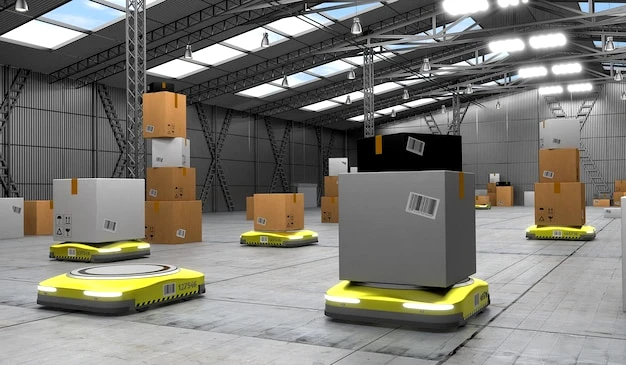
Warehouse automation is not only about industrial robots or fully dark facilities. It is a spectrum. At one end are basic conveyor lines and automated fire alarms. At the other end are integrated systems where Autonomous Mobile Robots navigate aisles using AI sensors, and Goods‑to‑Person solutions bring totes and racks straight to pickers. Between these extremes lie many hybrid scenarios.
In practice, a contemporary automated warehouse in Ukraine often combines Automated Guided Vehicles that follow defined paths for pallet transport, robotic pallet stackers for loading and unloading trucks without operators, and AI‑driven parcel sorters that send shipments directly to the correct dock or last‑mile route. These elements can be phased in over time to balance risk and payback.
When manual operations stop scaling
There is a clear threshold where manual operations in a warehouse near Odesa stop being efficient. This usually happens when daily throughput, SKUs, or order lines grow faster than the local labor market can support. Extra shifts and overtime only partially solve the issue and often create more errors.
In short, if you are expanding space, adding docks, and still cannot meet service level agreements, then the issue is process capacity rather than floor area. At this moment, robotics and AI start to look less like an innovation experiment and more like a necessary production tool that protects your margins.
🤖 What does an automated warehouse in Odesa look like in practice?
Layout and core equipment
An automated site in the Odesa region typically combines high‑bay storage with clearly separated inbound, storage, picking, and outbound zones. The building design must anticipate autonomous equipment flows, especially turning radiuses of vehicles and safety zones for people.
Core equipment often includes:
- Parcel sorters: Warehouse robots that sort parcels quickly and accurately by destination reduce manual scanning and errors.
- Conveyors and lifts: They connect floors and mezzanines and feed robotic pallet stackers or manual pick stations.
- Robotic pallet stackers: These systems automate loading and unloading of trucks, which cuts waiting time at docks.
- Automated storage modules: Compact storage units that feed items to Goods‑to‑Person workstations.
This combination lets investors reach higher throughput per square meter and per employee. It also gives planners more predictable process times, which improves slot booking at the port or rail terminal.
The role of AI, AMRs, and robots‑as‑a‑service
Autonomous Mobile Robots equipped with AI sensors can navigate dynamic environments. They detect people, pallets, and temporary obstacles and reroute in real time. This flexibility removes the need to rebuild the whole warehouse structure every time the product mix changes, because robotic systems can be reconfigured without major construction.
Some providers now offer warehouse robots on a subscription model, often called robotics as a service. For investors and tenants, this reduces the initial capital expenditure on automation. Instead of buying the full robotic fleet upfront, companies can spread costs and adjust fleet size if volumes change, which is especially relevant in the volatile Ukrainian market.
Integration with highway, port, and rail
For Odesa, integration with external infrastructure defines the productivity ceiling. A site that sits near the Odesa–Kyiv highway and has good access to the sea port, dry port, and rail node can receive and dispatch more trucks per day. Automation inside the warehouse ensures these trucks are processed fast enough.
According to best‑practice designs, a logistics complex with autonomous water supply, robust power feed of about 1 MW, a solar station, and 24/7 video surveillance creates a stable platform for automation. Once this base infrastructure exists, AI systems and robots can run with fewer interruptions and predictable energy costs, which matters greatly to the investment model.
📈 How to calculate when warehouse robotization pays off
Key cost components for investors
When assessing robotization, investors should separate building‑related costs from automation costs. Building costs cover land, construction of the main structure and shelter, office space, utilities, and safety systems such as automatic fire alarms and monitoring. Automation costs cover robotics hardware, software, integration, and future maintenance.
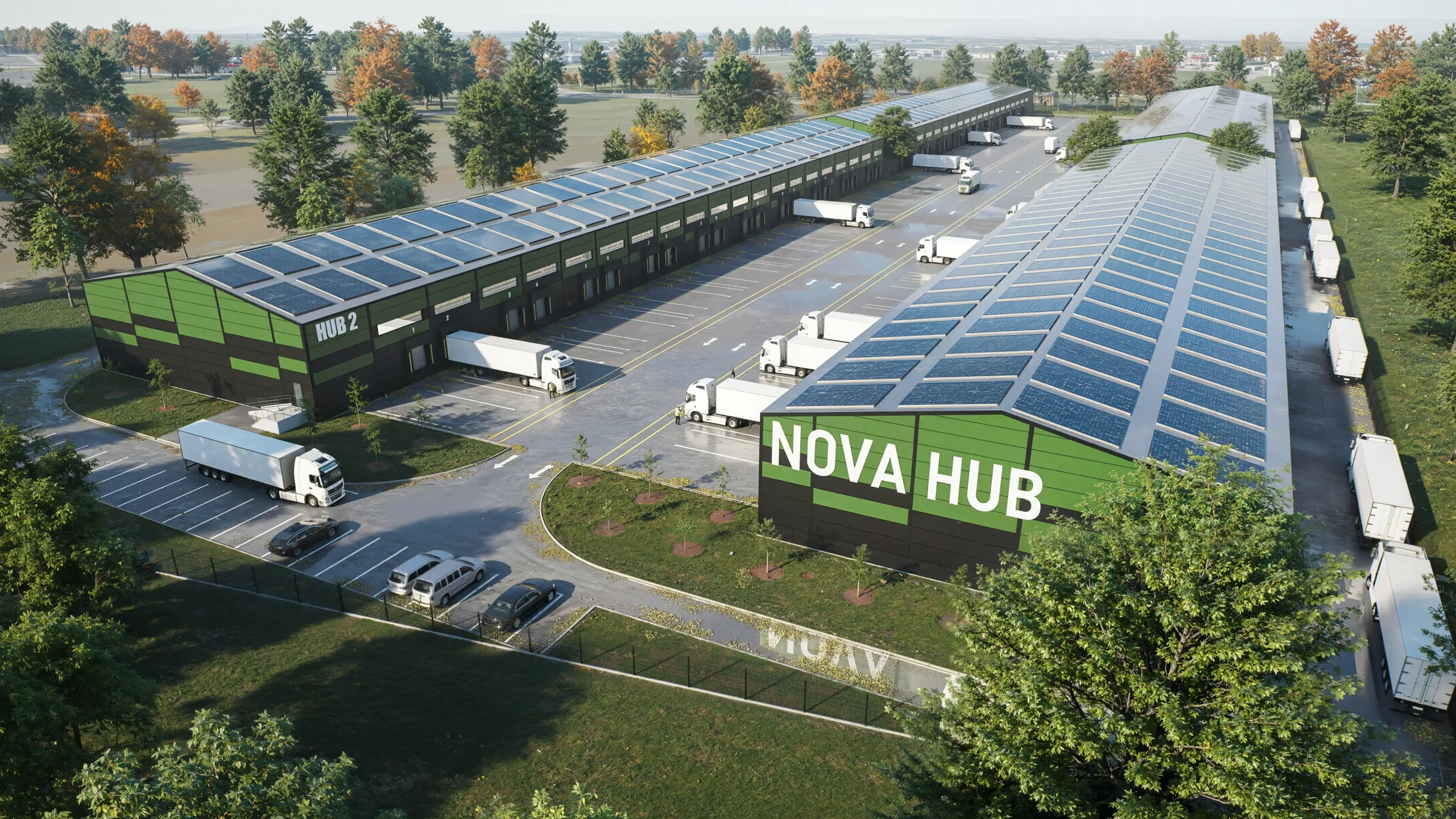
A modern logistics complex near Odesa might include about 41,970 m² of land, close to 19,200 m² of warehouse and auxiliary space, and roughly 2,460 m² of offices. The base construction can already have a defined payback period, for example around seven years, before any additional automation. Robots and AI then modify that curve through savings and additional revenue potential.
Savings and revenue drivers
Automation affects both cost and income. On the cost side, it reduces labor expenses and overtime, limits product damage, and cuts energy waste due to smarter routing and storage. On the revenue side, faster order processing can attract higher‑margin clients and enable value‑added services such as late cut‑off times or guaranteed next‑day delivery.
Warehouse robots also improve accuracy during parcel sorting by destination, which reduces the cost of returns and re‑delivery. Goods‑to‑Person systems cut picker travel distances and free up floor area, so more SKUs or clients can be supported within the same envelope. In a nutshell, the same building starts to generate more billed operations per year.
A simple payback model for automation
Investors often ask when robotization will pay off on top of the base construction. A simplified approach looks like this: define current manual operating costs, model automated operating costs, and calculate the annual savings plus extra revenue from improved service. Then compare this total benefit with the automation investment.
| Parameter | Manual operation | Automated operation |
|---|---|---|
| Average orders per hour | 100 | 200 |
| Staff on shift | 50 | 30 |
| Labor cost per year | 100% | ≈70% |
| Error / mis‑sort rate | High | Low |
If automation doubles throughput per hour and cuts labor costs by around 30 percent, while keeping the building and energy costs similar, then the incremental investment into robots can often be justified within a few years. For a logistics park that already has a seven‑year payback as pure real estate, adding robotization may reduce the combined payback to the range of five to six years, depending on pricing and utilization.
🏗️ Case: investing in a modern logistics center near Odesa
Site and infrastructure as a foundation for automation
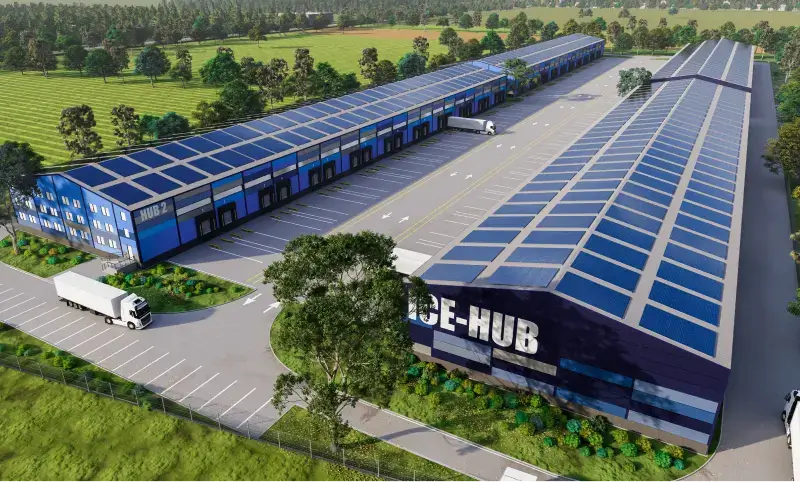
NovaHub promotes an investment concept for a logistics complex in the Odesa region with a clear focus on reliability, contemporary construction standards, and high European‑level quality. The total land area is just under 42,000 m², with about 19,174 m² of built space and over 2,400 m² of offices, which offers flexibility for both 3PL operators and single large tenants.
The site features autonomous water supply, a 1 MW electrical connection, solar generation for green energy, an automatic fire alarm system, 24/7 video surveillance, and a dedicated shelter. Project management is handled by a specialized team, with a general contractor responsible for construction quality and speed. Design, permitting, and construction are scheduled so that commissioning is expected around August 2026, which gives investors a clear timeline.
For more detailed parameters of this investment in a logistics complex, you can review the official NovaHub description of the investment in a modern logistics complex near Odesa.
Automation scenarios and payback horizon
The base project is designed so that both traditional and automated operations are possible. Robotization can be phased. For example, phase one may only introduce conveyor lines, sorting systems, and partial robotic pallet handling at cross‑docks. Phase two can add Autonomous Mobile Robots and Goods‑to‑Person modules once tenants reach specific volumes.
Given the estimated seven‑year payback for the construction itself, early introduction of automation for high‑volume tenants can potentially shorten the total payback to closer to six years, through higher rental rates and longer contracts. The regional mix of sea, road, and rail flows gives strong potential utilization, which is critical for any automation business case.
Stable income potential for investors
Investors in logistics real estate in Ukraine are primarily looking for predictable long‑term cash flow. A site that can support semi‑automated and fully automated operations attracts operators that sign multi‑year leases and invest in their own processes. This directly contributes to a more stable income from the warehouse asset itself.
From the investor’s perspective, the combination of strong physical infrastructure, green energy options, and future‑proof design for robotics reduces the risk of obsolescence. In summary, such a complex can serve as a resilient platform for both current manual operations and the gradual introduction of cutting‑edge automation technologies.
Key project milestones that matter for ROI
| Stage | Planned period | Impact on payback |
|---|---|---|
| Project design | April 2025 – November 2025 | Defines building readiness for robotics and energy efficiency. |
| Permitting | August 2025 – January 2026 | Locks in timelines that affect when tenants can start operations. |
| Construction start | January 2026 | Triggers main capital deployment. |
| Commissioning | August 2026 | Marks start of rental income and possible automation phases. |
Clear milestones reduce uncertainty for investors and make it easier to calculate net present value and internal rate of return for different automation scenarios.
⚖️ Pros and cons of warehouse automation for the Odesa market
Advantages of automating a logistics center
- Higher throughput: Robotic systems, including Automated Guided Vehicles and sorters, let the warehouse process more orders per hour within the same footprint.
- Lower operating costs: Automation leads to significant time savings and labor cost reduction, which is especially important where labor availability is volatile.
- Scalability and flexibility: Robotic systems can be reconfigured without changing the structural design, which helps respond to new clients or product types.
- Improved safety and quality: Robots handle heavy and repetitive tasks, while humans focus on supervision and exceptions, which reduces injuries and product damage.
- Tenant attractiveness: A modern logistics center with automation options attracts stronger clients who commit for longer terms.
Limitations and risks of robotization
- High initial investment: Even with robotics as a service, automation requires upfront planning, integration, and training that add to the baseline construction cost.
- Technology dependence: Operations become dependent on software, sensors, and networks, so downtime risk must be managed carefully.
- Market volatility: If cargo volumes or tenant demand drop, underutilized robots slow the payback period.
- Skill requirements: The workforce must be trained to manage and maintain robotic systems, which may be challenging in some regions.
- Complex integration: Connecting robots, warehouse management systems, and client IT platforms is not trivial and requires experienced partners.
Which businesses gain the most from automation
Not every operator needs a fully automated warehouse from day one. E‑commerce players, parcel carriers, and high‑turnover FMCG distributors around Odesa usually see the fastest payback, because they run many repetitive operations that robots can optimize. Companies with strong peaks linked to port schedules or seasonal exports also benefit from technologies that compress processing time.
For lower‑volume or project‑based logistics, a semi‑automated solution with shared robotic resources can be more reasonable. The key is to match the level of automation with stable long‑term demand, so that investors see predictable returns rather than speculative upside.
🚧 Common mistakes when automating a Ukrainian warehouse
Typical errors and how to avoid them
- No clear process baseline: Many companies jump into buying robots without first mapping and measuring their current processes. This leads to automation of waste instead of efficiency. A proper time‑and‑motion study before investment helps avoid this trap.
- Over‑automation from day one: Implementing the most complex robotic solution in a brand‑new facility can overload the team. Starting with core flows such as pallet movement and sorting, then scaling up, is usually safer.
- Ignoring maintenance and support: Some investors plan only the purchase price of robots, not ongoing service contracts, spare parts, and updates. This underestimation later harms uptime and financial performance.
- Underestimating change management: People are central to the success of any automated warehouse. Without training, communication, and clear new roles, staff resistance can slow adoption.
- No future‑proofing in construction: Designing a building only for manual operations limits future automation options. Considering power, floor flatness, and data infrastructure early makes later upgrades cheaper.
Why these mistakes are common in the region
In Ukraine, many logistics projects historically focused on quick build times and low cost per square meter. Automation was seen as an optional add‑on, not part of the core concept. As a result, process analysis and long‑term IT strategy often received less attention than physical construction.
To put it simply, success with warehouse robots in Odesa today requires a mindset shift. Investors and operators must treat automation as a strategic capability, not a gadget. NovaHub’s emphasis on speed and high construction quality, combined with planning for robotics readiness, directly addresses this challenge.
Correcting course before it is too late
Even if a project is already under way, some corrections are still possible. Additional conduits for data cables, reserved power capacity for chargers, and flexible mezzanine design can be introduced during construction rather than after commissioning.
For running facilities, a phased automation pilot in one zone of the warehouse allows the team to learn and refine processes before a full roll‑out. This reduces the risk of long downtime and gives real local data on performance gains and ROI.

🛠️ Practical recommendations before you invest in automation
Start with a joint audit and roadmap
Before committing capital, investors should commission a joint audit with logistics and automation specialists. This includes flow analysis, demand forecasts, and scenario modeling for different automation levels. The result should be a practical roadmap that aligns with the expected life cycle of the building and leases.
According to industry practice, it is better to define clear trigger points for each automation phase. For example, once daily order lines exceed a defined threshold, the operator introduces Goods‑to‑Person robots, or once dock utilization reaches a critical level, robotic pallet stackers are added.
Choose technology and partners carefully
Reliable partners are as important as the robots themselves. NovaHub focuses on robust design, modern construction standards, and adherence to high European norms, which gives a stable base for any automation project. On top of that base, experienced integrators can deploy AI‑driven systems with lower technical risk.
When comparing vendors, investors should look at references in similar environments, local service presence, update policies, and the possibility of robotics as a service contracts. A partner that can support both hardware and software over many years reduces operational uncertainty and protects your investment.
Implementation steps and realistic timelines
Experience shows that a structured implementation path greatly increases the chances of success. Typical steps include concept design, detailed design and simulation, installation, integration testing, ramp‑up, and continuous optimization. Each step must have clear owners and acceptance criteria.
For a greenfield project with construction completing in 2026, the concept and vendor selection for automation should ideally be finished during the design stage. This ensures that the building will be fully compatible. In summary, the earlier automation is integrated into planning, the smoother and cheaper the actual deployment will be.
Actionable tips for investors
- Define your target clients first: Clarify whether you are serving e‑commerce, FMCG, or industrial cargo, and size automation accordingly.
- Model at least three scenarios: Compare manual, semi‑automated, and highly automated operations with realistic volumes and tariffs.
- Secure sufficient power capacity: Plan for robot chargers and IT equipment from day one, not as an afterthought.
- Plan staff training early: Allocate budget and time for operators and technicians to learn new systems.
- Use pilots: Test critical automation modules on a smaller scale before expanding to the whole site.
- Align contracts: Ensure lease and service agreements reflect the complexity and value of automated operations.
🎯 When does robotization make sense for your Odesa warehouse?
Volume and labor thresholds
Robotization makes the most sense once a warehouse reaches stable, repeatable volumes that strain manual operations. Typical indicators are persistent overtime, high staff turnover, and a growing need to correct errors. If adding more people does not translate into proportional throughput, then automation becomes a rational option.
In the Odesa region, where port schedules and export campaigns can create intense peaks, AMRs and automated sorters help flatten those spikes without hiring and dismissing large temporary teams. This is particularly attractive for investors looking for long‑term efficiency rather than constant firefighting.
Strategic goals and risk profile
Automation is never only a technical decision. It reflects the strategic priorities of both the investor and the operator. Those who value premium service levels, resilience, and long‑term competitiveness accept a larger initial investment in exchange for future cost control and higher service quality.
More conservative investors may choose a building that is “automation‑ready” but deploy robots later once a major tenant signs. This still protects the long‑term value of the asset while pacing capital deployment in line with actual demand.
How NovaHub helps align automation with investment goals
NovaHub’s approach combines reliable construction, fast project delivery, and logistics‑oriented design. This means the physical warehouse is already prepared for future automation in terms of layout, utilities, and safety. From there, specialized partners can layer AI and robotics without structural rework.
As a result, investors can treat automation as a flexible module that enhances a solid logistics asset, rather than a risky all‑or‑nothing bet. Over time, this creates a more stable income from the warehouse, since attractively located and technologically advanced facilities tend to keep quality tenants even in turbulent markets.
✅ Conclusion and next steps for investors
Key takeaways in a few sentences
An automated warehouse in Odesa pays off when stable cargo volumes, rising labor costs, and service pressure converge and can be addressed by robotics and AI. A strong physical platform with reliable utilities, safety systems, and thoughtful design, such as the NovaHub logistics complex, makes it much easier to phase in automation with controlled risk. When modeled correctly, robotization can shorten the combined payback period of construction and equipment, and secure long‑term tenants who value advanced logistics capabilities.
Holiday‑season perspective and gentle invitation
As the New Year approaches and businesses plan their strategies with optimism and fresh budgets, it is a good moment to review how your logistics assets will perform in the coming years. A future‑ready, modern logistics center with the option to deploy warehouse robots can become a powerful competitive advantage and a source of steady, predictable income. If you want your next holiday season shipments to move through a smarter, safer facility, explore NovaHub’s projects and consider how a well‑planned automated complex near Odesa can support your long‑term goals.
Below are selected references that support the concepts discussed above and reflect current industry understanding of warehouse automation and logistics investments.
- Industry analysis: Warehouse robots and AI navigation
- Investment best practices: Logistics real estate development
- Regional context: Ukrainian logistics and port infrastructure
According to a range of logistics technology reports, automation in warehouses leads to substantial time savings and lower labor costs, particularly when combined with AI‑driven navigation and parcel sorting.
— Global Logistics Automation Report (2023)
Additional reading may include:
- — Statista Research (2024)
- — Forbes Technology Council
- — Industry Report by McKinsey
- — European Logistics Real Estate Review
FAQ
What makes Odesa a strong location for an automated warehouse?
Odesa combines access to a sea port, a dry port ecosystem, railway connections, and the Odesa–Kyiv highway. This concentration of transport modes increases potential cargo volumes, which in turn supports the business case for automation and a modern logistics center.
How long is the expected payback period for the NovaHub logistics complex near Odesa?
The base construction of the complex is designed for an estimated payback period of about seven years. When automation is added for suitable tenants, increased throughput and higher rental rates can shorten the combined payback, often targeting a five to six year horizon depending on utilization.
Which types of robots are most relevant for a new warehouse in the Odesa region?
For this market, Autonomous Mobile Robots, Automated Guided Vehicles, robotic pallet stackers, and goods‑to‑person systems are particularly useful. They help automate pallet movement, parcel sorting by destination, and picking operations without major changes to the warehouse structure.
Can I start with a manual operation and add automation later?
Yes, if the building is designed as automation‑ready from the start, including sufficient power, data infrastructure, and appropriate layout. The NovaHub project near Odesa is structured to support both manual and phased automation scenarios, which lets you invest in robots once volumes justify it.
What are the most common mistakes when implementing warehouse automation in Ukraine?
Typical mistakes include skipping a detailed process baseline, over‑automating from day one, underestimating maintenance and support needs, neglecting change management, and failing to future‑proof the building. Addressing these points early improves ROI and operational stability.
How does automation influence the stability of warehouse rental income?
Automation makes a warehouse more attractive to high‑quality tenants that need reliable, high‑throughput operations and are willing to sign longer‑term leases. This helps investors secure a more stable income from the warehouse asset over time, even in a volatile market.
When is the right moment to consider robotization for my Odesa facility?
The right moment typically arrives when manual operations struggle to keep up despite adding space and staff. Persistent overtime, higher error rates, and missed service levels are strong signals. At that point, a feasibility study on automation can clarify the potential payback.
What role does robotics as a service play in reducing investment risk?
Robotics as a service lets you access warehouse robots through subscription rather than full upfront purchase. This model spreads costs over time and allows you to adjust fleet size if volumes change, which is valuable in a market where demand can be unpredictable.
How far in advance should automation be planned relative to construction?
Ideally, concept design and vendor pre‑selection for automation should occur during the building design stage. For a facility planned for commissioning in August 2026, integration thinking should start during the 2025 design and permitting phases to avoid costly modifications later.