

A well-designed ecological warehouse can be financially attractive. NovaHub’s Class A complex near Odesa targets a 7-year payback by combining solar energy, autonomous utilities, and strategic location to enhance rentability and resilience.
Warehouse and logistics investors are under pressure to square two demands at once. On one side tenants expect reliable, Class A infrastructure close to key transport corridors. On the other, regulators and customers are pushing for lower carbon footprints, energy efficiency, and resilient supply chains. The question many boards ask is not whether green design looks good in presentations, but whether it delivers a measurable return.
This article explores when an ecological warehouse complex can outperform a conventional facility in financial terms. We will unpack the business model of modern Class A logistics, show how energy and resource efficiency translate into cash flows, and use the NovaHub project near Odesa as a concrete reference. You will see the main advantages and risks, common mistakes to avoid, and a practical roadmap for structuring an investment in a sustainable logistics complex.
Along the way we will look at why the profitability of a warehouse complex increasingly depends on energy autonomy, location quality, and professional project management rather than on construction cost alone.
What makes a warehouse complex ecological today?
Energy and power autonomy
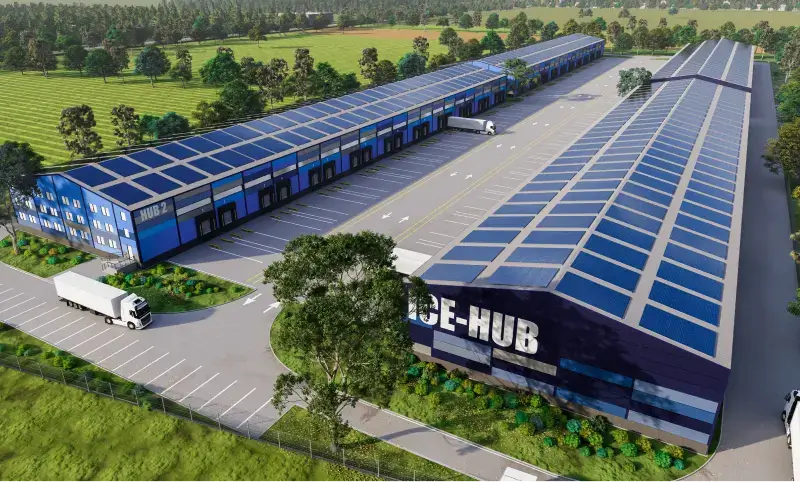
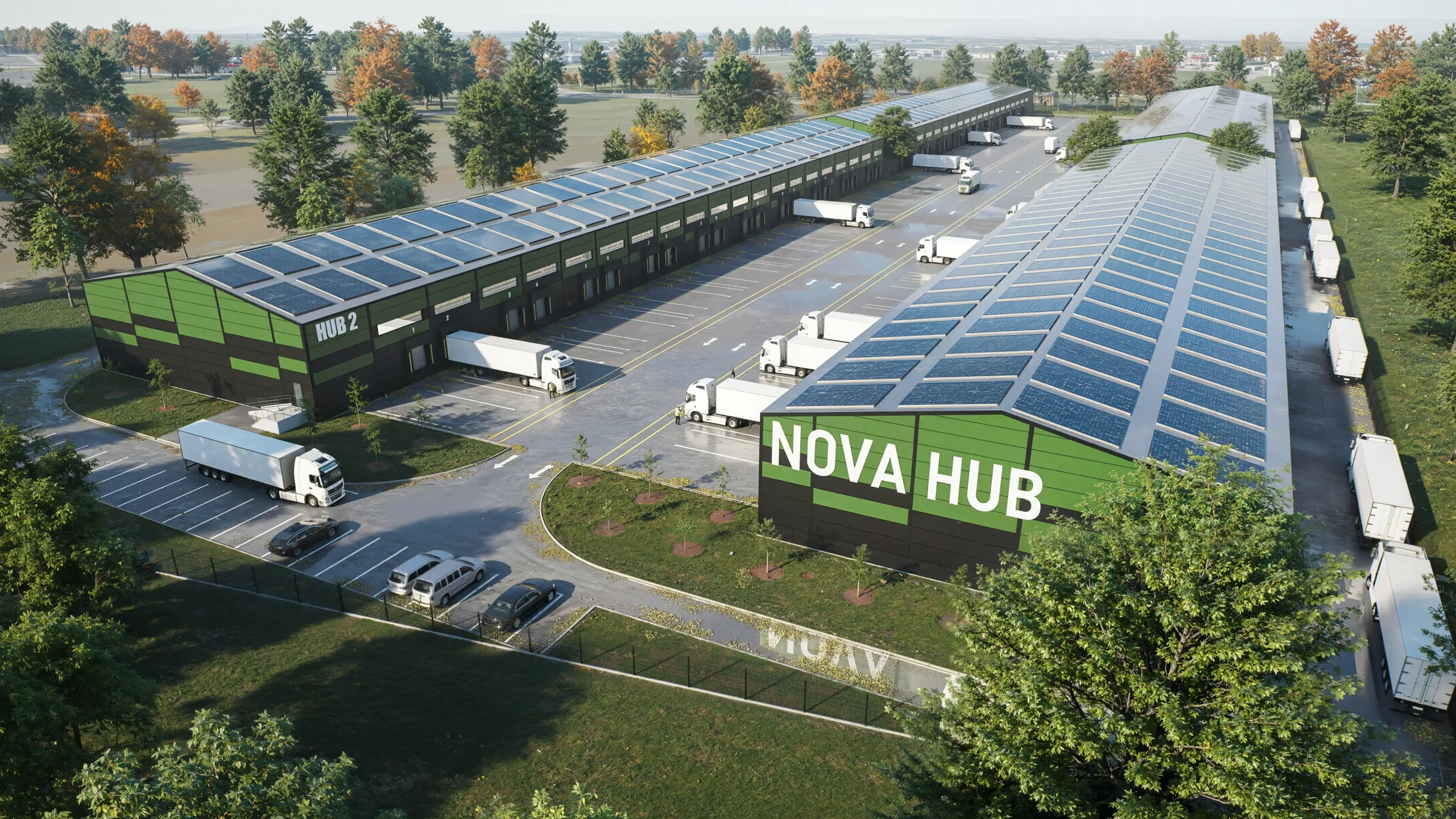
In practical terms, the core of an ecological warehouse is its energy concept. NovaHub’s innovative complex uses a solar power station to cover a significant part of its electricity demand and is supported by a dedicated 1 MW power supply capacity. This limits exposure to grid price volatility and outages, which is critical for temperature-sensitive or time-critical cargo.
For investors, this setup reduces operating expenses over time and creates a clear marketing advantage for tenants with ESG commitments. In short, energy autonomy is no longer a bonus feature. It is a long-term hedge on operating costs and business continuity that can support higher rental rates and better tenant retention.
Resource-efficient building design
An ecological facility must also respect land and building efficiency. The NovaHub project combines a total land area of 41,970 m² with a total complex area of 19,174 m² and office space of 2,460 m². This mix allows for efficient circulation, parking, and maneuvering while still offering a compact, revenue-generating footprint.
Working heights between 8 and 12 meters support high-density storage and modern racking systems, which means more pallet positions per square foot of built area. Over the investment horizon, that density directly affects rental income potential and makes the property more competitive as a Class A asset.
Location and transport impact
Transport emissions typically account for a major share of logistics carbon footprints. That is why the location of an ecological warehouse matters as much as its walls and roof. NovaHub’s complex is positioned close to the Odesa–Kyiv highway, the sea port, a dry port, and railway infrastructure, which reduces empty mileage and transit times for tenants.
From an investor’s point of view, this type of multimodal accessibility supports higher occupancy, diversified tenant profiles, and reduced default risk. It also enables users to cut fuel costs and delivery times, which strengthens the value proposition when negotiating lease terms.
How does a green logistics facility earn money?
Revenue streams of a Class A warehouse
The basic revenue model of a Class A ecological warehouse is familiar. The owner generates income from leasing storage and office space, plus ancillary revenues such as yard usage, technical services, and sometimes value-added logistics services provided on-site by third parties.
Where a green asset differs is in its ability to attract tenants that value reliable power, modern safety systems, and ESG-aligned infrastructure. Features such as automatic fire alarms, 24/7 video surveillance, and a dedicated shelter increase perceived quality. This can justify slightly higher base rents and longer lease terms, which stabilizes cash flow and supports the asset valuation.
Cost structure and where savings appear
Upfront capital expenditure for an ecological facility is often higher, especially when a solar plant and robust autonomous utilities are included. However, operating expenses for electricity and sometimes water are lower and more predictable over time. This is especially relevant for facilities with continuous operations or energy-intensive tenants.
Over a planned payback period of 7 years, these savings can significantly improve net operating income. According to logistics industry analyses, energy-efficient warehouses tend to show lower total occupancy costs for tenants, which in turn reduce vacancy and re-leasing risk for owners.
Why energy autonomy matters for margins
Energy autonomy is not only about saving on bills. It reduces downtime risk, protects temperature-controlled storage, and supports critical IT and automation systems during grid instability. That resilience is valuable enough that many occupiers are prepared to sign longer leases or agree to triple-net structures where they carry more operating costs.
For investors, this resilience converts into lower perceived risk and potentially tighter capitalization rates at exit. Put differently, a technically resilient building with solar generation, strong power capacity, and robust safety systems can command a premium in both rental and sale markets.
Case study: NovaHub’s ecological logistics complex near Odesa
Site parameters and technical concept
The NovaHub ecological logistics complex near Odesa illustrates how sustainable design and investor economics can align. The project is planned on 41,970 m² of land with 19,174 m² of built warehouse and 2,460 m² of office space. Working heights of 8–12 meters place it firmly in the Class A category.
The facility combines an autonomous water supply with a 1 MW power connection and an on-site solar plant, creating a high level of utility independence. Security and safety are reinforced through an automatic fire alarm, round-the-clock video surveillance, and a dedicated shelter. Each resident receives ownership of their land plot, which is a strong differentiator on the Ukrainian market.
Timeline and project governance
Project management is handled by TOV “SK GROUP” (SK GROUP LLC), while TOV “BAU-CENTER” acts as general contractor. The schedule is clearly structured. Design works are planned from April 7, 2025 to November 28, 2025. Permitting is scheduled from August 18, 2025 to January 9, 2026.
Construction is set to begin on January 15, 2026, with commissioning targeted for August 2026. This tight calendar reflects a focus on speed and quality that matches NovaHub’s positioning as a provider of modern, European-standard logistics infrastructures.
Payback expectations and risk profile
The project is structured around a 7-year investment payback period. This horizon is realistic for a high-spec Class A warehouse in a strategic corridor, especially when supported by energy savings from the solar power station and stable rental demand from the Odesa–Kyiv logistics flow.
To better understand the profile, compare some of the project’s core attributes in the table below.
| Parameter | NovaHub complex near Odesa |
|---|---|
| Total land area | 41,970 m² |
| Total complex area | 19,174 m² |
| Office space | 2,460 m² |
| Working height | 8–12 m (Class A) |
| Power capacity | 1 MW plus solar plant |
| Water supply | Autonomous |
| Security systems | Automatic fire alarm, 24/7 video surveillance, shelter |
| Payback period | 7 years (planned) |
These parameters combine into an investment project in Odesa that targets both operational resilience and long-term financial stability, with professional oversight by SK GROUP and BAU-CENTER.
For more details on the investment in logistics complex concept, you can review the overview provided by NovaHub.
Pros and cons of investing in an ecological warehouse complex
Key advantages
Any capital-intensive asset has trade-offs. For ecological logistics complexes the balance often comes out positive, but only when the investor understands both sides clearly.
- Lower long-term operating costs: Solar generation and efficient utilities can reduce energy expenses and buffer against price shocks over the asset’s life.
- Stronger tenant appeal: Class A specifications, ESG alignment, and modern safety systems attract higher quality tenants with longer planning horizons.
- Resilience and continuity: Autonomous water, reliable power, and a protected shelter improve business continuity in unstable conditions.
- Higher exit attractiveness: Institutional buyers increasingly favor sustainable assets, which can support better valuation metrics at sale.
- Regulatory readiness: Green design anticipates tighter environmental rules, lowering compliance risk in future.
Main limitations and risks
Balanced decision-making also requires an honest look at the constraints and exposure associated with green logistics assets.
- Higher initial CAPEX: Solar plants, high-spec envelopes, and advanced safety systems increase upfront investment compared to basic warehouses.
- Technology complexity: Operating and maintaining renewable energy and automation requires specialized service partners.
- Market education: Some local tenants may still focus only on base rent, underestimating total cost of occupation and the value of green features.
- Regulatory uncertainty: Permitting processes can become more complex when multiple autonomous systems are integrated.
- Concentration risk: Investing heavily in a single logistics location requires careful analysis of regional trade flows and geopolitical context.
When the balance is attractive
The trade-off becomes attractive when three conditions are met. First, there is stable or growing demand for Class A warehousing in the region, as seen along the Odesa–Kyiv corridor. Second, energy costs or grid reliability risks are material enough to justify autonomous systems.
Third, the investor has or can secure professional partners, like SK GROUP for project management and BAU-CENTER as general contractor, to deliver the asset to specification and on schedule. When these conditions align, the ecological concept tends to outperform a traditional build in risk-adjusted returns.
How to evaluate the profitability of a warehouse complex
Core financial metrics
To assess the profitability of a warehouse complex, investors usually start with net operating income, internal rate of return, and payback period. For the NovaHub project, a 7-year payback is the guiding benchmark that combines lease-up assumptions, rental levels, and operating expenses.
It is wise to model scenarios with conservative, base, and optimistic rental rates, as well as varying occupancy levels. This makes it easier to see how much of the profitability depends on green features such as the solar plant and energy autonomy.
Scenario modeling for green features
A practical approach is to compare an ecological design with a hypothetical traditional warehouse on the same site. The table below illustrates a simplified conceptual comparison.
| Aspect | Ecological design (NovaHub-like) | Conventional design |
|---|---|---|
| Energy source | Grid plus solar plant | Mainly grid power |
| Operating energy cost | Lower and more stable | Higher and more volatile |
| Tenant appeal | High for ESG-focused clients | Moderate |
| Base construction cost | Higher | Lower |
| Risk of downtime | Lower due to autonomy | Higher in outages |
| Expected payback | Around 7 years (planned) | Depends strongly on tariffs and demand |
By quantifying these differences, an investor can decide whether the ecological add-ons improve the return profile enough to justify their cost, given the local market conditions.
Land ownership and exit value
Another profitability driver is ownership structure. At the NovaHub complex, each resident obtains a land plot with property rights. This structure can make the offer more attractive for users that want balance-sheet assets, not just lease liabilities.
For the investor or developer, this affects exit strategy. They can sell built-to-suit units with land, retain parts of the complex as income-producing assets, or package the entire site as a stabilized investment for an institutional buyer. Flexibility in exit routes often improves long-term risk-adjusted returns.
Common mistakes in green warehouse investments
Overestimating demand for Class A space
A frequent error is assuming that every logistics user in a region is ready to pay a premium for Class A and green features. In practice, some segments remain extremely price-sensitive and do not value ESG or autonomy enough to justify higher rents.
Investors should map current and potential tenants, focusing on those who benefit most from power reliability, temperature stability, and compliance. This reduces the risk of slower lease-up and protects the planned payback period.
Underbudgeting technical systems
Another mistake is treating solar plants, autonomous water systems, and safety infrastructure as afterthoughts instead of core design elements. When these systems are not properly engineered and costed from the start, projects face overruns or performance shortfalls.
Working with experienced technical teams and contractors, as NovaHub does with BAU-CENTER, helps ensure that specifications and budgets are realistic. This is essential to keep the profitability of a warehouse complex on target.
Weak project management and partners
Complex ecological facilities involve many stakeholders. Without strong project management, design, permitting, and construction can easily slip, leading to delays and unplanned costs. This is particularly risky when projects follow tight commissioning timelines.
Professional coordinators such as SK GROUP provide a single point of responsibility for schedules, quality control, and communication. Investors who underestimate this role often face longer payback periods than planned.
Ignoring regulatory and grid realities
Some investors rely on optimistic assumptions about grid connections, permits for solar capacity, or environmental approvals. When these assumptions prove false, the project design must be changed late in the process, increasing cost and complexity.
Early engagement with competent local advisors and authorities reduces these surprises. It also ensures that ecological claims are supported by real, compliant systems, not just marketing rhetoric.

Practical steps to launch an investment project in Odesa’s logistics market
Pre-investment due diligence
Before committing capital, investors should assess regional cargo flows, the role of the Odesa sea port and dry port, and the importance of the Odesa–Kyiv corridor for national and international trade. This provides a basis for estimating tenant demand and acceptable rental ranges.
In addition, technical due diligence of potential land plots must cover access roads, existing utilities, environmental conditions, and any zoning constraints. These factors can significantly affect the cost and feasibility of an ecological design.
Designing and permitting
Once a site is selected, the design phase must integrate Class A specifications, working heights of 8–12 meters, and the full utility concept including solar power and autonomous water. As the NovaHub schedule shows, a thorough design can require several months to complete.
Permitting should run in parallel where possible. Engagement with authorities early in the process helps clarify expectations around safety systems, fire protection, and environmental compliance, which in turn protects the project timeline.
Construction and commissioning
With permits in place, construction can proceed under a general contractor with clear performance obligations. NovaHub’s plan to start building in January 2026 and commission by August 2026 illustrates a compressed but achievable timeline when responsibilities are well defined.
Commissioning should include full testing of the solar plant, power infrastructure, water systems, fire safety, and surveillance. Tenants can then move into a fully operational, reliable facility, which supports immediate income generation for investors.
Practical recommendations for investors considering NovaHub
Who this format suits best
In practice, an ecological warehouse complex near Odesa is best suited to investors with a medium- to long-term horizon who value both cash flow and asset quality. It fits portfolios that seek exposure to logistics but also want strong ESG credentials.
It can be especially attractive for investors aligned with international partners or funds that now prefer sustainable, Class A warehouses over lower-grade stock that may face obsolescence risks.
How to work with NovaHub
NovaHub specializes in the sale and construction of modern warehouses and logistics complexes with high European standards. Investors can collaborate on tailored configurations of warehouse and office space within the planned 19,174 m² of built area.
Because each resident receives a land plot with ownership rights, cooperation formats can include both long-term lease income structures and partial or full unit sales. NovaHub’s focus on reliability, speed, and quality supports investors that value clear timelines and predictable execution.
Risk mitigation checklist
To wrap this into actionable guidance, consider the following measures when evaluating an ecological logistics investment.
- Validate demand: Confirm interest from target tenant segments that benefit from energy autonomy and Class A specifications.
- Stress-test economics: Model different energy price and occupancy scenarios over at least a 7-year horizon.
- Lock in expertise: Engage professional project managers and contractors experienced with solar, safety, and autonomous utilities.
- Plan for resilience: Include shelters, robust security, and redundancy as core elements, not options.
- Align exit strategy: Decide in advance whether you plan to hold for income, sell units with land, or package a stabilized complex for institutional buyers.
Conclusion
In many cases, a well-designed ecological warehouse complex can outperform a traditional facility by combining lower operating costs, higher tenant appeal, and stronger resilience. The NovaHub project near Odesa shows how solar energy, autonomous utilities, and Class A standards can be integrated into a coherent investment case with a 7-year planned payback.
The key success factors include realistic demand assessments, disciplined project management, and careful attention to technical and regulatory details. When those are in place, green design becomes a financial advantage rather than a cost burden.
For investors seeking reliable, modern logistics exposure in Ukraine, NovaHub offers a structured, professionally managed route into sustainable warehouse assets with clear timelines and quality benchmarks.
Sources
— Statista Research (2024)
— McKinsey Global Institute, Logistics and Infrastructure Report
— Forbes Real Estate Council
— World Green Building Council
— Internal NovaHub project documentation
Frequently Asked Questions
What is the planned payback period for the NovaHub ecological warehouse complex?
The NovaHub ecological logistics complex near Odesa is structured around a planned 7-year investment payback period. This figure reflects expected rental income, occupancy, and operating cost savings from features like the solar power plant.
What are the key technical parameters of the NovaHub facility?
The project includes 41,970 m² of land, 19,174 m² of total complex area, and 2,460 m² of office space. Working heights range from 8 to 12 meters, with autonomous water supply, 1 MW power capacity plus a solar plant, and advanced safety and security systems.
Who manages and builds the NovaHub ecological warehouse complex?
Project management is provided by TOV “SK GROUP” (SK GROUP LLC), while TOV “BAU-CENTER” serves as the general contractor. This division of roles helps ensure professional oversight of design, permitting, construction, and commissioning.
How does the NovaHub location near Odesa improve profitability?
The complex is strategically located near the Odesa–Kyiv highway, the sea port, a dry port, and railway infrastructure. This multimodal access reduces transport time and cost for tenants, supporting higher occupancy and more stable rental income for investors.
What are the main advantages of investing in an ecological warehouse complex?
Key benefits include lower long-term energy costs, stronger appeal to ESG-focused tenants, improved resilience through autonomous utilities and shelters, and higher attractiveness for institutional buyers seeking sustainable assets. Together, these factors can enhance long-term returns.
What typical mistakes should investors avoid in green logistics projects?
Common errors include overestimating demand for premium Class A space, underbudgeting technical systems like solar and safety infrastructure, and neglecting professional project management. These issues can delay commissioning and extend the payback period.
How long is the expected design and construction timeline for the NovaHub project?
Design is planned from April 7, 2025 to November 28, 2025, with permitting running from August 18, 2025 to January 9, 2026. Construction is scheduled to start on January 15, 2026, and commissioning is targeted for August 2026.
How do land ownership rights work for residents at the NovaHub complex?
Each resident at the NovaHub ecological warehouse complex receives a land plot with ownership rights. This structure allows users to hold a real property asset on their balance sheet rather than only a lease obligation.
How does the solar power plant influence the warehouse’s financial performance?
The solar plant reduces dependence on grid electricity, which lowers operating energy costs and makes them more predictable. Over the 7-year payback period, these savings improve net operating income and can support more attractive lease terms for both tenants and investors.
Why is professional project management critical for a project like NovaHub?
Ecological warehouses integrate complex systems such as solar generation, autonomous water, and advanced safety technologies. Professional project management, as provided by SK GROUP, coordinates these elements, keeps the schedule on track, and protects the investment case from cost overruns.