


Ukrainian logistics offers high-risk, high-potential investments. Focusing on multimodal locations, European-standard construction, backup utilities, and professional management can support a realistic seven-year payback and resilient long-term returns.
📦 Why logistics investments in Ukraine deserve a closer look
Despite war-related disruption, Ukraine’s logistics sector continues to operate, adapt, and attract strategic capital, especially around Odesa and key export corridors. Investors see a rare combination of long-term demand, structural undersupply of modern warehouses, and attractive entry prices. At the same time, the risk profile remains high and requires a very disciplined approach.
This article explains where the main risks lie when considering investments in Ukrainian logistics, how to assess them, and which tools can reduce your exposure. We will examine market and operational threats, construction and technical risk, regulatory and contractual issues, and the specific impact of the war. The article also shows how a modern logistics hub such as the NovaHub complex near Odesa can structure risk, improve the return on real estate investments, and support a predictable payback of investments in warehouse real estate.
🚢 What makes Ukrainian logistics strategically important for investors?
How war reshaped transport routes and demand
The full-scale war has forced Ukrainian exporters to rethink their logistics chains almost continuously. Port blockades and attacks on infrastructure in Odesa created interruptions in sea shipments. Exporters responded with a mix of Danube river ports and western land borders, including rail and road crossings to EU states.
According to industry summaries, the ports of Odesa still processed 96,298 TEU in the first half of 2025. This shows that maritime logistics did not stop, yet it operates in a more volatile environment. Diversification of routes is now essential for exporters, which increases the strategic value of inland logistics hubs, dry ports, and warehouse complexes that can buffer and redirect flows.
The role of Odesa as a logistics gateway
Odesa remains the country’s key maritime gate for container and bulk cargo. However, war risk has changed its business model. Insurance premiums for the Black Sea fluctuate sharply, and the number of shipping lines ready to serve Ukrainian ports is still limited. This affects schedules and capacity planning for shippers.
At the same time, Odesa has an advantage compared with some EU ports. Polish terminals, for example, apply more complex veterinary and sanitary controls for agro-commodities, which slows cargo. For many Ukrainian exporters it is still more efficient to consolidate in the Odesa region, store products in a modern logistics hub, and then ship through whatever window the market and security situation provide.
Why modern logistics real estate is in focus
There is a structural shift in demand. E-commerce and 3PL providers need reliable, energy efficient, secure warehouse space with good transport access. Older Soviet-era buildings do not meet modern standards for floor load, fire safety, and operations, and are often energy intensive.
Investments in Ukrainian logistics assets that meet European construction standards can therefore combine downside protection with upside potential. In simple terms, tenants are ready to pay for facilities that protect their cargo, secure uptime, and help them comply with safety and insurance requirements.
⚠️ What are the main risks of investing in Ukrainian logistics?
Market and geopolitical risks
The most visible risk is military escalation. Attacks on port and logistics infrastructure in the Odesa region immediately increase insurance costs and risk premiums. This often translates into higher commodity prices and volatility in export volumes.
Shipping schedules remain unstable. The number of shipowners that accept calls to Ukrainian ports is still limited. Freight rates and war risk insurance can change within days, which influences warehouse occupancy, cargo turnover, and the pace of rental negotiations.
Operational and route risks
Logistics routes can change with little warning, for example when a border crossing is overloaded or a river draft limit is introduced. Operators who rely on a single route or mode can face costly downtime.
Additionally, infrastructure damage or congestion can create sudden capacity constraints. Warehouses without backup systems or alternative access roads are more exposed to disruption than multi-modal complexes located near major highways, ports, and rail.
Construction and technical risks
Another layer of risk is technical. Logistics warehouses are complex engineering systems. If the developer ignores European standards for floor loads, fire safety, and energy systems, investors may face hidden CAPEX later or even structural safety issues.
Buildings without autonomous utilities, sufficient electrical capacity, or backup power can lose tenants in a crisis. Poor design of circulation areas, ceiling height, and loading docks reduces operational efficiency and makes assets less competitive.
Financial and contractual risks
Delayed projects or unclear agreements can transform an attractive investment into a long legal dispute. Without transparent contracts and professional property management there are higher risks of cost overruns, unpaid rent, and inefficient operating expenses.
In some cases investors underestimate the importance of a management company that can control receivables, interact with tenants, and keep operating costs in check. This directly affects the return on real estate investments over the full cycle.
📊 Pros and cons of investing in Ukrainian logistics real estate
Main advantages for long-term investors
For clarity, the lists below summarize key strengths and limitations of this asset class in the current environment.
- Strategic location: Ukraine connects EU markets with the Black Sea and further to Asia, and Odesa remains a critical maritime gate even during war.
- Growing demand drivers: Expansion of e-commerce and 3PL services keeps pushing demand for modern, safe, and energy efficient warehouse space.
- Attractive entry pricing: Risk-adjusted pricing can be favorable compared with more mature EU markets, especially for projects with clear risk mitigation.
- Modern engineering standards: New complexes that follow European norms for logistics buildings offer competitive specifications and lower technical risk.
- Professional asset management: Cooperation with experienced management companies can improve operating margins and stabilize cash flow.
Key limitations and challenges
- War-related volatility: Military action around ports and key infrastructure creates unpredictable shocks for cargo flows and rental demand.
- Route and regulatory uncertainty: Changes in border procedures, customs regimes, and inspection rules can disrupt established transport chains.
- Insurance and freight exposure: Insurance premiums and freight rates are sensitive to security incidents in the Black Sea region, which affects tenants’ ability to plan.
- Project execution risk: Weak contractors or non-transparent agreements can lead to delays, overruns, or quality problems that damage returns.
- Financing constraints: Some international lenders remain cautious about Ukrainian assets, which can limit leverage or increase borrowing costs.
Illustrative risk profile table
| Risk category | Impact on investor | Typical mitigation tools |
|---|---|---|
| Geopolitical / war | Occupancy volatility, temporary asset downtime | Diversified tenants, shelters, backup utilities, strong insurance |
| Route / market | Cargo volume fluctuations, renegotiation of leases | Multi-modal access, focus on flexible 3PL and e-commerce tenants |
| Construction / technical | Unexpected CAPEX, reduced asset lifespan | European standards, reputable contractor, independent supervision |
| Financial / contractual | Lower yields, cash flow gaps, disputes | Transparent contracts, professional property management |
🏗️ How NovaHub’s Odesa logistics complex structures risk and returns
Location and transport connectivity
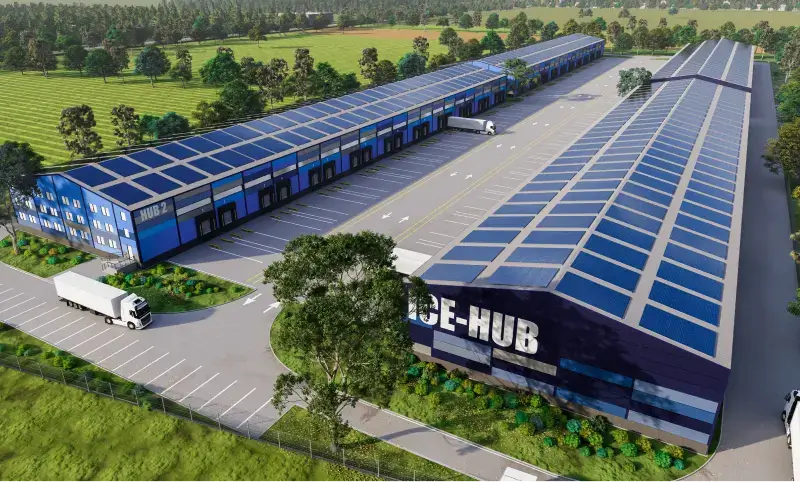
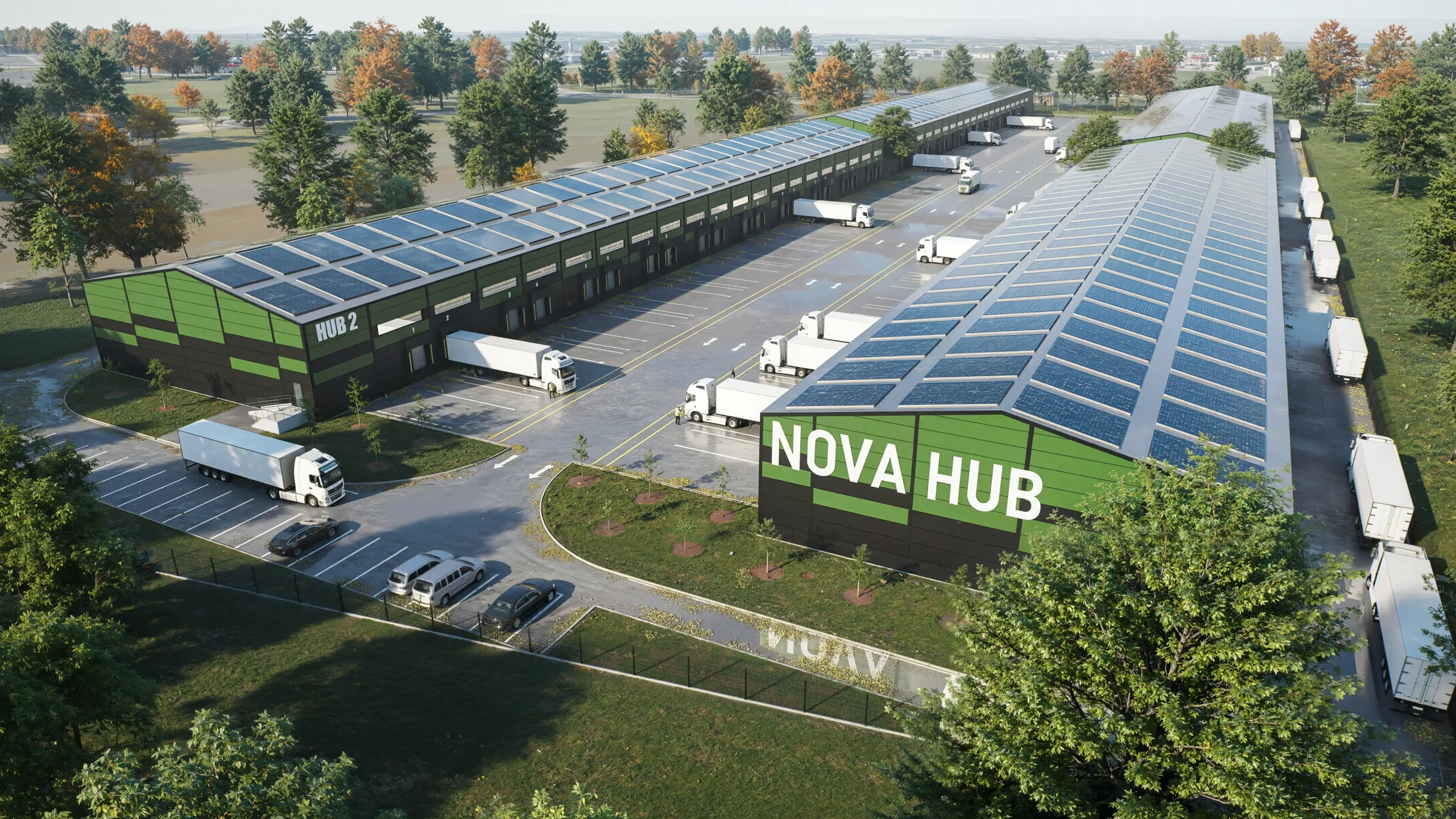
The planned NovaHub complex near the Odesa–Kyiv highway illustrates how a logistics hub of Ukraine can be designed with risk mitigation in mind. The site combines fast access to the highway with proximity to the sea port, a dry port, and rail infrastructure.
This location supports multimodal logistics. Cargo can be received from the sea, consolidated in the hub, and then moved by rail or road to western borders, or vice versa. For investors this reduces dependence on a single route and enhances resilience in case one corridor is temporarily blocked.
Technical specifications and engineering resilience
The total land area of the NovaHub project is planned at 41,970 square meters. The complex itself will have 19,174 square meters of built area, of which 2,460 square meters are office premises integrated into the logistics facility.
The project includes autonomous water supply and an electrical capacity of 1 MW. A solar power station will supply green energy and improve energy resilience. The design incorporates an automatic fire alarm system, 24/7 video surveillance, and a shelter, which addresses both safety and continuity of operations in a high-risk region.
Construction quality and project governance
NovaHub focuses on European standards in the design and construction of logistics buildings to minimize technical risks. This approach is important for floor load capacity, ceiling height, structural durability, fire safety, and the overall engineering systems that define warehouse functionality.
Project management is provided by TOV “SK GROUP”, with TOV “BAU-CENTER” acting as general contractor. A defined schedule plans design work from April 7, 2025 to November 28, 2025, permitting from August 18, 2025 to January 9, 2026, the start of construction on January 15, 2026, and commissioning in August 2026. Clear milestones and responsible parties are essential to reduce project execution risk.
Payback and return expectations
In short, the payback period for investment in this logistics complex is projected at 7 years. For warehousing real estate in an emerging, high-risk market, a seven-year payback can be attractive when combined with strong technical standards and a strategic location.
NovaHub uses transparent agreements and an emphasis on build quality to support long-term occupancy and rental stability. This directly influences the payback of investments in warehouse real estate and helps investors manage their expected internal rate of return over the asset life cycle.
| Parameter | NovaHub Odesa complex | Typical older warehouse in region |
|---|---|---|
| Total land area | 41,970 m² | Smaller plots with limited expansion potential |
| Built area | 19,174 m², incl. 2,460 m² office | Mixed-use, often fragmented, smaller office share |
| Power and utilities | 1 MW supply, own water, solar plant | No backup power, higher energy losses |
| Safety and security | Fire alarm, 24/7 CCTV, shelter | Basic or outdated safety systems |
| Standards | European-grade logistics engineering | Legacy construction, limited floor loads |
Investment in logistics complex by NovaHub shows how focusing on reliability, speed of execution, and European-level quality can reshape the risk profile of Ukrainian logistics real estate.
📈 How to evaluate returns and payback in Ukrainian logistics
Understanding the revenue drivers
The return on real estate investments in logistics assets depends on rental levels, occupancy, lease duration, and indexation. In Ukraine, demand from export-oriented companies, e-commerce, and 3PL providers is an important driver.
In Odesa specifically, logistics projects that combine port-related activities with customs terminal functions can capture additional revenue streams. These include value-added services like consolidation, inspection, packaging, and documentation handling for cargo that passes through the port.
Factoring in operating costs and risk premiums
Operating expenses play a key role in net yield. Energy efficiency, backup power, and modern engineering reduce running costs and unplanned downtime. For tenants, a facility that can operate even during grid instability has clear economic value.
Investors also need to consider risk premiums in their required return. War risk, currency volatility, and financing conditions all influence the target yield. Projects that demonstrate strong technical and contractual risk management can justify a lower premium compared with less structured assets.
How payback periods are formed
A seven-year payback period, as envisaged for the NovaHub complex, is the result of projected rental income, operating costs, and initial CAPEX. It assumes stable occupancy supported by location and technical standards, plus efficient management.
When assessing payback, investors should test several scenarios. One scenario can assume temporary drops in port activity due to security events, another includes higher energy prices, and a third reflects potential delays. A robust project still delivers acceptable окупність інвестицій у складську нерухомість under these stress cases.
Example: stress-testing an investment case
Imagine an investor who acquires a share in a modern warehouse near Odesa with a similar specification to the NovaHub project. The base case model assumes 95 percent occupancy and a 7-year payback. To test resilience, the investor reduces occupancy to 80 percent in the first two years and increases operating costs by 10 percent.
Even in this stress scenario, the asset can reach payback in about 8 to 9 years if technical reliability keeps key tenants on site and if indexation clauses protect rental income from inflation. This shows that strong engineering and professional management can absorb part of the external shock.
💼 Practical examples: how risk mitigation works in real scenarios
Case 1: Exporter using Odesa and alternative routes
Consider an agricultural exporter that usually ships through Odesa ports but also has the option to move cargo by rail to EU ports if maritime risk spikes. This company rents space in a logistics center near the Odesa–Kyiv highway, with quick access to both directions.
When a temporary attack increases insurance premiums for the Black Sea, the exporter stores more cargo in the warehouse, waits for conditions to stabilize, or diverts some volume by land to western borders. The multi-modal location and reliable storage protect the exporter’s business continuity, while the investor benefits from consistent demand for warehousing and handling services.
Case 2: 3PL operator focused on e-commerce
A 3PL specializing in e-commerce fulfillment rents space in a modern warehouse with high floor load capacity and sufficient ceiling height for multi-level racking and automation. The facility has backup power and robust security systems.
During power grid instability, many older warehouses struggle to maintain operations. The modern complex continues to process orders thanks to its energy systems and organized loading docks. The 3PL consolidates more activities there, which supports long-term leases and stable income for the asset owner.
Case 3: Investor cooperating with a professional management company
An institutional investor acquires units in a newly built logistics hub. Instead of self-managing the property, the investor appoints a professional management company that specializes in logistics real estate.
This partner optimizes utilities, negotiates service contracts, implements receivables control, and coordinates repairs. Over time, improved cost control and lower vacancy increase the net operating income. As a result, the actual return on real estate investments exceeds the initial conservative projections.

🔍 Common mistakes investors make in Ukrainian logistics
Strategic and market assessment errors
- Ignoring route diversification: Some investors rely on a single export route or port. When that corridor faces disruption, occupancy and cargo flows drop sharply.
- Overestimating short-term demand: Assuming immediate full occupancy without considering cycles in export volumes or seasonal patterns can lead to unrealistic payback expectations.
- Focusing only on headline yields: High nominal yields sometimes hide major technical or legal risks that will erode returns later.
Technical and construction oversights
- Accepting substandard engineering: Ignoring floor load requirements, fire safety, or ceiling height reduces the asset’s competitiveness for modern logistics operations.
- Underestimating energy systems: Failing to account for energy efficiency and backup power increases operating costs and vulnerability during outages.
- Weak contractor selection: Choosing contractors without a proven track record can lead to delays and quality issues that are expensive to fix.
Contractual and management gaps
- Vague agreements: Contracts that do not clearly define responsibilities, timelines, and quality standards create room for disputes.
- No professional asset management: Trying to self-manage complex logistics real estate without experience often leads to higher costs and inconsistent tenant relations.
- Insufficient contingency planning: Not building financial and operational buffers for war-related shocks leaves investors exposed during crises.
🧭 Practical tips to reduce risks and improve returns
Due diligence and project selection
For investors who want a concise checklist, the following recommendations can significantly improve the risk-return profile of інвестиції в логістику України.
- Prioritize multimodal locations: Focus on sites with access to major highways, ports, and rail to reduce dependence on a single corridor.
- Check engineering standards: Verify that the project follows European norms for logistics facilities, including floor loads, fire safety, and energy systems.
- Review utilities and energy design: Look for autonomous water supply, sufficient electrical capacity, and, where possible, renewable power sources such as solar.
Governance, contracts, and partners
- Work with reputable developers: Give preference to projects with clear project management structures and experienced general contractors.
- Insist on transparent contracts: Define responsibilities, construction milestones, quality requirements, and penalties for delays or defects.
- Engage professional management: Appoint a specialized management company that understands logistics assets, cost optimization, and receivables control.
Financial structuring and scenario planning
- Model multiple scenarios: Test your investment case under conservative, base, and stress assumptions for occupancy, tariffs, and operating costs.
- Plan liquidity buffers: Keep reserves to cover temporary income drops caused by war-related disruptions or sudden regulatory changes.
- Align payback expectations: Calibrate your окупність інвестицій у складську нерухомість to realistic timelines, for example 7 to 9 years for high-quality projects in the current environment.
📚 External perspectives on Ukrainian logistics risk
What international observers highlight
International organizations regularly note that Ukrainian logistics faces not only physical risks to infrastructure but also uncertainty in insurance and shipping behavior. Freight rates in the Black Sea can change quickly after any incident, which influences every part of the logistics chain.
According to one industry report in 2024, risk premiums for maritime shipments from Ukrainian ports have been among the most volatile globally due to the combination of war risk, limited shipowner participation, and dynamic corridor arrangements.
Global Maritime Risk Review (2024)
This reinforces the importance of inland logistics hubs with strong safety and continuity features. Facilities that withstand operational shocks can support exporters even when seaborne logistics is temporarily constrained.
How this shapes a long-term view
In practical terms, investors should accept that there will be short-term volatility and focus on assets designed for resilience. This includes high construction quality, robust security, and flexible operations that can adapt to changing cargo flows.
Over the long run, rebuilding, modernization, and integration with EU transport networks may significantly increase the value of strategically located logistics assets. Investors who structure risk properly today are positioned to benefit from that transformation.
✅ Conclusion
Investments in Ukrainian logistics combine higher-than-average risk with strong structural demand and strategic importance for exports. The war has forced a rapid reconfiguration of routes, yet it has also highlighted the value of modern, resilient logistics hubs near Odesa and other key corridors.
Projects that follow European construction standards, provide autonomous utilities and safety systems, and rely on transparent agreements can materially reduce technical and project risks. Professional management further stabilizes income and supports a healthy return on real estate investments.
In the end, disciplined due diligence, clear risk mitigation, and realistic expectations about payback are essential. If you are considering exposure to this sector, partnering with a developer like NovaHub that emphasizes reliability, speed, and quality is a practical next step.
Sources
— Global Maritime Risk Review (2024)
— Industry Report by McKinsey (2023)
— Statista Research on E-commerce Logistics (2024)
— Ukrainian Infrastructure Market Overview, Industry Association (2024)
FAQ
What are the main risks of investing in logistics assets in Odesa?
The main risks include war-related attacks on port and logistics infrastructure, volatility in insurance and freight rates, and potential disruptions to cargo routes. These factors can temporarily reduce warehouse occupancy or shift cargo volumes, which impacts rental income and asset utilization.
How does the NovaHub logistics complex near Odesa mitigate these risks?
The NovaHub project reduces risk through its multimodal location near the Odesa–Kyiv highway, sea port, dry port, and rail. It also offers autonomous water supply, a 1 MW power connection, a solar plant, automated fire safety, 24/7 surveillance, and a shelter, all designed to maintain operations during crises.
What is the expected payback period for the NovaHub logistics complex?
The investment payback for the NovaHub complex is projected at 7 years, based on its technical specifications, strategic location, and expected demand from exporters, e-commerce, and 3PL operators. Investors should still test this figure under conservative and stress scenarios for occupancy and operating costs.
Why are European construction standards important for Ukrainian warehouses?
European standards ensure adequate floor load capacity, ceiling height, fire safety, and robust engineering systems, which are critical for modern logistics operations. This reduces technical risk, limits unexpected CAPEX, and makes the asset more attractive to international tenants and insurers.
How do e-commerce and 3PL services influence demand for warehouses in Ukraine?
E-commerce and 3PL providers require reliable, secure, and energy efficient facilities that support high throughput and automation. Their growth significantly increases demand for modern logistics centers, especially those with backup power and strong security, which supports occupancy and rental levels for investors.
What practical steps can I take to reduce risk when investing in Ukrainian logistics?
You should prioritize multimodal locations, verify compliance with European standards, and review utilities and energy design. Additionally, work with reputable developers, insist on transparent contracts, engage a professional management company, and model multiple scenarios for occupancy and costs.
How does route diversification benefit a logistics investor in Ukraine?
Route diversification allows cargo to move via different ports, rail, and road corridors when one route becomes constrained by security or regulatory issues. For investors, this supports more stable warehouse utilization, reduces downtime, and improves the predictability of the return on real estate investments.
What makes a seven-year payback reasonable in the current Ukrainian market?
A seven-year payback blends higher risk from the war and financing conditions with the strong structural demand for modern warehouses and favorable entry prices. When combined with resilient engineering, professional management, and a strategic location, it can represent a balanced окупність інвестицій у складську нерухомість.
Why is professional property management crucial for logistics assets?
Professional managers optimize operating costs, manage receivables, coordinate maintenance, and maintain tenant relationships. In a volatile environment like Ukraine, effective management directly supports occupancy, reduces cash flow gaps, and helps investors achieve their targeted returns.