

Investment warehouses in Ukraine can deliver solid returns when you focus on location, modern specifications, strong tenants, and transparent developers. Assess highway access, technical standards, lease terms, and realistic cash flow scenarios. Work with reliable partners like NovaHub and stress‑test your financial model to understand true risks and warehouse investment payback.
Introduction
Investment warehouses in Ukraine can offer attractive yields if you pick projects with strong locations, modern specifications, reliable developers, and transparent cash flow models. Investors should analyze demand from logistics operators, rental rates, construction quality, and legal security to understand true risks and the realistic warehouse investment payback period.
Ukraine’s logistics and e‑commerce sectors are transforming rapidly, even amid uncertainty. Modern Class A warehouse complexes are replacing outdated facilities, and professional developers like NovaHub are setting higher construction and management standards. This article explains how to evaluate investment warehouse projects, from market fundamentals and technical parameters to financial returns, risks, and typical mistakes. You will see how logistics investment Ukraine works in practice and what matters most when choosing a warehouse partner.
📦 How the Ukrainian warehouse market is changing and why it matters for investors
Over the last decade the Ukrainian warehouse market has been moving from small fragmented storage spaces to large integrated logistics hubs. This shift is driven by demand from online retail, 3PL providers, and FMCG companies that need reliable distribution centers.
Structural demand from logistics and e‑commerce
Large logistics operators now prefer consolidated warehouse complexes near key transport corridors around Kyiv, Lviv, Odesa, and Dnipro. They need high ceilings, efficient loading docks, and energy‑efficient systems that older Soviet facilities cannot provide.
For investors this structural demand means that correctly located modern projects can secure long leases from solvent tenants. In brief, long‑term operational users are the core engine behind stable real estate investment returns in the warehouse segment.
Impact of war and reconstruction on warehouse investment
Military risks affect location decisions, insurance, and financing costs. However, they also accelerate relocation of logistics activities to safer western and central regions and create new demand for distribution, humanitarian, and rebuilding supplies.
When planning investments, focus on regions with relatively resilient infrastructure, good highway access, and active reconstruction programs. This approach helps balance risk and opportunity over a 10 to 15 year investment horizon.
Why professional developers change the risk profile
Professional developers and managers like NovaHub apply European construction standards, transparent documentation, and centralized property management. This significantly lowers operational and construction risk for outside investors.
Using experienced partners also simplifies interaction with banks and institutional tenants who require full technical passports, building permits, and standardized lease documentation.
📍 Location and infrastructure: the first filter for any warehouse deal
The key takeaway for warehouse investors is that location and infrastructure determine the ceiling for both rent and occupancy. Even perfect buildings underperform in weak locations.
Macro‑location: region and transport corridors
Look for assets close to international and national highways that connect Kyiv with regional centers and EU borders. For export‑oriented tenants, proximity to western crossings with Poland and Slovakia is often decisive.
Regions like Kyiv, Lviv, and surrounding hubs typically show stronger demand, but individual nodes along busy corridors can also work if there is clear cargo flow and limited modern competition.
Micro‑location: access, visibility, and labor
On the micro level evaluate truck access, turning areas, and distance to main roads. Long or difficult approaches increase logistics costs and reduce tenant interest, which directly pressures rents.
Availability of labor and public transport for warehouse staff also matters. Tenants struggle to operate facilities that are not reachable within reasonable commute times for workers.
On‑site engineering and utilities
Modern logistics complexes need reliable electricity, water, sewage, and telecom connections. Pay attention to reserved capacity for future expansion and to the presence of backup power solutions.
To understand these aspects in practice, review project materials that detail infrastructure and master planning, such as the master development plan of a logistics hub offered by NovaHub.
🏗️ Building quality and technical characteristics: what to inspect carefully
Bottom line, technical characteristics turn a piece of land into a revenue‑generating logistics asset. They define operating efficiency for tenants and long‑term maintenance costs for owners.
Key warehouse specifications
When analyzing investment warehouses, check core parameters like ceiling height, column grid, floor load capacity, and number of loading docks. These determine what type of tenants can use the space.
Modern logistics centers also focus on energy efficiency through insulation, LED lighting, and smart building systems that reduce utilities and improve ESG scores for corporate tenants.
Compliance with European standards
NovaHub and similar professional developers orient their design on high European standards of construction and fire safety. This includes certified materials, modern fire detection systems, and planned evacuation routes.
Such standards are not just a marketing phrase. They expand the pool of international tenants who often require documented compliance before signing long‑term leases.
Using project documentation and visualizations
Investors should study technical sheets, BIM models, and construction roadmaps. NovaHub, for example, provides structured data on heights, loads, zones, and utilities in the section with key characteristics of their logistics center.
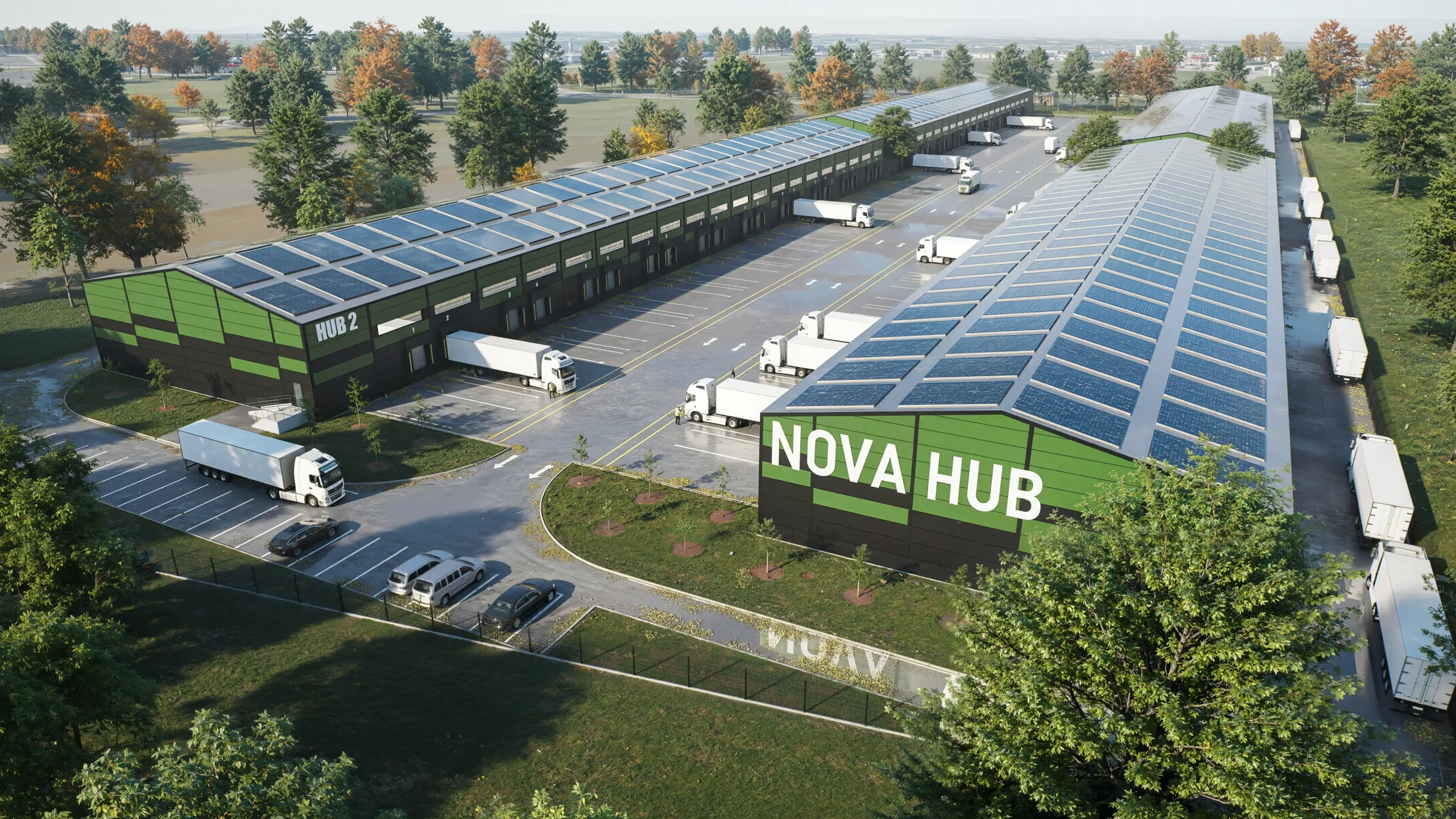
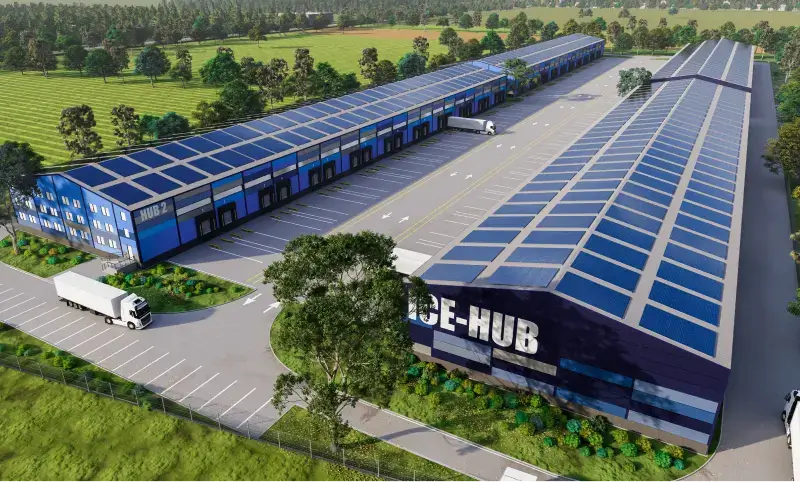
Visual tools such as 3D renders and master layouts help assess circulation of trucks, placement of docks, and potential for future expansion. You can explore such materials through detailed project visualizations of warehouse complexes.
💰 Financial model: how to estimate warehouse investment payback and returns
To summarize, a warehouse deal becomes attractive only when the numbers confirm the story. Investors should always build or review a detailed financial model before committing capital.
Understanding income: rents and indexation
Income usually comes from base rent per square meter, indexation clauses, and additional service charges for utilities and common area maintenance. Market rents differ by region, quality, and tenant mix.
Good projects use leases with clear annual indexation mechanisms and predictable service charge structures. This provides visibility for both tenants and investors over multiple years.
Operating expenses and net operating income
From gross income deduct property taxes, insurance, maintenance, management fees, and vacancy losses. The result is net operating income, which drives yields and valuation.
Well‑designed complexes with efficient layouts, quality materials, and modern engineering typically show lower maintenance costs and fewer technical failures, which supports higher net margins.
Estimating returns and payback period
Investors usually look at entry yield, internal rate of return, and simple payback period when comparing logistics assets. Warehouse investment payback in Ukraine may vary from 7 to 12 years depending on risk, leverage, and rental growth.
Higher quality projects with reliable developers can justify slightly lower initial yields because they reduce construction risk and potential downtime, which stabilizes long‑term real estate investment returns.
| Parameter | Conservative scenario | Optimistic scenario |
|---|---|---|
| Initial yield at stabilization | 9 % | 11 % |
| Average annual rent growth | 2 % | 4 % |
| Assumed vacancy | 8 % | 3 % |
| Estimated payback period | 11–12 years | 7–8 years |
This simple comparison shows how vacancy and rent growth assumptions can materially change the warehouse investment payback horizon.
⚖️ Pros and cons of investing in Ukrainian logistics warehouses
Every asset class combines strengths and limitations. Investment warehouses are no exception, especially in a developing market like Ukraine.
Advantages for investors
- Stable demand drivers from logistics, FMCG, and e‑commerce, which need physical storage even during economic volatility.
- Attractive yields compared to many Western European markets, where logistics cap rates are significantly lower.
- Inflation protection through rent indexation and potential long‑term growth of logistics tariffs.
- Value‑add potential via expansion, modernization, or re‑zoning of large logistics parks.
- Professional management options that allow investors to be relatively passive while specialists handle day‑to‑day operations.
Limitations and risks
- Geopolitical and security risks that can affect financing costs, insurance, and tenant decisions in certain regions.
- Currency risk when leases are linked to foreign currencies while some costs are in local currency.
- Liquidity constraints since large logistics assets can take time to sell in a narrow buyer market.
- Construction and permitting risk if the developer lacks experience or sufficient equity.
- Tenant concentration risk when income depends heavily on one or two large occupiers.
In short, investors are rewarded for accepting measured risks, but only if they mitigate them through careful project and partner selection.
📊 Practical case examples: how different strategies work in real life
Real or realistic scenarios help translate abstract financial models into understandable stories about risk and reward.
Case 1: Investor buying into a modern logistics hub
Imagine an investor who acquires a share in a newly built Class A logistics complex near a major highway around Lviv. The project is developed by a professional team, offers 12 meter clear height, high floor loads, and a flexible dock layout.
Most units are pre‑leased to national and international logistics providers on 7‑year agreements with indexation. The investor’s yield at stabilization is slightly lower than secondary assets, but long lease terms, strong tenants, and high construction standards create predictable cash flow.
Case 2: Value‑add repositioning of an outdated warehouse
Another investor buys an older warehouse with lower ceilings and no modern loading docks in an industrial area near Kyiv. Purchase price is attractive, but significant capital expenditure is needed for reconstruction, fire safety, and energy efficiency.
If the investor successfully upgrades the asset and signs 3PL tenants, the realized yield can be high. However, construction delays, permitting issues, or weaker leasing demand can easily extend the payback period beyond the initial forecast.
Comparing core and value‑add approaches
| Feature | Core logistics hub | Value‑add warehouse |
|---|---|---|
| Construction quality | New, to EU standards | Mixed, needs upgrades |
| Tenant profile | International and top national 3PLs | Local SMEs, then 3PLs |
| Risk level | Moderate | Higher |
| Target payback period | 8–10 years | 6–12 years depending on success |
| Investor involvement | Lower, more passive | High, active management |
These scenarios illustrate how investors must match their risk tolerance and time horizon with the chosen warehouse strategy.
❗ Common mistakes investors make with investment warehouses
Many problems in warehouse investing come from predictable errors that can be avoided with proper preparation and professional support.
Focusing only on high yields
Some investors chase the highest advertised yield without checking tenant quality, lease terms, or construction standards. This often leads to unexpected vacancies or expensive repairs.
Balanced deals with slightly lower yields but reliable tenants and modern design usually deliver better long‑term real estate investment returns.
Ignoring technical and legal due diligence
Skipping independent technical and legal checks is another frequent issue. Hidden defects, incomplete permits, or unclear land titles can create long disputes and additional costs.
Engage engineers and lawyers early and insist on full documentation, including building permits, technical passports, and operating certificates.
Underestimating development and leasing timelines
Investors sometimes assume overly optimistic construction and leasing schedules. Delays in utilities, roads, or tenant fit‑outs quickly erode projected returns.
More conservative timelines allow for realistic warehouse investment payback forecasts and help avoid cash flow gaps.
Not diversifying tenant base
Relying on a single large tenant may look convenient, but creates dependency. If that tenant downsizes or leaves, income can drop dramatically.
Prefer complexes that can host multiple tenants and have flexible layouts to accommodate various business types.
🧭 Practical tips: how to choose a reliable warehouse project in Ukraine
What matters most for new investors is having a clear checklist to compare potential projects and partners objectively.
Evaluate the developer’s track record
Check how many projects the developer has completed, how they performed, and how quickly they were leased. Reliable counterparts like NovaHub emphasize reliability, speed, and quality in both construction and subsequent management.
Request references from tenants and lenders and ask detailed questions about past challenges and how they were solved.
Clarify project roadmap and control tools
Ask for a transparent roadmap with key milestones for permitting, construction, leasing, and commissioning. This helps you monitor progress and identify delays early.
Some developers provide online tools that let investors track construction status and documentation. Reviewing a structured master plan with a clear roadmap is a good starting point.
Analyze the advantages of each specific complex
Do not rely on generic marketing promises. Look at concrete advantages such as location, access roads, engineering reserves, and service quality.
NovaHub, for instance, outlines specific competitive edges of its logistics hub, which you can review in the section describing the main advantages of their complex. Compare these with rival projects before deciding.
Stress‑test your financial model
Run scenarios with lower rents, longer vacancy periods, and higher operating expenses. If the project still looks acceptable under stress assumptions, the risk is more manageable.
This is especially important in a market with geopolitical uncertainties and evolving regulations.
Align investment horizon with project type
Short‑term oriented investors should focus on stabilized or nearly stabilized assets. Long‑term capital can consider development‑stage or value‑add projects with higher return potential.
Matching horizon, risk appetite, and partner capabilities is the cornerstone of successful logistics investment in Ukraine.
🧾 How NovaHub strengthens trust and transparency for warehouse investors
Professional project presentation and clear communication significantly reduce uncertainty for investors evaluating a logistics complex.
Comprehensive visual and technical information
NovaHub provides detailed 3D and plan‑level visual material that allows investors to see how the logistics center will function in reality. This is available in their dedicated visualization section for the investment project.
Combined with structured technical data and characteristics, this makes it easier to compare the asset with international benchmarks and to explain the opportunity to co‑investors or lenders.
Modern construction with high European standards
The company positions itself on modernity and high European standards of construction. This includes durable materials, careful engineering design, and compliance with fire and safety regulations.
Such focus on quality supports long asset life and lower maintenance costs, which are crucial inputs in financial models that forecast warehouse investment payback and long‑term returns.
Reliability, speed, and quality of implementation
NovaHub emphasizes reliability in meeting deadlines and budget targets, together with fast and well‑organized construction processes. For investors this lowers time‑related risk and improves trust in project delivery.
In many cases, speed of commissioning and leasing is just as important as headline yield because it directly shapes the cash flow curve in the first critical years.
✅ Conclusion: how to approach investment warehouses in Ukraine with confidence
Investment warehouses in Ukraine can provide compelling risk‑adjusted returns for investors who carefully analyze location, technical characteristics, tenants, and financial models. The key takeaway is that strong partners, modern design, and transparent documentation matter more than the highest advertised yield.
Focus on logistics complexes that combine modern European‑level construction, reliable infrastructure, clear legal status, and diversified tenant demand. Use realistic assumptions for warehouse investment payback and always check how sensitive returns are to rent, vacancy, and cost changes.
If you want a practical starting point, review NovaHub projects to see how reliability, modern standards, and construction speed are integrated into a single logistics platform. This will help you benchmark other opportunities in the Ukrainian market.
As you plan your investment strategy for the coming year, treat modern warehouses as a way to participate in Ukraine’s recovery and long‑term trade growth. With the New Year season approaching, it is a good moment to rethink your portfolio structure, explore high‑quality logistics hubs, and visit NovaHub’s website for up‑to‑date information on available warehouse complexes that can support your long‑term goals with a sense of optimism for the year ahead.
Sources
— CBRE Industrial & Logistics Market Outlook (2024)
— JLL Eastern Europe Logistics Report (2023)
— Statista Research Department, E‑commerce in Ukraine (2024)
— Industry Insight by Colliers International (2023)
— McKinsey Global Institute, Future of Freight (2022)
FAQ
What are the most important factors when choosing an investment warehouse in Ukraine?
The most important factors are macro and micro location, building quality, tenant demand, and a transparent financial model. You should examine access to highways, technical characteristics like height and floor load, and realistic assumptions for rents, vacancy, and operating costs.
How long is a typical warehouse investment payback period in Ukraine?
In the article, typical payback periods range from 7 to 12 years depending on risk level, rent growth, and vacancy. Conservative scenarios with higher vacancy and lower growth can extend payback to 11–12 years, while strong projects with good tenants and leasing can achieve 7–8 years.
Why is working with a professional developer like NovaHub important?
Professional developers provide modern construction to European standards, structured documentation, and clearer timelines. NovaHub, for example, offers visualization, technical characteristics, and a master plan, which make it easier to evaluate risks and support discussions with banks or co‑investors.
What common mistakes should warehouse investors avoid?
Typical mistakes include focusing only on headline yields, skipping technical and legal due diligence, underestimating construction and leasing timelines, and depending on a single large tenant. Avoiding these errors requires conservative modeling and involvement of qualified engineers and lawyers.
How do modern logistics warehouses differ from older industrial buildings?
Modern logistics warehouses offer higher clear heights, stronger floor loads, more loading docks, and better energy efficiency than older buildings. They are also designed around truck circulation and worker safety, which makes them more attractive to logistics operators and supports higher and more stable rents.
Is it better to invest in a stabilized logistics hub or a value‑add warehouse project?
A stabilized logistics hub usually offers lower risk and more predictable income but slightly lower yields. Value‑add projects can deliver higher returns if upgrades and leasing go well, yet carry more construction, permitting, and leasing risk, so they suit investors with higher risk tolerance and longer horizons.
How can I evaluate the technical quality of a warehouse investment?
You should review technical sheets that list height, column grid, floor load, dock numbers, and engineering systems. In addition, check compliance with European fire and safety standards and analyze visual materials, such as 3D models and master plans, that show traffic flows and expansion potential.
What role does tenant mix play in warehouse investment risk?
A diversified tenant mix reduces the impact of any single tenant leaving or downsizing. Projects designed for multiple tenants with flexible layouts usually offer lower concentration risk than those reliant on a single big occupier, which is especially important in volatile markets.
How does the geopolitical situation in Ukraine affect logistics investments?
Geopolitical risks influence financing, insurance, and preferred regions, pushing demand towards relatively safer central and western areas. Investors can still achieve attractive returns by focusing on resilient locations, strong developers, and conservative financial assumptions, as discussed in the article.