

Odesa’s 2025 warehouse market favors modern, resilient logistics complexes near key transport nodes. NovaHub’s innovative project exemplifies this trend with strong engineering, safety, and a seven year payback horizon.
By 2025, the warehouse market around Odesa will be shaped by two powerful forces. On one side, businesses are returning or expanding toward the Black Sea corridor. On the other, investors and logistics operators are racing to build safer, more efficient assets that match European construction and sustainability standards. Understanding where these trends meet is essential for anyone planning storage, distribution, or long term investment in the region.
This article reviews the current and expected structure of warehouse space in Odesa in 2025, examines demand drivers, analyzes the impact of new projects such as innovative logistics complexes, and outlines practical steps for occupiers and investors. You will see how Odesa fits into the wider network of new warehouses in Ukraine, which opportunities look realistic, which risks should not be ignored, and how to prepare your logistics strategy for the next two to three years.
How did the Odesa warehouse market arrive at the 2025 reality?
Disruption, relocation, and the shift of stock westward
The full scale invasion radically changed cargo flows across Ukraine. Many national and international companies rethought where to keep critical inventory. One of the most visible effects was the rapid relocation of stock from the frontline and coastal regions to the west of the country.
“With the start of the war, large companies were forced to transfer their warehouse stocks and goods to western Ukraine.”
For Odesa, this meant a temporary reduction in direct demand, while transit flows shifted to safer corridors. Yet the port city remained strategically important. As businesses adapted, many started to look again at the Black Sea region, expecting that restored sea export capacity would quickly tighten the local logistics market.
From emergency storage to strategic planning
In the early phase, most warehousing decisions were tactical. Companies accepted suboptimal locations simply to safeguard goods. By 2024 and into 2025, behavior became more strategic. Occupiers began asking about building quality, power autonomy, shelter availability, and long term operating costs.
This shift has opened the door for modern projects that treat Odesa as part of a resilient logistics hub of Ukraine instead of a single risky node. Developers that can prove reliability, construction quality with European level standards, and timely delivery gain a clear advantage.
What 2025 demand for Odesa warehouses looks like
In 2025, demand for warehouse space in Odesa is likely to come from three main groups. First, exporters and importers tied to the port, including agro, food, and metals. Second, regional distributors that serve southern Ukraine and need cross docking and storage close to main highways. Third, e commerce and retail chains that require modern, energy efficient space with good last mile access.
Each of these groups evaluates risk differently, but they share a preference for contemporary complexes that combine storage with quality office units and reliable engineering systems. Projects that match these expectations will drive the benchmark for new leases and investment deals.
What types of warehouse properties dominate Odesa in 2025?
Legacy assets versus contemporary logistics complexes
The Odesa area still has a large stock of legacy warehouses. Many were built for older industrial uses, with limited clear height, poor insulation, and outdated fire safety systems. They can work for low margin operations but often fail to satisfy international tenants or investors.
By contrast, a new generation of logistics complexes is emerging. These assets focus on modern construction, more efficient layouts, better loading configurations, and integrated office space. They are designed as part of wider freight corridors that connect highway, railway, sea port, and dry port infrastructure.
Key specifications of innovative logistics projects
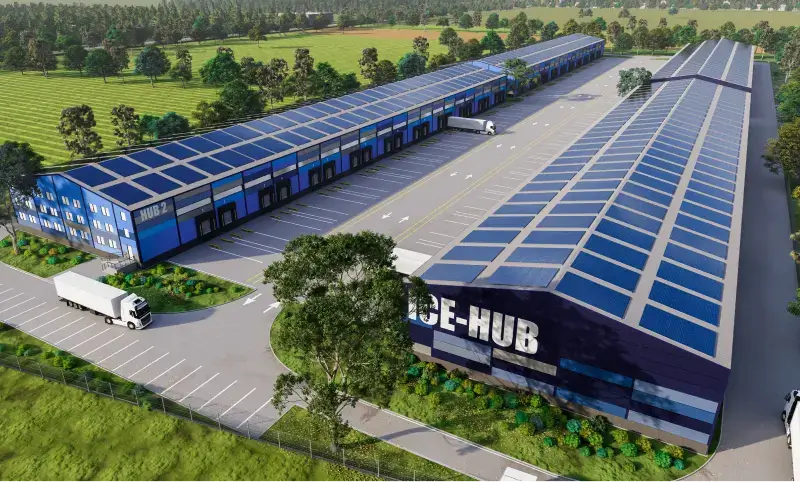
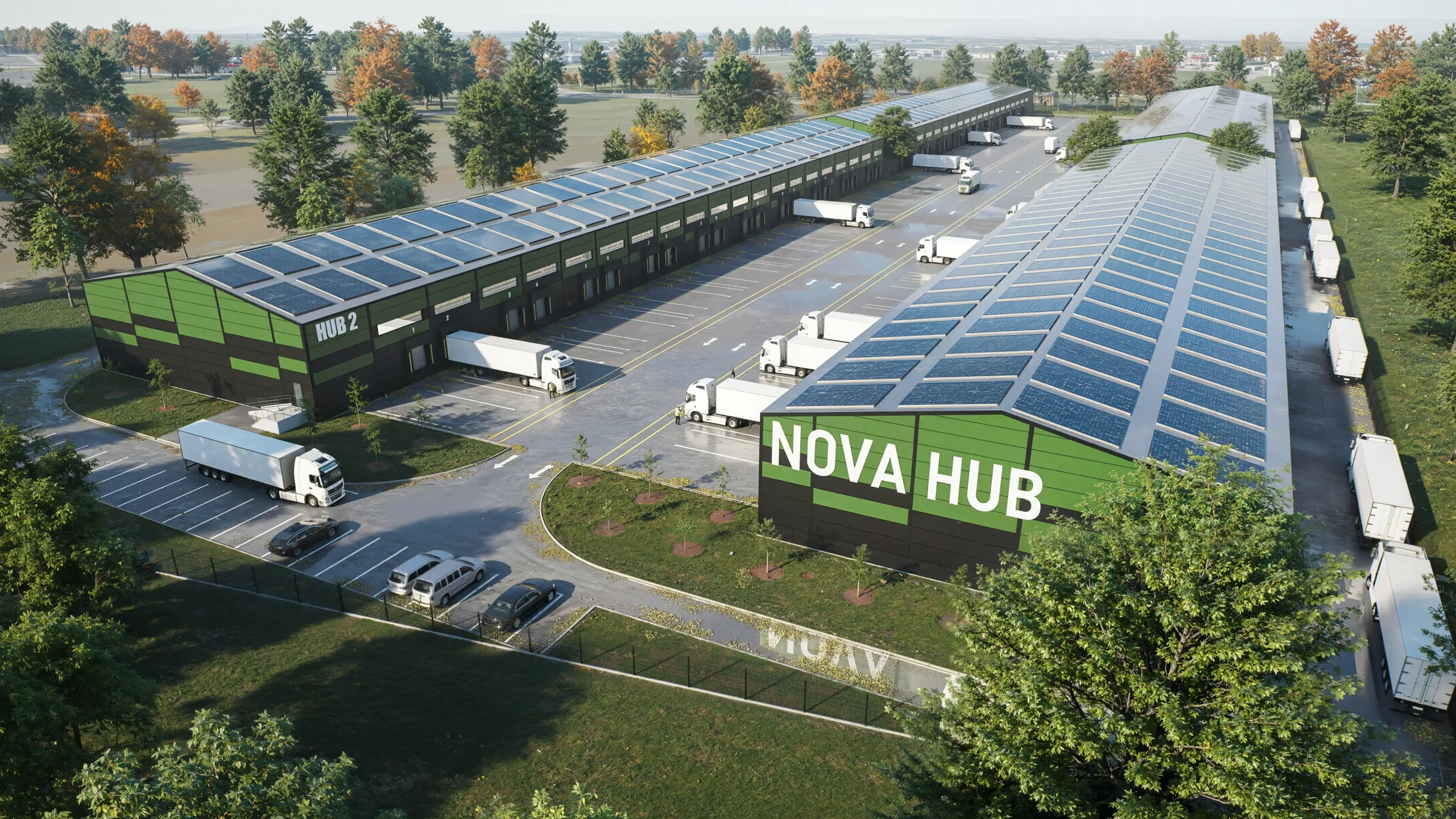
One example of this new wave is an innovative logistics complex promoted by NovaHub. It is planned on a land plot of 41,970 m², with a total building area of 19,174 m² and 2,460 m² of office space for administrative and commercial functions. The site is positioned near the Odesa–Kyiv highway and has access to sea and dry ports as well as railway infrastructure.
The engineering concept includes an autonomous water supply, 1 MW of electricity, an automatic fire alarm, 24/7 video surveillance, and a dedicated shelter. A solar power station is planned to support green energy production and reduce dependence on the grid. For many tenants, these specifications address the most pressing operational risks.
| Parameter | Legacy warehouse (typical) | Innovative complex (example) |
|---|---|---|
| Land area | Often undefined or fragmented | 41,970 m² unified plot |
| Total building area | Variable, often below 10,000 m² | 19,174 m² logistics complex |
| Office space | Basic or external offices | 2,460 m² integrated modern offices |
| Power supply | Standard grid only | 1 MW with solar power station support |
| Safety and security | Basic systems, partial CCTV | Automatic fire alarm, 24/7 video monitoring, shelter |
How Odesa fits into the wider network of new warehouses in Ukraine
New warehouses in Ukraine tend to cluster around major highways and multimodal nodes. Odesa already satisfies these criteria because it combines road, rail, and sea connections. As logistics strategies become more network oriented, many national operators treat the city as a southern anchor.
For investors, this means that well located assets in Odesa compete not only with local buildings but with projects near Lviv, Kyiv, and other hubs. Buildings that match or exceed the technical level of those western and central assets are better placed to secure long leases and stable cash flows.
How does NovaHub’s logistics complex project shape the 2025 landscape?
Location advantages and transport connectivity
The innovative logistics complex backed by NovaHub is positioned near the Odesa–Kyiv highway, which forms a backbone for long distance trucking between the capital and the Black Sea. Proximity to the main sea port, a dry port, and railway infrastructure allows tenants to combine container, wagon, and truck transport in one operating model.
This level of connectivity is critical when companies rebuild export and import chains. In practical terms, tenants can maintain central distribution operations in one facility and still reach regional markets efficiently. It also improves the argument for using Odesa as a logistics hub of Ukraine for southern flows.
Technical resilience and safety features
From an engineering perspective, the complex is designed for operational stability. An autonomous water supply reduces dependence on municipal networks. A 1 MW electrical capacity supports refrigeration, automation, or high intensity warehousing. The solar power station improves energy security and supports sustainability goals.
Safety design includes an automatic fire alarm system, 24/7 video surveillance, and an integrated shelter. These features are no longer “nice to have” for tenants. They are becoming basic requirements for corporate risk committees and insurance providers.
Investment case, timelines, and payback
The project implementation is structured in clear stages. Design work is planned from April 7, 2025 to November 28, 2025. Permitting is scheduled from August 18, 2025 to January 9, 2026. Construction is expected to start on January 15, 2026, with commissioning targeted for August 2026.
Project management is provided by TOV “SK GROUP”, while general contracting is handled by TOV “BAU-CENTER”. This structure supports professional control of cost, timeline, and quality. The projected payback period for investors is around seven years, which reflects both increased construction standards and strong expectations for rental demand once operations begin.
| Stage | Planned period | Key responsibility |
|---|---|---|
| Project design | 07.04.2025 – 28.11.2025 | TOV “SK GROUP” project management |
| Permitting | 18.08.2025 – 09.01.2026 | Coordination with authorities |
| Construction start | 15.01.2026 | TOV “BAU-CENTER” as general contractor |
| Commissioning | August 2026 | Handover to tenants and investors |
| Estimated payback | 7 years | Based on expected rental income |
How this project reflects NovaHub’s positioning
NovaHub builds its market role around reliability, contemporary construction that meets high European standards, and a combination of speed and quality in delivery. The Odesa logistics complex translates these principles into a concrete asset with clear timelines and robust technical parameters.
For occupiers, this means lower operational risk and more predictable conditions. For investors, it offers an asset that aligns with global institutional expectations rather than local minimums. The project also sets a reference point for other warehouse space in Odesa, raising the bar for future developments.
What are the main advantages and limitations of the current Odesa warehouse market?
Advantages: why Odesa remains attractive in 2025
When you weigh the pros and cons of placing storage or distribution functions in the region, several advantages stand out. These relate to geography, infrastructure, and the new wave of high quality developments.
- Strategic location: Odesa combines access to the Black Sea, national highways, and railway routes, which supports multimodal logistics for export and domestic distribution.
- Growing base of modern assets: New logistics complexes with strong technical specifications reduce the gap between local facilities and Western European standards.
- Potential to serve as a national hub: As flows rebalance, Odesa can act as a southern anchor node in a broader logistics network across Ukraine.
- Energy and safety upgrades: Projects with solar generation, autonomous utilities, and advanced fire and security systems address key risk concerns.
- Professional project management: Involvement of specialized companies in design and construction improves delivery reliability for investors and tenants.
Limitations and risk factors you must acknowledge
At the same time, any realistic 2025 market review must recognize the constraints. These risks do not necessarily block investment, but they need to be managed explicitly in strategy and contracts.
- Security environment: The region still operates under elevated security risk, which can affect insurance costs and contingency planning.
- Legacy building stock: A significant portion of warehouse space remains outdated and may require heavy retrofit or may not meet corporate standards at all.
- Regulatory and permitting complexity: Obtaining approvals for new construction or change of use can take time and demands professional management.
- Infrastructure stress: Local infrastructure, including power networks and roads, can face overload without proper upgrades at the project level.
- Financing conditions: Higher perceived risk may translate into stricter lending terms or higher required returns for equity investors.
Balancing pros and cons in investment and leasing decisions
In practice, successful strategies focus on mitigating structural risks through asset quality and location. For example, an investor may accept a longer permitting phase if the result is a fully compliant complex with autonomous utilities and a shelter. A tenant may commit to a medium term lease if the building offers energy efficient systems that lower operating costs over time.
In short, the strength of Odesa lies in carefully selected projects rather than the average quality of the current warehouse stock. This selective approach is what turns theoretical advantages into tangible business value.
Practical examples: how different businesses might use Odesa warehouses in 2025
Case 1: Regional distributor consolidating operations
Imagine a regional FMCG distributor that currently operates from three small, outdated facilities on the outskirts of Odesa. Each building lacks proper loading docks and reliable power. In 2025, the management team designs a consolidation plan that would move all inventory into a single modern complex near the Odesa–Kyiv highway.
They select a facility with integrated office space, 1 MW of electrical capacity, automatic fire systems, and 24/7 surveillance. The consolidation reduces duplicated handling, cuts transport between sites, and simplifies staffing. Within a few years, the lower logistics cost offsets the higher rent, while the improved working environment helps retention of key staff.
Case 2: Export oriented manufacturer targeting the Black Sea corridor
A mid sized manufacturer of agricultural machinery plans to grow exports to neighboring markets when maritime routes stabilize. The company decides to position finished goods storage close to Odesa with direct access to both the port and main highway network.
They choose a warehouse that combines high quality storage with 2,460 m² of office space. This allows them to run logistics planning, customer service, and quality control on site. Solar supported power and a shelter are decisive for their corporate risk assessment. The location ultimately allows them to shorten delivery times and respond faster to regional customers.
Case 3: Investor seeking a balanced risk return profile
An institutional style investor considers several new warehouses in Ukraine. The portfolio team compares a project in western Ukraine with an innovative Odesa logistics complex. While the western asset may appear safer at first glance, the Odesa complex offers multimodal connectivity and a projected seven year payback period backed by professional project management and a reliable general contractor.
After assessing potential rent levels, engineering specifications, and timelines, the investor decides to allocate a portion of capital to the Odesa project. They accept some regional risk in exchange for higher yield and strategic positioning in a future trade corridor.
Common mistakes when choosing or developing warehouse space in Odesa
Mistakes occupiers often make
Businesses moving into the region frequently repeat a set of avoidable mistakes. Understanding these patterns can save significant time and cost.
- Focusing only on rent per square meter: Ignoring energy efficiency, power reliability, and layout often results in higher total logistics cost despite lower nominal rent.
- Underestimating permitting and construction timelines: Tenants sometimes expect new space to be available in a few months, while real projects follow design and approval cycles similar to those scheduled for 2025–2026.
- Neglecting safety and shelter requirements: Some occupiers prioritize cheap space and then realize that insurance or corporate policy requires higher safety standards.
- Choosing locations without multimodal access: Selecting sites far from main highways or rail connections increases reliance on local roads and raises transport risk.
- Overlooking office functionality: Under specified office space can disrupt management, planning, and support operations that are essential for a high performing warehouse.
Typical investor errors
Investors also face their own set of traps when they assess warehouse projects in Odesa. Most relate to misjudging technical and operational realities.
- Assuming all warehouses are interchangeable: Treating legacy stock as equivalent to a modern logistics complex leads to unrealistic rent expectations and higher vacancy.
- Ignoring engineering resilience: Underinvesting in backup power, autonomous water supply, and fire safety can reduce tenant interest and damage long term value.
- Overly optimistic lease up assumptions: Counting on full occupancy from day one without structured pre leasing strategies can extend payback periods beyond expectations.
- Underestimating the value of professional project management: Trying to save on management fees can result in delays, cost overruns, and quality issues during construction.
How to avoid these pitfalls in practice
To avoid these errors, both occupiers and investors should adopt a more structured evaluation process. This includes technical due diligence, careful review of construction and permitting schedules, and explicit checks of safety and energy systems.
It is also important to benchmark candidate assets against the newer standard of logistics complexes in the region, not simply against older buildings. This comparative approach helps to set realistic expectations about rent, capex, and long term operating cost.

Practical tips for selecting or investing in warehouse space in Odesa
Technical and location checklist for occupiers
Tenants planning to lease warehouse space in Odesa in 2025 should build a clear, prioritized checklist. This allows procurement, operations, and finance teams to evaluate options consistently.
- Prioritize multimodal access: Select sites near main highways with convenient routes to sea and dry ports and, where possible, railway connections.
- Verify power and water autonomy: Confirm available electrical capacity, presence of a solar power station, and autonomous water supply to ensure operational continuity.
- Inspect safety infrastructure: Check for automatic fire alarm systems, 24/7 video monitoring, and shelters that comply with internal and regulatory requirements.
- Assess office and support space: Ensure that office areas, like the 2,460 m² in modern complexes, can host all necessary management and support functions.
- Model total cost of operations: Include rent, utilities, maintenance, and transport cost in one model instead of focusing only on headline rental rates.
Guidance for investors evaluating new projects
Investors should also follow a disciplined process. In brief, sound decisions rely on understanding the interplay between asset quality, demand drivers, and risk mitigations.
- Align with credible developers and managers: Work with teams that provide structured project management and reliable general contracting, similar to TOV “SK GROUP” and TOV “BAU-CENTER”.
- Analyze timelines realistically: Factor in design and permitting windows comparable to those scheduled between April 2025 and January 2026.
- Stress test payback assumptions: Test different occupancy and rent scenarios around the projected seven year payback to understand downside risk.
- Compare technical specs to market benchmarks: Use modern Odesa logistics complexes as reference points for construction quality and engineering resilience.
When to prioritize Odesa over other Ukrainian locations
You should consider Odesa as a priority location when your supply chain depends on the Black Sea corridor, when you need direct access to port infrastructure, or when your business model benefits from serving southern regions more quickly. The city also makes sense when multimodal flexibility is a strategic requirement.
On the other hand, if your flows are almost entirely westbound or focused on central Ukraine, it may be more efficient to place primary distribution centers closer to those demand clusters and use Odesa assets more for buffer stock and export staging.
How NovaHub’s approach supports clients in the Odesa warehouse market
Reliability and adherence to high construction standards
NovaHub positions itself as a provider of reliable warehouse and logistics solutions that align with high European construction and safety standards. In the context of Odesa, this means designing complexes with robust engineering systems, resilient structures, and compliant safety infrastructure.
Such standards are not only about structural quality. They are also about predictable operations, easier certification, and smoother interactions with insurance providers and corporate auditors. This reliability is especially valuable in a market where legacy stock often falls short of international expectations.
Speed and quality in project execution
The scheduled design, permitting, and construction phases for the Odesa logistics complex illustrate a commitment to disciplined, timely delivery. By defining clear milestones between April 2025 and August 2026, NovaHub and its partners aim to reduce uncertainty for both tenants and investors.
Fast execution does not mean cutting corners. Instead, it means aligning professional management, experienced contractors, and clear technical standards from the early planning stages. This approach supports faster entry into operation while preserving long term quality.
How NovaHub can support your next step
If your company is planning a presence in Odesa or evaluating new warehouses in Ukraine, working with a partner that understands both technical and strategic aspects can significantly reduce risk. NovaHub focuses on combining high construction standards, reliable management, and competitive delivery times to create assets that fit complex logistics strategies.
To explore how an innovative logistics complex near the Odesa–Kyiv highway could support your distribution or investment goals, you can review the project details on the NovaHub investment in logistics complex page and align them with your own demand forecasts and risk policies.
Conclusion: what the 2025 Odesa warehouse market means for you
The Odesa warehouse market entering 2025 is defined by contrast. Legacy stock and current uncertainties sit alongside a new generation of logistics complexes designed around resilience, safety, and European level technical standards. For both occupiers and investors, value lies in carefully chosen projects rather than the average building.
Strategic location near the Odesa–Kyiv highway and port infrastructure, combined with modern engineering features such as autonomous utilities, solar generation, and integrated shelters, makes selected assets strong candidates for long term logistics roles. Clear project timelines and professional management add further confidence.
For your next step, focus on total logistics performance instead of short term rent savings. Evaluate assets like NovaHub’s innovative complex against your network needs, risk profile, and growth plans, then commit to locations that can genuinely support your operations through the next decade.
FAQ about the Odesa warehouse market in 2025
What makes Odesa attractive for warehouse operations in 2025?
Odesa combines access to the Black Sea port, the Odesa–Kyiv highway, and railway and dry port infrastructure, which supports multimodal logistics. In addition, new logistics complexes with modern specifications are raising the overall quality of available space.
How long does it take to develop a modern logistics complex near Odesa?
A typical timeline includes several months for design and permitting, followed by construction and commissioning. For example, one innovative project plans design from April to November 2025, permitting to January 2026, construction start in mid January 2026, and commissioning in August 2026.
What technical features should I prioritize when choosing warehouse space in Odesa?
Key features include reliable power supply, ideally around 1 MW for larger facilities, autonomous water systems, automatic fire alarms, 24/7 video surveillance, and an integrated shelter. Energy efficient systems and proximity to main highways and ports are also critical.
What is the typical payback period for investing in a new Odesa logistics complex?
For a modern, well specified complex with good location and professional management, an estimated payback of about seven years is realistic. This assumes a balanced scenario for rent levels, occupancy, and operating costs over time.
How can I avoid common mistakes when leasing warehouse space in Odesa?
Avoid focusing only on rent per square meter and instead calculate total logistics costs, including energy and transport. Also, verify safety infrastructure, shelter availability, and realistic timelines for construction or fit out before signing any agreements.
Why are integrated office areas important in a logistics complex?
Integrated office space, such as the 2,460 m² planned in some projects, allows management, planning, and customer service teams to work directly alongside warehouse operations. This improves coordination, decision making, and responsiveness to clients.
When should my company prioritize Odesa over western Ukrainian locations?
You should prioritize Odesa when your supply chain depends on the Black Sea corridor, requires fast access to the sea port, or serves southern regions. Western locations may be more suitable when most flows are directed toward central Europe and western Ukraine.
What role do project managers and general contractors play in warehouse investments?
Professional project managers and reliable general contractors coordinate design, permitting, and construction to meet technical standards and timelines. Their involvement reduces the risk of delays, cost overruns, and quality issues that can harm investment returns.
How did the war initially affect warehouse demand in Odesa?
At the start of the war, many large companies moved their warehouse stocks to western Ukraine for safety, which reduced immediate demand in Odesa. Over time, as strategies evolved, interest in the Black Sea region began to recover due to its strategic location.