

Rooftop solar turns warehouses into efficient energy producers, cutting electricity costs by up to 80% and enabling new income from surplus power. With proper design, systems repay investment in 4–5 years and raise asset value.
Energy prices, decarbonization pressure, and the need for resilient logistics have turned warehouse roofs into one of the most undervalued profit centers in commercial real estate. Owners and investors who treat rooftop solar as a core asset, not a side project, are now securing lower operating costs and stronger long term returns. A professionally designed solar power plant for a warehouse can transform a logistics building from a pure cost item into a generator of both savings and stable income.
This article explains how a solar installation changes the economics of a warehouse, how to structure revenue and savings, and what payback to expect. We will walk through a detailed example based on NovaHub’s innovative logistics complex near the Odesa Kyiv highway, outline pros and cons, common mistakes, and practical steps that help maximize the profitability of a warehouse complex.
How does a rooftop solar system change the business model of a warehouse?
From energy consumer to energy producer
Conventional warehouses simply buy electricity from the grid. Costs rise with tariffs and usage, and there is little control over long term energy risk. Once rooftop solar photovoltaic (PV) is installed, the building becomes a producer that offsets grid purchases and can sometimes export surplus energy.
According to industry data, warehouse solar installations can cut annual electricity expenses by roughly 40 to 80 percent when properly sized and designed. This shift improves margins and also stabilizes forecasting because a large share of costs is now linked to predictable solar production instead of volatile tariffs.
Creating a passive income stream from surplus power
When solar generation exceeds on site demand, stored or exported energy can form a new revenue line. Batteries capture daytime excess for use during evening peaks. If regulations allow, surplus can be sold to nearby consumers or back to the grid, creating passive income from a warehouse that previously had no such capability.
Industry experience shows that the initial investment in solar panels is often recovered within four to five years through a combination of bill savings and revenue from selling excess energy. After that point, most of the cash flow becomes net income for the remaining life of the system, which typically extends to around 25 years.
Impact on asset value and leasing strategy
Rooftop solar is not only a cost measure. It is also a capital improvement. A warehouse with a high quality PV system is more attractive to logistics operators who want energy certainty and green credentials. This can support higher rents, longer leases, or lower vacancy risk.
Rooftop solar with a 25 year technical lifespan adds intrinsic value to the building. For owners who plan to sell the asset, the presence of solar can justify a premium because future buyers inherit reduced operating expenses and a proven energy system.
What does the income and savings model look like in practice?
Main cash flow components
In broad terms, the financial model for solar on a warehouse combines several flows. Understanding each one helps investors judge the total profitability of a warehouse complex.
- Energy savings: Reduced grid electricity purchases due to self generated solar power.
- Export revenue: Income from selling surplus electricity where regulation and infrastructure allow it.
- Avoided peak charges: Lower costs during peak tariff hours when batteries cover demand.
- Tax and incentive benefits: In some markets, commercial solar incentives or tax credits reduce the net investment cost.
- Asset value uplift: A higher property valuation linked to long term energy efficiency.
Illustrative payback and returns
In many commercial projects, rooftop solar PV provides an internal rate of return in the range of 10 to 15 percent on self financed installations. Industry data indicates that the simple payback of the solar equipment alone often sits around four to five years, depending on local tariffs, sun hours, and system size.
To put it simply, the early years are focused on debt service or recovering equity, while the later years deliver comparatively clean cash flow. Over a 25 year lifespan, warehouses can enjoy decades of reduced bills and recurring income from power sales once installation costs are fully recouped.
How the NovaHub logistics complex model works
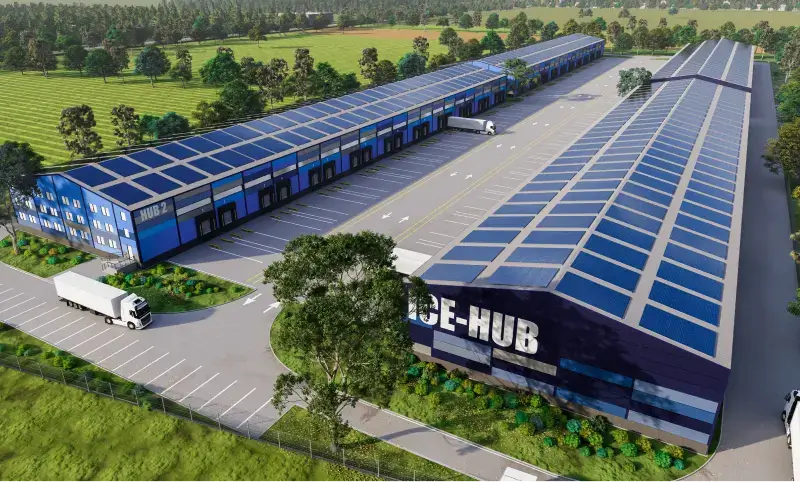
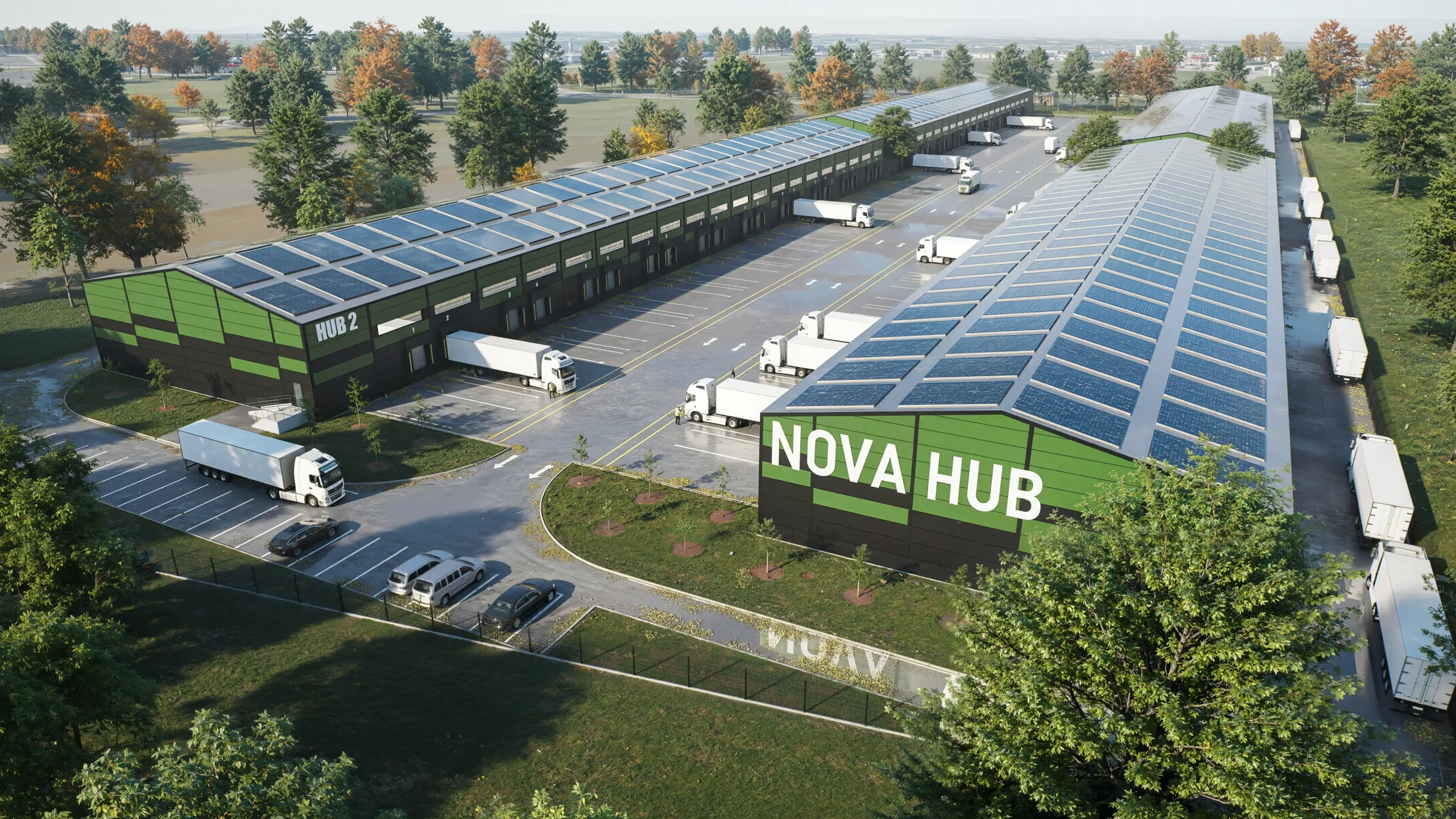
NovaHub’s innovative logistics complex near the Odesa Kyiv highway is designed as a modern, energy aware asset. The site covers about 41,970 square meters of land with a total built area of 19,174 square meters, including 2,460 square meters of office space. The complex has its own water source, a one megawatt electrical connection, 24/7 video surveillance, automatic fire detection, and a shelter.
The project also includes a solar power station that supplies green energy to the warehouse and offices. The investment is structured with a projected payback period of seven years for the entire complex, which reflects not only solar but the full spectrum of construction and systems. Project management is carried out by TOV “SK GROUP” and general construction by TOV “BAU CENTER”, with commissioning scheduled for August 2026 after a clear design and permitting timeline.
How does rooftop solar interact with warehouse operations?
Using large roof space efficiently
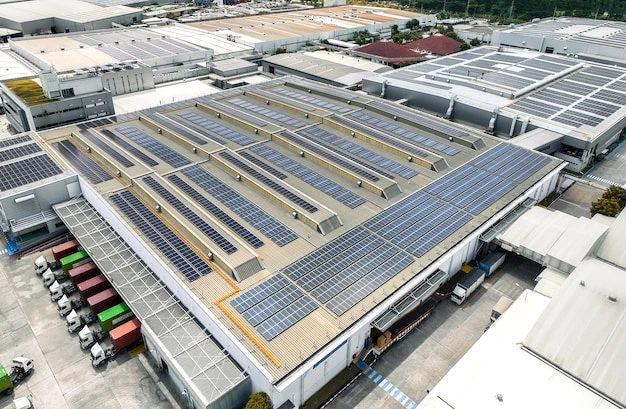
Warehouses have one crucial advantage over many other commercial buildings. Their roofs are typically large, flat, and relatively free of shading. This makes them ideal for sizeable PV arrays that can match or exceed the internal electricity demand of the facility.
Because rooftop space is extensive, designers can optimize panel tilt and orientation to maximize annual generation. The combination of scale and design flexibility is what enables warehousing to achieve 40 to 80 percent reductions in annual power costs compared to a grid only baseline.
Battery storage and peak demand management
Battery energy storage systems complement rooftop solar by capturing midday surplus for use at night or during grid peaks. Industry data shows that using storage during periods of high tariffs can substantially improve the return on investment by reducing the most expensive kilowatt hours.
For critical logistics facilities with around the clock activity, batteries also support resilience. When paired with solar, they allow essential operations such as lighting, IT systems, and security to continue during short grid interruptions.
Reinvesting savings into safety and efficiency
Energy cost reductions from solar are not just a line on a spreadsheet. They free up budget for other improvements. Industry experience indicates that solar savings can help finance upgrades such as smarter LED lighting, expanded camera networks, or advanced access control.
In complexes like NovaHub’s, where 24/7 video surveillance and automatic fire systems are already built in, sustained savings can be allocated to further digitalization, warehouse automation, or tenant specific fit outs. This improves both operational quality and the perceived modernity of the asset.
What are the pros and cons of a solar strategy for warehouses?
Advantages: why solar improves warehouse profitability
- Lower operating expenses: Solar PV can cut electricity bills by 40 to 80 percent, which improves net operating income and the overall profitability of a warehouse complex.
- Attractive returns: Many commercial systems achieve 10 to 15 percent internal rates of return with simple paybacks near four to five years on the solar portion of the investment.
- Asset differentiation: A warehouse that generates its own green energy stands out in the market and can support premium leasing terms or reduced vacancy.
- Long life asset: With a typical lifespan of about 25 years, solar remains productive long after it has repaid its capital cost.
- Environmental reputation: Lower emissions and visible renewable energy support ESG reporting and corporate sustainability goals for both owners and tenants.
Limitations and risks to account for
- Upfront capital requirement: Even with incentives, the initial outlay for panels, inverters, and installation is significant and must be carefully planned within the project budget.
- Regulatory dependency: Revenue from energy exports depends on local rules, tariffs, and grid access conditions, which can change over time.
- Technical planning complexity: Poor system design can lead to underperformance, shading losses, or integration issues with warehouse electrical systems.
- Maintenance obligations: Panels and inverters require periodic cleaning, inspection, and replacement to sustain promised yields.
- Roof structural limits: Existing roofs may need reinforcement or partial renovation before supporting a large solar array.
Case example: NovaHub logistics complex as an investment model
Key parameters of the NovaHub complex
The NovaHub logistics complex is a good illustration of how solar fits into a broader, investment grade warehouse project. It combines modern engineering with a strong transport location near a major highway, ports, and rail connections. This reduces logistics costs for future tenants and supports high occupancy.
The facility offers almost 19,200 square meters of built area, including offices, on a site of around 41,970 square meters. It is served by a dedicated one megawatt electrical connection and includes autonomous water supply, a solar power station, fire detection, round the clock CCTV coverage, and a shelter that increases resilience for staff.
| Parameter | NovaHub logistics complex |
|---|---|
| Total land area | Approx. 41,970 m² |
| Total building area | Approx. 19,174 m² |
| Office space | Approx. 2,460 m² |
| Electrical capacity | 1 MW connection with solar station |
| Planned payback | Approx. 7 years for total investment |
Timeline and project governance
Professional governance is critical for any warehouse energy project. In this case, project management is provided by TOV “SK GROUP” with TOV “BAU CENTER” as the general contractor. Design work is planned from early April to late November 2025, followed by permitting that runs into early January 2026.
Construction is scheduled to begin in mid January 2026, with commissioning in August 2026. This clear schedule reflects NovaHub’s focus on reliability, speed, and quality, which reduces execution risk for investors interested in stable logistics and energy infrastructure.
Income, savings, and risk profile
The seven year payback period for the full complex includes building construction, infrastructure, and energy systems. Within that portfolio, the solar power station contributes by reducing operating expenses for tenants and by enhancing the green and technological profile of the asset.
Once the initial capital is recovered, investors benefit from ongoing rental income supported by efficient operations, plus long term solar savings that help keep service charges competitive. That combination positions the complex as a source of passive income from a warehouse with a strong location and contemporary standards.
For readers who want a deeper look at the property parameters, the investment in logistics complex overview from NovaHub provides additional context.
How does solar improve warehouse profitability compared to a non solar building?
Side by side financial impact
To clarify the difference, consider a simplified comparison over the life of a warehouse investment. Both buildings have similar rents and occupancy, but only one includes a well designed solar system.
| Aspect | Warehouse without solar | Warehouse with solar |
|---|---|---|
| Electricity costs | 100% grid dependent, exposed to tariff increases | 40–80% lower annual electricity costs |
| Additional energy income | None | Possible revenue from surplus energy and peak shaving |
| Asset value | Standard logistics valuation | Higher value from energy efficiency and green profile |
| Return profile | Purely rental based | Combination of rent, savings, and energy revenues |
| Risk exposure | Greater sensitivity to energy price volatility | Mitigated energy risk and better cost visibility |
Strategic fit with modern tenants
Many logistics operators are under pressure to reduce emissions and report on sustainability metrics. A warehouse that already includes rooftop solar and modern systems helps them meet these targets without extra capital expenditure.
In practice, this can translate into longer lease terms or preference for solar enabled buildings over conventional facilities. Investors benefit because their properties are aligned with future regulatory trends instead of lagging behind.
Role of modern construction standards
Solar works best when combined with high quality building envelopes and precise engineering. NovaHub’s focus on reliability, compliance with high European standards of warehouse construction, and fast yet controlled delivery supports this integration.
Well insulated walls and roofs, efficient lighting, and modern fire and security systems ensure that solar energy is not wasted on inefficiencies. The overall result is a warehouse that uses less power per square meter and produces a significant part of that power on site.

Common mistakes when planning solar for warehouses
Underestimating roof and structural requirements
One frequent error is assuming that any existing roof can carry a large PV system without assessment. In reality, loads from panels, mounting structures, and potential snow must be checked by engineers. Failure to do so may lead to reinforcement costs that were not in the original budget.
To avoid this, structural evaluation should be integrated into early design stages. New projects like NovaHub’s incorporate these checks from the start, which makes later solar implementation smoother.
Poor system sizing and orientation
Another mistake is oversizing or undersizing the system relative to actual load profiles. Oversized arrays can create a lot of unused generation if export conditions are weak. Undersized systems leave potential savings on the table.
Designers should analyze hourly consumption patterns, consider seasonal variations, and plan panel orientation to maximize annual yield. Proper design is one of the main reasons rooftop solar can repay investment within four to five years in many cases.
Ignoring integration with safety and operations
Some projects treat solar as an isolated component and overlook its interaction with fire safety and operations. Cables, inverters, and battery rooms must be integrated into the overall fire protection design and evacuation plans.
Well managed projects coordinate solar layout with automatic fire detection, emergency access, and maintenance routes. This approach protects both the asset and the people who work in it.
Neglecting maintenance and monitoring
Solar systems with no cleaning schedule, inspection routine, or performance monitoring will underperform over time. Dust accumulation, shading from new structures, or component degradation can silently reduce output.
To prevent this, owners should include simple maintenance contracts and remote monitoring, with clear performance benchmarks. This keeps long term savings on track and signals professionalism to tenants and investors.
Practical tips to maximize income and savings from a solar warehouse
Plan solar into the warehouse from day one
The most efficient projects design the roof, electrical system, and equipment rooms with solar in mind. This reduces retrofit costs and ensures that structural strength, cable pathways, and inverter locations are optimized.
For new builds, work with developers that prioritize modern energy standards and fast, high quality construction, such as NovaHub, so that solar integration is part of the base concept rather than an afterthought.
Align system size with tenant profiles
Tenant activities strongly influence load patterns. Cold storage, automation, and high intensity operations require more power than simple dry storage. Before fixing system size, consider the likely mix of tenants and their operating hours.
In short, a good solar design is not only about panel count. It is about matching generation to realistic consumption across the day and year.
Use batteries where peak tariffs or outages are significant
Battery storage adds cost, but in markets with high peak tariffs or grid instability, it often pays off. Batteries allow warehouses to use stored solar power instead of buying expensive peak electricity, which can significantly raise effective returns.
They also support business continuity for critical systems such as security, IT, and essential lighting, which is particularly valuable in logistics hubs that operate around the clock.
Structure leases to share benefits fairly
When owners, tenants, and sometimes energy buyers are all involved, clear contractual structures are essential. For example, service charges can reflect lower energy costs, or power purchase agreements can fix a favorable tariff for tenants.
Transparent benefit sharing encourages tenants to stay longer and makes the warehouse more attractive in a competitive market.
Monitor performance and reinvest part of savings
Regularly compare actual solar output and energy bills against initial projections. If performance is higher than expected, consider reinvesting a portion of the savings into further warehouse upgrades or additional PV capacity.
This continuous improvement mindset helps keep the facility at the forefront of modern logistics and energy efficiency over its full life.
A well planned solar installation can transform a warehouse from a simple energy consumer into a productive asset that combines rental income, significant cost savings, and in some cases, new revenue streams from surplus electricity. When integrated into a modern logistics complex like NovaHub’s project near the Odesa Kyiv corridor, solar enhances both operational resilience and investment performance.
With typical paybacks of four to five years for solar equipment and long lifespans around 25 years, rooftop PV is now a central tool for improving the profitability of a warehouse complex. The key is competent design, strong project governance, and alignment between owners and tenants.
Investors who prioritize reliability, contemporary construction to high European standards, and efficient delivery, as demonstrated in NovaHub’s approach, are better positioned to benefit from these trends. The practical next step is to assess your warehouse portfolio or project plans and quantify how solar could reshape your income and expense profile.
Sources
— International Renewable Energy Agency (2023)
— Statista Research on Commercial Solar PV (2024)
— McKinsey Global Energy Perspective (2023)
— Logistics Real Estate Sustainability Report, CBRE (2023)
— Forbes Real Estate Council Insights on Industrial Assets (2024)
FAQ
How much can a warehouse cut electricity costs with rooftop solar?
Industry data shows that well designed rooftop PV can reduce annual warehouse electricity expenses by about 40 to 80 percent. The exact figure depends on system size, local tariffs, and operational load profiles.
What typical payback period can I expect for warehouse solar?
The solar equipment itself often pays back in roughly four to five years through bill savings and income from surplus energy. In integrated projects like the NovaHub logistics complex, overall investment payback is projected at around seven years for the entire asset.
How does solar contribute to the profitability of a warehouse complex?
Solar improves profitability by cutting operating expenses, generating possible revenue from exported or stored energy, and raising the property’s value and market appeal. Together, these elements strengthen both cash flow and long term asset valuation.
What role does battery storage play in warehouse solar projects?
Battery storage captures surplus solar energy for use during evening or peak tariff periods. This helps avoid expensive grid power, improves return on investment, and supports continuity for critical systems in logistics facilities.
Why is the NovaHub logistics complex a strong example of solar integration?
The NovaHub complex combines a strategic location, modern construction, and a dedicated solar power station with a one megawatt electrical connection. It is managed by experienced contractors and designed with a clear seven year investment payback horizon.
What are the most common mistakes when adding solar to a warehouse?
Typical errors include neglecting roof structural checks, poor system sizing, weak integration with fire safety and operations, and lack of maintenance or monitoring. Addressing these points early helps secure expected performance and returns.
Can solar on a warehouse really generate passive income?
Yes, if local regulations and infrastructure allow the sale of surplus electricity, solar can create passive income from a warehouse. Combined with bill savings, this extra revenue improves the overall investment profile of the building.
How long does a commercial rooftop solar system typically last?
Commercial PV systems usually have a technical lifespan of about 25 years. This long period means that, after the initial payback, most remaining years deliver net savings or income to the warehouse owner.
When should solar be planned in a new warehouse project?
Solar should be considered from the earliest design stages so that roof structure, electrical systems, and safety planning support it. Developers like NovaHub integrate these requirements from the start, which lowers risk and improves results.
How does solar help attract and retain logistics tenants?
Solar equipped warehouses offer lower operating costs and support tenant sustainability goals. This combination can encourage longer leases and make the building more attractive than traditional facilities without on site renewable energy.