

Warehouse location directly affects profits through transport cost, delivery speed, risk, and energy use. Strategic port and highway access, plus modern logistics infrastructure and consolidation services, deliver faster payback and higher long-term returns.
Rising transport costs, fragile supply chains, and customer expectations for next‑day delivery are changing how companies think about logistics. In this environment, warehouse location is no longer a simple real-estate question. It is a core strategic decision that directly shapes margins, cash flow, and long-term competitiveness. Companies that treat location as an investment instead of an expense typically see faster delivery, lower transport costs, and more resilient operations.
This article explains how the placement of a logistics facility influences profitability, from transportation and inventory to energy and risk. We will look at strategic port location, proximity to highways and clients, and the specific advantages of locating storage facilities in and around Odesa. You will also see real-world style examples, a balanced pros and cons view, common mistakes to avoid, and practical steps for planning or upgrading a modern logistics center with partners such as NovaHub.
🚚 Why warehouse location is a profit driver, not just a cost
How location shapes transport costs and delivery speed
Transport typically accounts for the largest share of logistics spending. According to industry research, facilities placed near major markets and highways can significantly reduce delivery times and fuel consumption. Every extra kilometer adds fuel, driver time, tolls, and vehicle wear. Over thousands of shipments, those small differences become serious money.
When a storage facility is close to customers, delivery routes are shorter and more predictable. That makes scheduling easier and reduces the need for costly buffer inventory. Shorter lead times also mean fewer urgent express shipments, which are usually the most expensive transport mode and erode margins.
The impact of port proximity on global trade costs
For importers and exporters, strategic port location is one of the most important profitability decisions. Facilities near sea terminals and dry ports cut international shipping expenses by reducing drayage distance, transit time between ship and storage, and port storage fees. According to logistics studies, proximity to ports lowers overall shipping cost because containers move faster through the chain.
In practice, that means fewer days of capital tied up in in-transit inventory. Cash is freed earlier, which improves working capital and increases the effective return on investment for every shipment. For businesses trading through the Black Sea, port-adjacent facilities around Odesa can be especially powerful.
Customer experience and revenue growth
Today, customers expect fast and reliable delivery as a standard feature. Research consistently shows that positioning facilities closer to end consumers helps companies meet rising expectations for speed and reliability. Faster delivery increases conversion rates, reduces cart abandonment for e‑commerce, and raises repeat purchase rates in B2B channels.
In short, a well-placed facility does not just save money. It also helps protect and grow revenue. When you shorten delivery time and improve reliability, you strengthen customer loyalty and reduce churn.
⚓ How a strategic port location near Odesa affects profitability
Benefits of being close to sea, dry port, and railway
When a logistics complex is located near a sea port, a dry port, and a rail hub, as in the Odesa region, the entire transport network becomes more flexible. Containers can be switched between sea, road, and rail with fewer handovers and shorter drayage routes. That reduces the risk of congestion at one mode and gives planners more options to optimize cost and speed.
For example, a company importing components from Europe can route full containers through the sea port, move them a short distance to its facility by truck, and then distribute by rail or road across Ukraine. Each extra kilometer avoided between port and storage translates into direct savings and fewer delays at congested urban nodes.
Access to the Odesa–Kyiv highway and major markets
Connection to a primary corridor such as the Odesa–Kyiv highway is another decisive factor for warehouse profitability. Facilities placed near such axes benefit from direct, fast links to inland consumption and manufacturing centers. This reduces line-haul costs and simplifies route planning for carriers.
For businesses serving both export and domestic markets, this dual orientation is especially valuable. Goods can arrive at the port, move quickly into storage, and then be dispatched either to Kyiv and central Ukraine or back to the port for re-export. The same facility supports multiple profit streams with minimal repositioning costs.
Why Odesa is attractive for international supply chains
Odesa combines maritime access, overland corridors, and an established logistics ecosystem. Locating storage facilities in Odesa or nearby industrial zones allows international companies to centralize European supplier consolidation and distribute to multiple regions from a single hub.
Companies like NovaHub build on this advantage by consolidating European supplier orders into single shipments. That reduces transport costs for clients and simplifies supplier communication. One hub manages purchasing, quality control, and storage, while the strategic port location minimizes international freight overhead.
🏗️ What makes a modern logistics center financially efficient
Integrated infrastructure and autonomous utilities
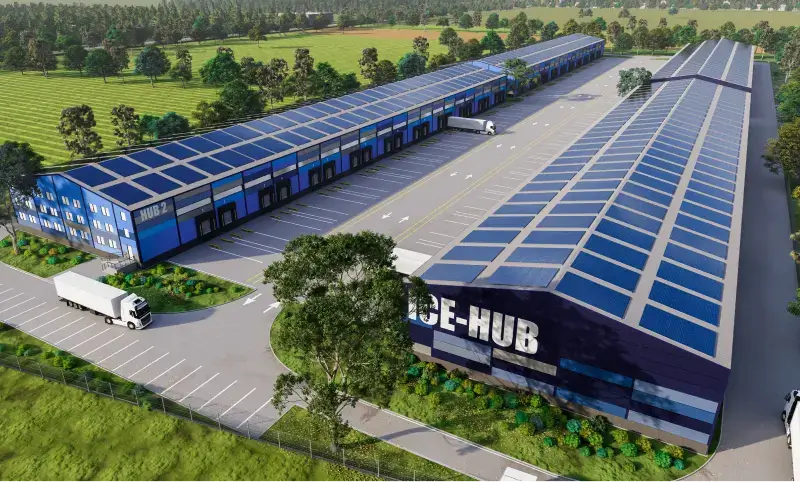
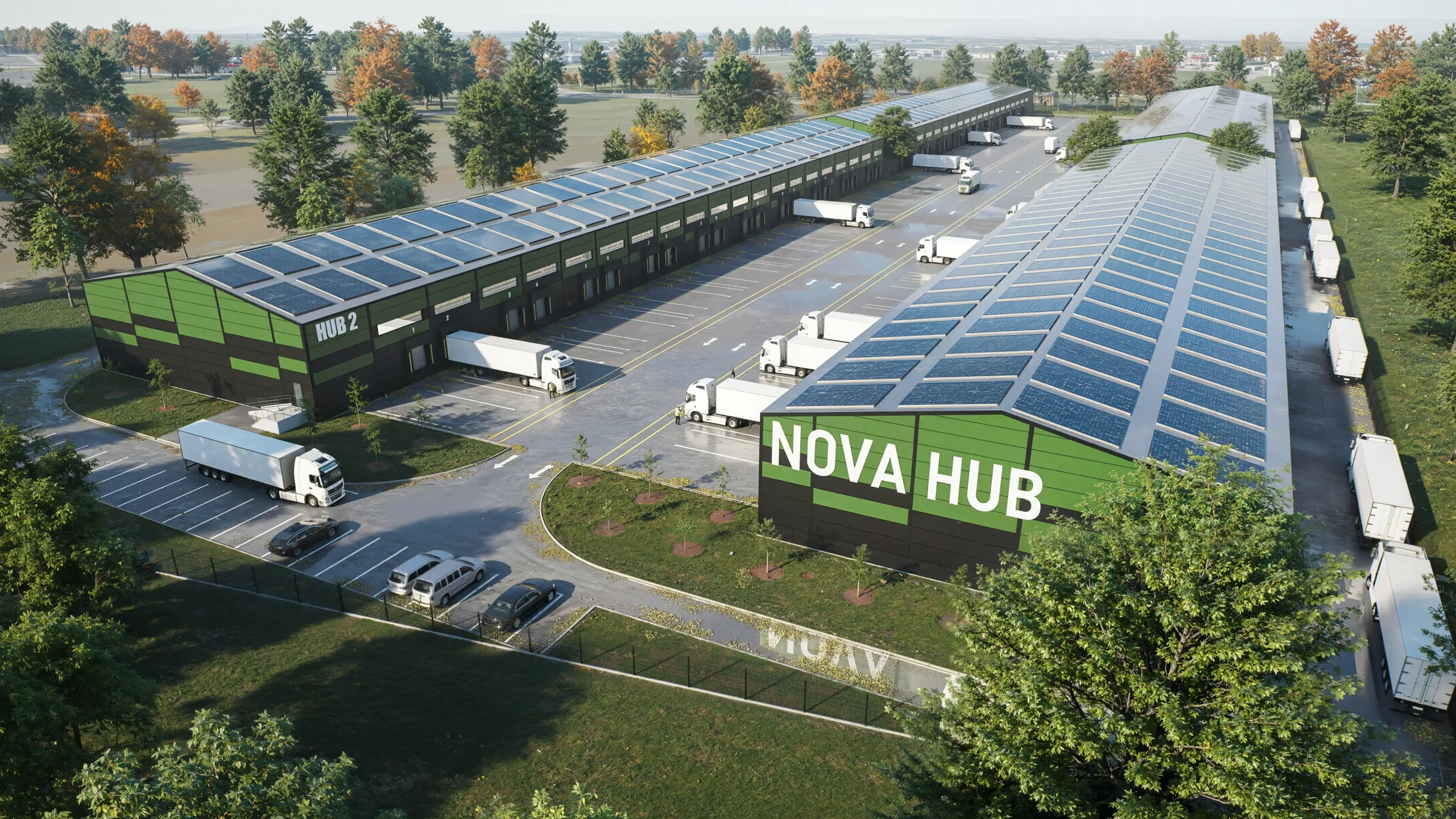
Modern facilities are not just big boxes. They are complex infrastructures that support reliable and safe operations. Consider a new logistics complex with nearly 42,000 m² of land and over 19,000 m² of built area, including around 2,460 m² of offices. When that complex has autonomous water supply, 1 MW of electrical capacity, automatic fire alarms, and 24/7 video surveillance, the risk of operational downtime or safety incidents is significantly reduced.
Reliable utilities protect goods and people and lower the likelihood of disruptions that can cause stockouts or delays. From a financial angle, fewer incidents mean lower insurance premiums, less waste, and more predictable operating costs. Clients are willing to pay a premium for that level of stability.
Energy efficiency and green power
Energy is a growing share of facility operating expenses. A logistics center that integrates a solar power plant for green energy can reduce dependence on grid electricity and decrease long-term energy costs. This matters especially for temperature‑controlled zones or large-scale lighting.
Beyond direct savings, renewable energy capability can be a commercial differentiator. Many international clients include sustainability criteria in supplier selection. A facility powered partly by solar has a stronger value proposition and can attract higher value contracts, which boosts overall warehouse profitability.
Design, construction quality, and risk management
High construction standards, proper fire systems, and even dedicated shelter space reduce operational and security risk. Facilities built to high European standards, managed by experienced project managers and reliable general contractors, are more resilient through crises and regulatory changes.
To put it simply, robust infrastructure is an insurance policy for your logistics operations. You might pay slightly more for quality construction, yet you avoid the severe costs of shutdowns, accidents, or non‑compliance. Over a payback period of about seven years, those avoided losses can be as important as direct savings.
📊 Pros and cons of investing in a strategically located logistics complex
Key advantages (+)
The right location and infrastructure come with strong upside, but they should be evaluated with clear expectations.
- + Lower transport and handling costs: Proximity to ports, highways, and rail reduces drayage, fuel, and handling expenses across thousands of shipments.
- + Faster order fulfillment: Serving customers from a central, well-connected hub shortens delivery times and improves service levels, which can increase revenue.
- + Better supplier consolidation: Bringing European supplier deliveries into one site simplifies logistics, improves quality control, and reduces partial-load inefficiency.
- + Stronger risk and safety profile: Modern systems for fire detection, surveillance, and autonomous utilities reduce risk of costly incidents.
- + Higher asset value: A modern logistics center in an attractive location tends to retain or grow in value, supporting long-term investment returns.
Key limitations (−)
Even the best location carries constraints that decision makers must understand and plan for.
- − Higher entry cost: Land and construction near major corridors and ports often cost more, which raises initial capital requirements.
- − Longer planning timelines: Permits, design, and construction can span more than a year, so benefits are not immediate and require careful cash-flow planning.
- − Dependence on regional infrastructure: A facility is partly dependent on the condition and security of nearby highways, ports, and rails.
- − Complexity of multi-modal operations: Managing sea, rail, and road flows from one hub requires skilled staff and good systems, which some companies may lack initially.
📈 Practical examples: how location decisions change profitability
Example 1: Consolidating European suppliers through Odesa
Imagine a mid-sized manufacturer that buys components from ten different European suppliers. Previously, each supplier shipped partial truckloads directly to the plant. Transport costs were high, delivery times were inconsistent, and the purchasing team had to manage ten separate logistics relationships.
By switching to a central facility near Odesa with a strategic port location and quick access to the Odesa–Kyiv highway, the company consolidates all supplier shipments into one hub. NovaHub coordinates communication with manufacturers, checks quality on arrival, stores goods, and then sends optimized full truckloads to the plant. Transport costs decrease, safety stock is reduced, and internal teams deal with a single logistics partner.
Example 2: Regional distribution center for e‑commerce
Consider an e‑commerce brand selling across Ukraine. Its original storage facility is located far from both ports and main highways. Deliveries to major cities take several days and often require expensive express options during seasonal peaks.
The brand moves its main inventory into a modern logistics center near Odesa, close to the port, dry port, rail lines, and the Odesa–Kyiv highway. Deliveries to Kyiv become faster and more predictable. International inbound shipments arrive through the port and move directly to the facility, which shortens the total lead time. Customer satisfaction improves, express shipping spend drops, and the center itself becomes a platform for future regional expansion.
Example 3: Investment case with seven-year payback
An investor is evaluating whether to co‑develop a high-standard logistics complex on a 41,970 m² land plot with 19,174 m² of buildings and significant office space. Project design runs from April to late November, permitting until early January, construction starting in mid‑January, and commissioning targeted for August of the following year.
The projected payback period is around seven years. Most of the return comes from long-term rental contracts with logistics users who value port and highway access, strong power capacity, green energy, and safety systems. Over time, lower vacancy rates and rising demand for modern space in Odesa improve the asset’s yield, validating the initial capital investment.
🔍 Common mistakes when choosing warehouse location
Focusing only on rent or land price
One of the most frequent errors is treating location as a pure cost factor. Companies select cheaper land away from ports and highways, only to find that transport spend and delays quickly wipe out the rent savings. Over the life of a facility, transport often outweighs rent many times over.
To avoid this, decision makers should model total logistics cost, including line‑haul, drayage, labor, and inventory, rather than optimizing a single budget line.
Underestimating infrastructure and utilities
Another mistake is ignoring utilities and building quality in favor of surface area. A large but poorly equipped building with unstable power, insufficient water, or weak fire protection can cause frequent outages and compliance problems.
Modern users expect dependable utilities, strong safety systems, and even shelters when required by regulation. Facilities that lack these features may struggle to attract quality tenants or to support demanding operations.
Ignoring long-term scalability
Companies sometimes choose sites that fit their immediate needs but cannot support future expansion. Land constraints, poor road access, or rigid building design can turn into bottlenecks as volumes grow.
A better approach is to plan for phased expansion on a site large enough to accommodate added modules or adjacent plots. This is especially important when building a regional hub that aims to support growth for a decade or more.
Not accounting for customer location dynamics
Customer bases shift over time as markets develop. Locating a facility based on today’s client distribution alone, without considering likely changes, can reduce its usefulness in a few years.
Companies should analyze demographic and economic trends and consider whether future customer clusters will be in the same regions. A central, well-connected hub can mitigate this risk.
🧠 How NovaHub’s approach increases warehouse profitability
End-to-end logistics from production to delivery
NovaHub positions itself as more than a landlord. The company provides integrated logistics services from production to final delivery. That includes managing international manufacturer communication, organizing transport, performing quality inspections, and storing goods in modern facilities.
For clients, this means lower coordination overhead and fewer handovers. One partner assumes responsibility for the entire chain. In practical terms, this reduces errors, delays, and hidden costs that can erode warehouse profitability.
Consolidation of European supplier orders
By consolidating orders from multiple European suppliers into single shipments at one location, NovaHub helps clients avoid inefficient partial loads and complex multi-party scheduling. Consolidation reduces per‑unit transport costs and simplifies customs and documentation flows.
From a financial viewpoint, consolidation decreases both direct freight cost and the administrative burden on internal teams. It also supports better inventory planning because inbound flows become more predictable.
High construction standards and modern facilities
NovaHub focuses on developing storage and logistics complexes built to modern European standards. These facilities emphasize reliability, contemporary design, and high execution speed with quality. Autonomous utilities, robust safety systems, and advanced power infrastructure support demanding operations such as high‑throughput cross-docking or sensitive goods storage.
In practical terms, clients benefit from reduced operational risk, better working conditions for staff, and an environment that supports automation and digital tools. All of this contributes to long-term cost efficiency and higher returns on investment.
For investors and users who wish to learn more about the planned complex near Odesa with strong port and highway access, the Investment in logistics complex overview provides detailed specifications.

📋 Practical tips for selecting a profitable warehouse location
Key recommendations
When selecting or developing a new facility, a structured process reduces risk and supports better financial outcomes.
- Evaluate total logistics cost, not just rent: Model transport, inventory, labor, and facility costs together. Slightly higher rent near a major corridor may still lower total cost substantially.
- Prioritize multimodal connectivity: Give preference to sites with access to sea ports, dry ports, rail, and primary highways, especially if you rely on international trade.
- Check utility capacity and redundancy: Confirm available power (such as 1 MW or more where needed), water autonomy, and backup options to minimize downtime risk.
- Assess safety and compliance features: Look for automatic fire alarms, 24/7 video surveillance, and shelter space where applicable. These features protect people, goods, and your reputation.
- Plan for growth from day one: Ensure the site and building design can be expanded in phases, both horizontally (more area) and vertically (more density or automation).
- Use partners with integrated services: Work with providers like NovaHub that can manage supplier communication, consolidation, and storage, which reduces complexity and hidden costs.
How to compare potential sites
To make decisions easier, summarize each candidate site using a structured comparison. Below is an example matrix for three hypothetical options.
| Criterion | Site A: Port-adjacent Odesa | Site B: Inland, near small town | Site C: Outer ring of large city |
|---|---|---|---|
| Distance to sea port | 5 km | 180 km | 60 km |
| Distance to main highway | 1 km to Odesa–Kyiv | 25 km | 10 km |
| Utility capacity | 1 MW, autonomous water | 0.4 MW, municipal water only | 0.8 MW, municipal water |
| Expected payback | 7 years | 10 years | 9 years |
| Suitable for consolidation hub | Yes | Limited | Moderate |
As this type of table makes clear, superior connectivity and infrastructure often justify a higher initial price through faster payback and better long-term profitability.
📚 How location, infrastructure, and services work together
Interplay between geography and operations
Location alone does not guarantee success. The way a facility is operated and integrated into the wider supply chain is just as important. A perfectly located building with weak processes may perform worse than a modestly located site with excellent management.
According to industry reports, multi-location networks that position facilities near both suppliers and customers improve inventory control and shipping costs. Strategic port hubs, combined with regional satellite sites, provide an optimal balance of speed, cost, and resilience.
Role of technology and modern layouts
Modern layouts that allow efficient loading, cross-docking, and storage density make it easier to exploit the advantages of a good location. Automated fire systems, structured racking, and digital visibility tools amplify the benefit of being close to ports or customers.
In essence, the most profitable operations are those where geography, building design, utilities, and process excellence all point in the same direction. That is the model NovaHub follows with its focus on contemporary, high-standard complexes and integrated logistics services.
Summary of key financial levers
To put everything together, the main financial levers of location choice include reduced line-haul and drayage costs, lower inventory carrying cost through shorter lead times, improved customer retention thanks to fast delivery, and lower risk due to robust infrastructure. Each of these levers can be quantified in business cases and tracked after go‑live.
Companies that rigorously evaluate these factors, instead of deciding purely on rent or intuition, are much more likely to realize the full profitability potential of their storage and distribution investments.
📌 Comparison: traditional warehouse vs modern logistics center
Feature comparison
The difference between a conventional storage building and a modern logistics center is often the difference between a cost center and a profit engine.
| Aspect | Traditional warehouse | Modern logistics center (e.g., NovaHub) |
|---|---|---|
| Location | Low-cost, peripheral | Strategic, near port and highway |
| Utilities | Basic grid power, municipal water | High-capacity power, autonomous water |
| Energy | No renewable sources | Solar power station for green energy |
| Safety | Basic alarms | Automatic fire system, 24/7 video, shelter |
| Services | Storage only | End-to-end logistics, supplier consolidation |
| Payback | Longer, less predictable | Planned ~7-year payback |
In short, the more your facility resembles the right-hand column, the more likely it is to support high warehouse profitability and long-term strategic value.
📜 Conclusion: turning location into a competitive advantage
A carefully chosen location transforms a storage facility from a passive cost into an active driver of profitability. Proximity to ports, highways, suppliers, and customers reduces transport expenses, shortens lead times, and improves service quality. When combined with robust infrastructure, green energy, and integrated logistics services, a modern logistics center can deliver predictable returns over many years.
NovaHub’s focus on reliable, contemporary complexes built to high European standards, coupled with supplier consolidation and end‑to‑end logistics, helps companies unlock these benefits in and around Odesa. For businesses planning their next facility or evaluating investment options, the practical next step is to model total logistics cost and align location, design, and services with long-term strategy.
As you plan for the New Year, this is an ideal moment to rethink your logistics footprint and explore how a strategically positioned hub can support the growth you want to achieve. Let the holiday season be the starting point for faster deliveries, greener operations, and stronger customer satisfaction. Visit NovaHub’s site for inspiration on new‑generation storage solutions that can carry your business into the next year with confidence and momentum.
Sources
— Statista Research (2024)
— European Logistics Market Overview (2023)
— McKinsey Global Supply Chain Report (2023)
— Forbes Logistics Council Insights
— Industry Analysis by Logistics Management Journal
FAQ
How does proximity to a port like Odesa improve profitability?
Being close to a sea port reduces drayage distance, international transit time, and port storage costs. This shortens the time your capital is tied up in transit and lowers total freight cost per shipment.
What makes a modern logistics center more profitable than a traditional warehouse?
A modern center combines a strategic port and highway location with strong utilities, safety systems, and services such as supplier consolidation. This mix reduces operating costs, improves service quality, and supports a predictable payback period of about seven years.
Why is it risky to choose a warehouse location based only on low rent?
Low-rent sites are often far from ports and major highways, which increases fuel, time, and vehicle wear. Over the facility’s life, higher transport and delay costs typically outweigh the initial rent savings.
How does NovaHub help with supplier consolidation from Europe?
NovaHub collects orders from multiple European suppliers at a single hub, manages communication with manufacturers, checks quality, and then ships optimized loads to your destination. This reduces transport cost and simplifies your internal logistics coordination.
What utilities and safety features should I look for in a new facility?
Check for sufficient power capacity, ideally around 1 MW for demanding operations, autonomous water supply, automatic fire alarms, and 24/7 video surveillance. Shelter space and robust construction standards further reduce operational risk.
How long does it take to develop a new logistics complex?
In the example discussed, design runs from early April to late November, permitting until early January, construction begins mid‑January, and commissioning occurs in August. That means roughly 16–18 months from initial design to operational readiness.
Why is Odesa attractive for storage facilities and logistics hubs?
Odesa offers combined access to a major sea port, a dry port, rail connections, and the Odesa–Kyiv highway. This multimodal connectivity supports efficient international trade and fast distribution to key Ukrainian markets.
How can I compare different potential locations objectively?
Create a table that scores each site on distance to ports and highways, utility capacity, safety features, and expected payback period. Comparing these metrics side by side makes trade-offs between cost and long-term profitability clearer.